英语 版本
科学
Locusts and Wild Honey
英语 BooksWhale 版本 · John Burroughs
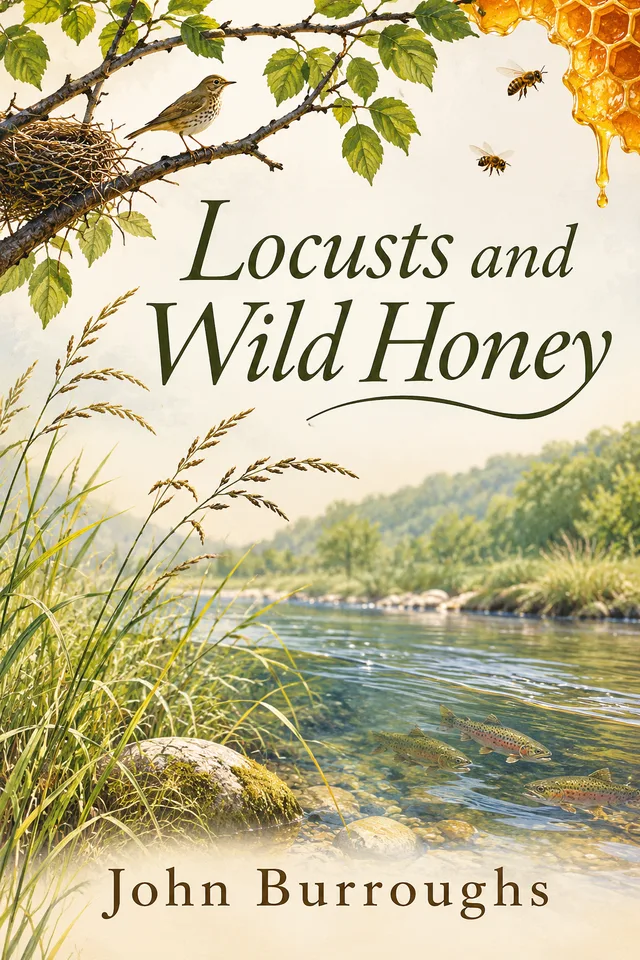
Burroughs traces wild bees, looks for trout and watches nesting birds in essays that teach readers where and how to look.
- 预览
- 文本节选
- 格式
- 在线阅读, EPUB, PDF
- 访问
- Library 获取
图书简介
Locusts and Wild Honey
The collection begins with the search for wild honey and moves through woodland weather, ripe strawberries, trout streams and bird calls. Burroughs draws on repeated walks and excursions, often explaining how one small sign led him to the next. His Canadian essay closes a series of observations shaped by seasons, patience and familiarity with a place.
BooksWhale 版本
此版本如何整理
此版本基于公版文本,并由 BooksWhale 整理为适合数字阅读的版本。
公版依据
为什么此版本可以分享
John Burroughs died in 1921. This edition uses the historical English text of the work, published in 1879 and digitized by Project Gutenberg.
阅读预览
文本节选
预览选自整理后的阅读文本。
预览章节PREFACE阅读预览
I am aware that for the most part the title of my book is an allegory rather than an actual description; but readers who have followed me heretofore, I trust, will not be puzzled or misled in the present case by any want of literalness in the matter of the title. If the name carries with it a suggestion of the wild and delectable in nature, of the free and ungarnered harvests which the wilderness everywhere affords to the observing eye and ear, it will prove sufficiently explicit for my purpose.
ESOPUS-ON-HUDSON, N. Y.
预览章节I THE PASTORAL BEES预览
The honey-bee goes forth from the hive in spring like the dove from Noah’s ark, and it is not till after many days that she brings back the olive leaf, which in this case is a pellet of golden pollen upon each hip, usually obtained from the alder or the swamp willow. In a country where maple sugar is made the bees get their first taste of sweet from the sap as it flows from the spiles, or as it dries and is condensed upon the sides of the buckets. They will sometimes, in their eagerness, come about the boiling-place and be overwhelmed by the steam and the smoke. But bees appear to be more eager for bread in the spring than for honey: their supply of this article, perhaps, does not keep as well as their stores of the latter; hence fresh bread, in the shape of new pollen, is diligently sought for. My bees get their first supplies from the catkins of the willows. How quickly they find them out! If but one catkin opens anywhere within range, a bee is on hand that very hour to rifle it, and it is a most pleasing experience to stand near the hive some mild April day and see them come pouring in with their little baskets packed with this first fruitage of the spring. They will have new bread now; they have been to mill in good earnest; see their dusty coats, and the golden grist they bring home with them.
When a bee brings pollen into the hive he advances to the cell in which it is to be deposited and kicks it off, as one might his overalls or rubber boots, making one foot help the other; then he walks off without ever looking behind him; another bee, one of the indoor hands, comes along and rams it down with his head and packs it into the cell, as the dairymaid packs butter into a firkin with a ladle.
The first spring wild-flowers, whose sly faces among the dry leaves and rocks are so welcome, are rarely frequented by the bee. The anemone, the hepatica, the bloodroot, the arbutus, the numerous violets, the spring beauty, the corydalis, etc., woo all lovers of nature, but seldom woo the honey-loving bee. The arbutus, lying low and keeping green all winter, attains to perfume and honey, but only once have I seen it frequented by bees.
The first honey is perhaps obtained from the flowers of the red maple and the golden willow. The latter sends forth a wild, delicious perfume. The sugar maple blooms a little later, and from its silken tassels a rich nectar is gathered. My bees will not label these different varieties for me, as I really wish they would. Honey from the maple, a tree so clean and wholesome, and full of such virtues every way, would be something to put one’s tongue to. Or that from the blossoms of the apple, the peach, the cherry, the quince, the currant,—one would like a card of each of these varieties to note their peculiar qualities. The apple-blossom is very important to the bees. A single swarm has been known to gain twenty pounds in weight during its continuance. Bees love the ripened fruit, too, and in August and September will such themselves tipsy upon varieties such as the sops-of-wine.
The interval between the blooming of the fruit-trees and that of the clover and the raspberry is bridged over in many localities by the honey locust. What a delightful summer murmur these trees send forth at this season! I know nothing about the quality of the honey, but it ought to keep well. But when the red raspberry blooms, the fountains of plenty are unsealed indeed; what a commotion about the hives then, especially in localities where it is extensively cultivated, as in places along the Hudson! The delicate white clover, which begins to bloom about the same time, is neglected; even honey itself is passed by for this modest, colorless, all but odorless flower. A field of these berries in June sends forth a continuous murmur like that of an enormous hive. The honey is not so white as that obtained from clover, but it is easier gathered; it is in shallow cups, while that of the clover is in deep tubes. The bees are up and at it before sunrise, and it takes a brisk shower to drive them in. But the clover blooms later and blooms everywhere, and is the staple source of supply of the finest quality of honey. The red clover yields up its stores only to the longer proboscis of the bumblebee, else the bee pasturage of our agricultural districts would be unequaled. I do not know from what the famous honey of Chamouni in the Alps is made, but it can hardly surpass our best products. The snow-white honey of Anatolia in Asiatic Turkey, which is regularly sent to Constantinople for the use of the grand seignior and the ladies of his seraglio, is obtained from the cotton plant, which makes me think that the white clover does not flourish there. The white clover is indigenous with us; its seeds seem latent in the ground, and the application of certain stimulants to the soil, such as wood ashes, causes them to germinate and spring up.
预览章节II SHARP EYES预览
Noting how one eye seconds and reinforces the other, I have often amused myself by wondering what the effect would be if one could go on opening eye after eye to the number say of a dozen or more. What would he see? Perhaps not the invisible,—not the odors of flowers or the fever germs in the air,—not the infinitely small of the microscope or the infinitely distant of the telescope. This would require, not more eyes so much as an eye constructed with more and different lenses; but would he not see with augmented power within the natural limits of vision? At any rate, some persons seem to have opened more eyes than others, they see with such force and distinctness; their vision penetrates the tangle and obscurity where that of others fails like a spent or impotent bullet. How many eyes did Gilbert White open? how many did Henry Thoreau? how many did Audubon? how many does the hunter, matching his sight against the keen and alert sense of a deer or a moose, or fox or a wolf? Not outward eyes, but inward. We open another eye whenever we see beyond the first general features or outlines of things,—whenever we grasp the special details and characteristic markings that this mask covers. Science confers new powers of vision. Whenever you have learned to discriminate the birds, or the plants, or the geological features of a country, it is as if new and keener eyes were added.
Of course one must not only see sharply, but read aright what he sees. The facts in the life of Nature that are transpiring about us are like written words that the observer is to arrange into sentences. Or the writing is in cipher and he must furnish the key. A female oriole was one day observed very much preoccupied under a shed where the refuse from the horse stable was thrown. She hopped about among the barn fowls, scolding them sharply when they came too near her. The stable, dark and cavernous, was just beyond. The bird, not finding what she wanted outside, boldly ventured into the stable, and was presently captured by the farmer. What did she want? was the query. What but a horsehair for her nest which was in an apple-tree near by? and she was so bent on having one that I have no doubt she would have tweaked one out of the horse’s tail had he been in the stable. Later in the season I examined her nest, and found it sewed through and through with several long horsehairs, so that the bird persisted in her search till the hair was found.
Little dramas and tragedies and comedies, little characteristic scenes, are always being enacted in the lives of the birds, if our eyes are sharp enough to see them. Some clever observer saw this little comedy played among some English sparrows, and wrote an account of it in his newspaper; it is too good not to be true: A male bird brought to his box a large, fine goose feather, which is a great find for a sparrow and much coveted. After he had deposited his prize and chattered his gratulations over it, he went away in quest of his mate. His next-door neighbor, a female bird, seeing her chance, quickly slipped in and seized the feather; and here the wit of the bird came out, for instead of carrying it into her own box she flew with it to a near tree and hid it in a fork of the branches, then went home, and when her neighbor returned with his mate was innocently employed about her own affairs. The proud male, finding his feather gone, came out of his box in a high state of excitement, and, with wrath in his manner and accusation on his tongue, rushed into the cote of the female. Not finding his goods and chattels there as he had expected, he stormed around awhile, abusing everybody in general and his neighbor in particular, then went away as if to repair the loss. As soon as he was out of sight, the shrewd thief went and brought the feather home and lined her own domicile with it.
目录
本版本内容
- 01PREFACE
- 02I THE PASTORAL BEES
- 03II SHARP EYES
- 04III STRAWBERRIES
- 05IV IS IT GOING TO RAIN?
- 06V SPECKLED TROUT
- 07I
- 08II
- 09VI BIRDS AND BIRDS
- 10I
- 11II
- 12III
- 13IV
- 14V
- 15VII A BED OF BOUGHS
- 16VIII BIRDS’-NESTING
- 17IX THE HALCYON IN CANADA