英语 版本
文学
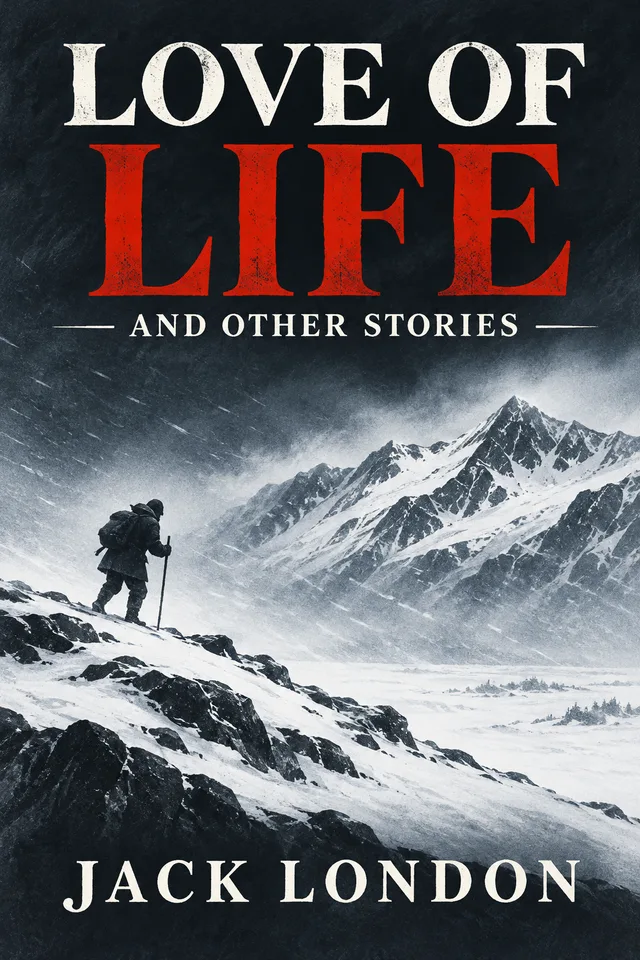
Love of Life and Other Stories
英语 BooksWhale 版本 · Jack London
Eight stories confront hunger, violence, loyalty and survival across the northern wilderness and the lives of its inhabitants.
- 预览
- 文本节选
- 格式
- 在线阅读, EPUB, PDF
- 访问
- Library 获取
图书简介
Love of Life and Other Stories
Jack London’s collection opens with an exhausted traveller’s struggle to survive in the northern wilderness and ranges through encounters shaped by racial conflict, courage and dependence. The eight stories include The Story of Keesh, Brown Wolf and Negore, the Coward. Animals, hunters and displaced people test the boundary between endurance and defeat.
BooksWhale 版本
此版本如何整理
此版本基于公版文本,并由 BooksWhale 整理为适合数字阅读的版本。
公版依据
为什么此版本可以分享
Jack London died in 1916. This edition uses the original-language text supplied by Project Gutenberg, identified there as public domain in the United States. Added illustrations and editorial notes are excluded.
阅读预览
文本节选
预览选自整理后的阅读文本。
预览章节Full text阅读预览
Love of Life and Other Stories
Jack London
预览章节LOVE OF LIFE预览
“This out of all will remain— They have lived and have tossed: So much of the game will be gain, Though the gold of the dice has been lost.”
They limped painfully down the bank, and once the foremost of the two men staggered among the rough-strewn rocks. They were tired and weak, and their faces had the drawn expression of patience which comes of hardship long endured. They were heavily burdened with blanket packs which were strapped to their shoulders. Head-straps, passing across the forehead, helped support these packs. Each man carried a rifle. They walked in a stooped posture, the shoulders well forward, the head still farther forward, the eyes bent upon the ground.
“I wish we had just about two of them cartridges that’s layin’ in that cache of ourn,” said the second man.
His voice was utterly and drearily expressionless. He spoke without enthusiasm; and the first man, limping into the milky stream that foamed over the rocks, vouchsafed no reply.
The other man followed at his heels. They did not remove their foot-gear, though the water was icy cold—so cold that their ankles ached and their feet went numb. In places the water dashed against their knees, and both men staggered for footing.
The man who followed slipped on a smooth boulder, nearly fell, but recovered himself with a violent effort, at the same time uttering a sharp exclamation of pain. He seemed faint and dizzy and put out his free hand while he reeled, as though seeking support against the air. When he had steadied himself he stepped forward, but reeled again and nearly fell. Then he stood still and looked at the other man, who had never turned his head.
The man stood still for fully a minute, as though debating with himself. Then he called out:
“I say, Bill, I’ve sprained my ankle.”
Bill staggered on through the milky water. He did not look around. The man watched him go, and though his face was expressionless as ever, his eyes were like the eyes of a wounded deer.
The other man limped up the farther bank and continued straight on without looking back. The man in the stream watched him. His lips trembled a little, so that the rough thatch of brown hair which covered them was visibly agitated. His tongue even strayed out to moisten them.
“Bill!” he cried out.
It was the pleading cry of a strong man in distress, but Bill’s head did not turn. The man watched him go, limping grotesquely and lurching forward with stammering gait up the slow slope toward the soft sky-line of the low-lying hill. He watched him go till he passed over the crest and disappeared. Then he turned his gaze and slowly took in the circle of the world that remained to him now that Bill was gone.
Near the horizon the sun was smouldering dimly, almost obscured by formless mists and vapors, which gave an impression of mass and density without outline or tangibility. The man pulled out his watch, the while resting his weight on one leg. It was four o’clock, and as the season was near the last of July or first of August,—he did not know the precise date within a week or two,—he knew that the sun roughly marked the northwest. He looked to the south and knew that somewhere beyond those bleak hills lay the Great Bear Lake; also, he knew that in that direction the Arctic Circle cut its forbidding way across the Canadian Barrens. This stream in which he stood was a feeder to the Coppermine River, which in turn flowed north and emptied into Coronation Gulf and the Arctic Ocean. He had never been there, but he had seen it, once, on a Hudson Bay Company chart.
Again his gaze completed the circle of the world about him. It was not a heartening spectacle. Everywhere was soft sky-line. The hills were all low-lying. There were no trees, no shrubs, no grasses—naught but a tremendous and terrible desolation that sent fear swiftly dawning into his eyes.
预览章节A DAY’S LODGING预览
It was the gosh-dangdest stampede I ever seen. A thousand dog-teams hittin’ the ice. You couldn’t see ’m fer smoke. Two white men an’ a Swede froze to death that night, an’ there was a dozen busted their lungs. But didn’t I see with my own eyes the bottom of the water-hole? It was yellow with gold like a mustard-plaster. That’s why I staked the Yukon for a minin’ claim. That’s what made the stampede. An’ then there was nothin’ to it. That’s what I said—NOTHIN’ to it. An’ I ain’t got over guessin’ yet.—Narrative of Shorty.
John Messner clung with mittened hand to the bucking gee-pole and held the sled in the trail. With the other mittened hand he rubbed his cheeks and nose. He rubbed his cheeks and nose every little while. In point of fact, he rarely ceased from rubbing them, and sometimes, as their numbness increased, he rubbed fiercely. His forehead was covered by the visor of his fur cap, the flaps of which went over his ears. The rest of his face was protected by a thick beard, golden-brown under its coating of frost.
Behind him churned a heavily loaded Yukon sled, and before him toiled a string of five dogs. The rope by which they dragged the sled rubbed against the side of Messner’s leg. When the dogs swung on a bend in the trail, he stepped over the rope. There were many bends, and he was compelled to step over it often. Sometimes he tripped on the rope, or stumbled, and at all times he was awkward, betraying a weariness so great that the sled now and again ran upon his heels.
When he came to a straight piece of trail, where the sled could get along for a moment without guidance, he let go the gee-pole and batted his right hand sharply upon the hard wood. He found it difficult to keep up the circulation in that hand. But while he pounded the one hand, he never ceased from rubbing his nose and cheeks with the other.
“It’s too cold to travel, anyway,” he said. He spoke aloud, after the manner of men who are much by themselves. “Only a fool would travel at such a temperature. If it isn’t eighty below, it’s because it’s seventy-nine.”
He pulled out his watch, and after some fumbling got it back into the breast pocket of his thick woollen jacket. Then he surveyed the heavens and ran his eye along the white sky-line to the south.
“Twelve o’clock,” he mumbled, “A clear sky, and no sun.”
He plodded on silently for ten minutes, and then, as though there had been no lapse in his speech, he added:
“And no ground covered, and it’s too cold to travel.”
Suddenly he yelled “Whoa!” at the dogs, and stopped. He seemed in a wild panic over his right hand, and proceeded to hammer it furiously against the gee-pole.
“You—poor—devils!” he addressed the dogs, which had dropped down heavily on the ice to rest. His was a broken, jerky utterance, caused by the violence with which he hammered his numb hand upon the wood. “What have you done anyway that a two-legged other animal should come along, break you to harness, curb all your natural proclivities, and make slave-beasts out of you?”
He rubbed his nose, not reflectively, but savagely, in order to drive the blood into it, and urged the dogs to their work again. He travelled on the frozen surface of a great river. Behind him it stretched away in a mighty curve of many miles, losing itself in a fantastic jumble of mountains, snow-covered and silent. Ahead of him the river split into many channels to accommodate the freight of islands it carried on its breast. These islands were silent and white. No animals nor humming insects broke the silence. No birds flew in the chill air. There was no sound of man, no mark of the handiwork of man. The world slept, and it was like the sleep of death.
目录
本版本内容
- 01Full text
- 02LOVE OF LIFE
- 03A DAY’S LODGING
- 04THE WHITE MAN’S WAY
- 05THE STORY OF KEESH
- 06THE UNEXPECTED
- 07BROWN WOLF
- 08THE SUN-DOG TRAIL
- 09NEGORE, THE COWARD