英语 版本
文学
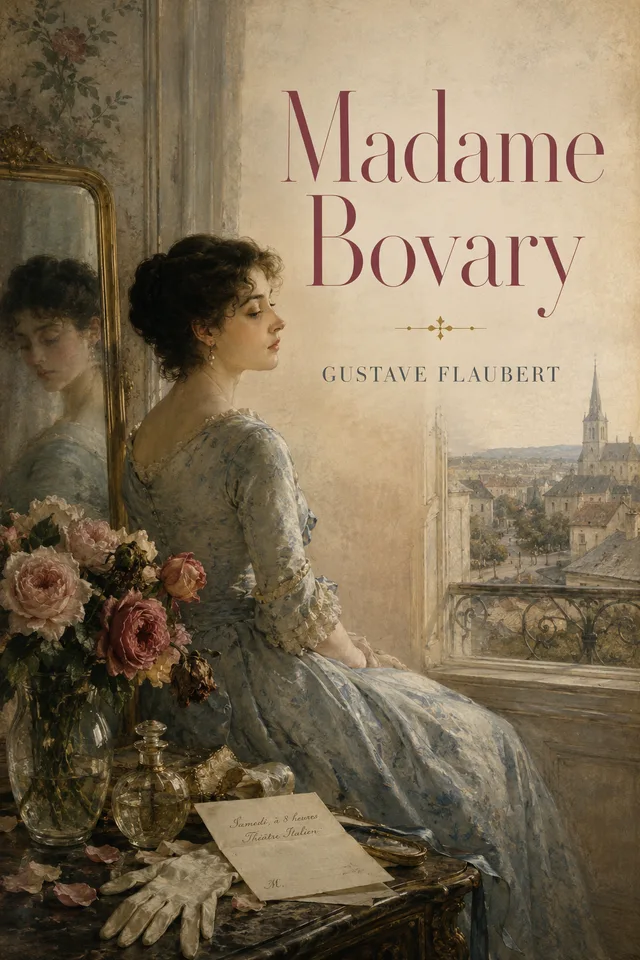
Madame Bovary
英语 BooksWhale 版本 · Gustave Flaubert
Emma Bovary tries to live the passionate life promised by romantic fiction, while marriage, debt, desire, and provincial judgment close in around her.
- 预览
- 文本节选
- 格式
- 在线阅读, EPUB, PDF
- 访问
- Library 获取
图书简介
Madame Bovary
Gustave Flaubert’s Madame Bovary follows Emma Rouault from a convent education and romantic fantasies into a marriage with the well-meaning but unimaginative Charles Bovary. Her affairs, purchases, and hunger for a more brilliant life gradually become a trap of debt and secrecy. Flaubert’s precise style turns the provincial town, the marketplace, the bedroom, and the courtroom into a powerful anatomy of desire, consumerism, social performance, and disappointment.
BooksWhale 版本
此版本如何整理
此版本基于公版文本,并由 BooksWhale 整理为适合数字阅读的版本。
公版依据
为什么此版本可以分享
The original work Madame Bovary is public domain. This English edition is a new BooksWhale translation prepared with AI assistance.
阅读预览
文本节选
预览选自整理后的阅读文本。
预览章节Full text阅读预览
Madame Bovary
Gustave Flaubert
预览章节PART ONE预览
PART ONE
预览章节I预览
We were in study hall when the headmaster entered, followed by a new boy dressed in ordinary clothes and by a classroom servant carrying a large desk. Those who had been asleep woke up, and everyone rose as though surprised at his work.
The headmaster motioned for us to sit down again; then, turning to the study master:
“Mr. Roger,” he said in a low voice, “here is a pupil I commend to your care. He is entering the fifth form. If his work and conduct are satisfactory, he will move up among the older boys, as his age requires.”
Standing in the corner behind the door, so that he could scarcely be seen, the new boy was a country lad of about fifteen, taller than any of us. His hair was cut straight across his forehead like that of a village chorister; he looked sensible and extremely embarrassed. Though his shoulders were not broad, his green cloth jacket with black buttons must have pinched him under the arms, and through the openings at the cuffs one could see red wrists accustomed to being bare. His legs, in blue stockings, emerged from yellowish trousers pulled very tight by suspenders. He wore heavy shoes, badly polished and studded with nails.
The recitation of lessons began. He listened with all his might, as attentively as if he were hearing a sermon, not even daring to cross his legs or lean on his elbow; and at two o’clock, when the bell rang, the study master had to tell him to line up with us.
Whenever we entered the classroom, we were in the habit of throwing our caps on the floor so that our hands would be free afterward; from the threshold we had to fling them under the bench so that they struck the wall and raised a great deal of dust. That was the fashionable thing to do.
But whether he had failed to notice this maneuver or had not dared imitate it, the prayer was over and the new boy was still holding his cap on both knees. It was one of those composite forms of headgear in which one could find elements of the bearskin cap, the shako, the round hat, the otter-skin cap, and the cotton nightcap—one of those pathetic objects, in short, whose mute ugliness has depths of expression like the face of an idiot. Oval-shaped and bulging with whalebone, it began with three circular rolls; then came alternating diamonds of velvet and rabbit fur, separated by a red band; after that came a sort of bag ending in a cardboard polygon covered with elaborate soutache embroidery, from which hung, at the end of a long and overly thin cord, a small cross-shaped tassel of gold thread. It was new; the visor shone.
“Stand up,” said the teacher.
He stood up; his cap fell. The whole class burst out laughing.
He bent down to pick it up. A neighbor knocked it down again with his elbow, and he picked it up once more.
“Do get rid of your helmet,” said the teacher, who was a witty man.
There was a roar of laughter from the schoolboys, which so disconcerted the poor fellow that he no longer knew whether to hold the cap in his hand, leave it on the floor, or put it on his head. He sat down again and placed it on his knees.
“Stand up,” the teacher repeated, “and tell me your name.”
The new boy, in a stammering voice, uttered an unintelligible name.
“Repeat it!”
The same jumble of syllables was heard, drowned by the hoots of the class.
“Louder!” shouted the master. “Louder!”
The new boy, then making an extreme effort, opened his mouth enormously and shouted at the top of his lungs, as though calling someone:
“Charbovari!”
A tremendous uproar broke loose at once, swelling in a crescendo of shrill cries—people howled, barked, stamped their feet, and repeated: “Charbovari! Charbovari!”—then it rolled away into scattered sounds, subsiding only with great difficulty, and from time to time suddenly broke out again along some bench where a stifled laugh still flared here and there like a badly extinguished firecracker.
目录
本版本内容
- 01Full text
- 02PART ONE
- 03I
- 04II
- 05III
- 06IV
- 07V
- 08VI
- 09VII
- 10VIII
- 11IX
- 12PART TWO
- 13I
- 14II
- 15III
- 16IV
- 17V
- 18VI
- 19VII
- 20VIII
- 21IX
- 22X
- 23XI
- 24XII
- 25XIII
- 26XIV
- 27XV
- 28PART THREE
- 29I
- 30II
- 31III
- 32IV
- 33V
- 34VI
- 35VII
- 36VIII
- 37IX
- 38X
- 39XI