英语 版本
文学
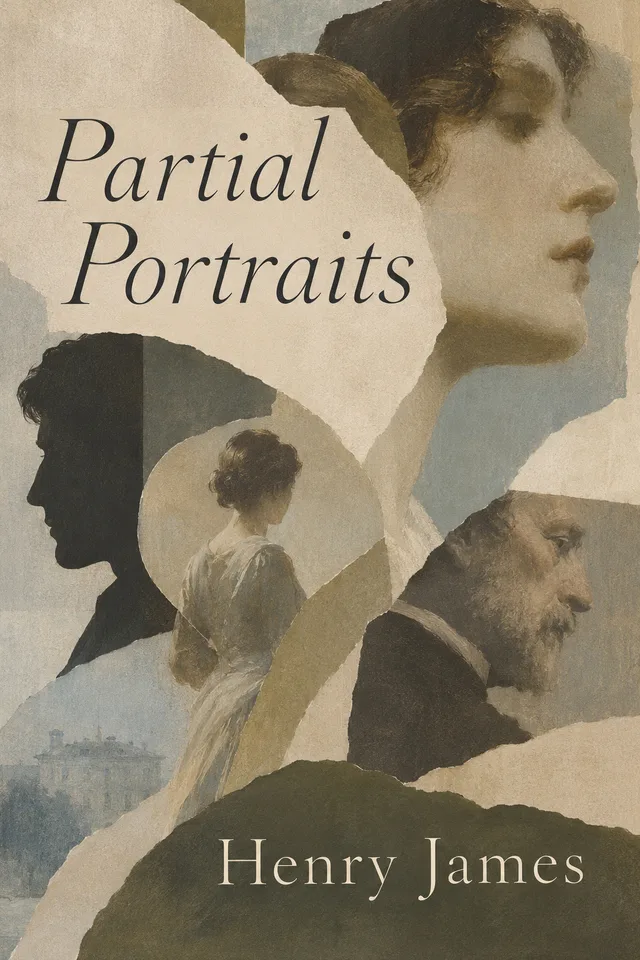
Partial Portraits
英语 BooksWhale 版本 · Henry James
Henry James studies fellow writers and the art of fiction through eleven essays on literary character, judgment, and narrative craft.
- 预览
- 文本节选
- 格式
- 在线阅读, EPUB, PDF
- 访问
- Library 获取
图书简介
Partial Portraits
These eleven essays bring Henry James into conversation with writers including Emerson, George Eliot, Anthony Trollope, Robert Louis Stevenson, Alphonse Daudet, Maupassant, and Turgenev. Literary biography becomes a way to explore artistic temperament, observation, and the relation between experience and form. The collection concludes with The Art of Fiction, James’s sustained argument for the novelist’s freedom to represent life through a distinctive consciousness.
BooksWhale 版本
此版本如何整理
此版本基于公版文本,并由 BooksWhale 整理为适合数字阅读的版本。
公版依据
为什么此版本可以分享
Henry James died in 1916. This edition uses the public-domain English text supplied by Project Gutenberg, without later editorial introductions or notes.
阅读预览
文本节选
预览选自整理后的阅读文本。
预览章节Full text阅读预览
Partial Portraits
预览章节NOTICE预览
The following attempts at literary portraiture originally appeared, with three exceptions, in American periodicals—The Atlantic Monthly, The Century, and Harper’s Weekly. The paper on Emerson was contributed to Macmillan’s Magazine, that on “The Art of Fiction” to Longman’s and that on M. Guy de Maupassant to The Fortnightly Review. The reminiscences of Turgénieff were written immediately after his death, the article on Anthony Trollope on the same occasion, before the publication of his interesting Autobiography, and the appreciation of Alphonse Daudet before that of his three latest novels. The date affixed to the sketch of Robert Louis Stevenson is that of composition.
预览章节I EMERSON预览
Mr. Elliot Cabot has made a very interesting contribution to a class of books of which our literature, more than any other, offers admirable examples: he has given us a biography intelligently and carefully composed. These two volumes are a model of responsible editing—I use that term because they consist largely of letters and extracts from letters: nothing could resemble less the manner in which the mere bookmaker strings together his frequently questionable pearls and shovels the heap into the presence of the public. Mr. Cabot has selected, compared, discriminated, steered an even course between meagreness and redundancy, and managed to be constantly and happily illustrative. And his work, moreover, strikes us as the better done from the fact that it stands for one of the two things that make an absorbing memoir a good deal more than for the other. If these two things be the conscience of the writer and the career of his hero, it is not difficult to see on which side the biographer of Emerson has found himself strongest. Ralph Waldo Emerson was a man of genius, but he led for nearly eighty years a life in which the sequence of events had little of the rapidity, or the complexity, that a spectator loves. There is something we miss very much as we turn these pages—something that has a kind of accidental, inevitable presence in almost any personal record—something that may be most definitely indicated under the name of colour. We lay down the book with a singular impression of paleness—an impression that comes partly from the tone of the biographer and partly from the moral complexion of his subject, but mainly from the vacancy of the page itself. That of Emerson’s personal history is condensed into the single word Concord, and all the condensation in the world will not make it look rich. It presents a most continuous surface. Mr. Matthew Arnold, in his Discourses in America, contests Emerson’s complete right to the title of a man of letters; yet letters surely were the very texture of his history. Passions, alternations, affairs, adventures had absolutely no part in it. It stretched itself out in enviable quiet—a quiet in which we hear the jotting of the pencil in the note-book. It is the very life for literature (I mean for one’s own, not that of another): fifty years of residence in the home of one’s forefathers, pervaded by reading, by walking in the woods and the daily addition of sentence to sentence.
If the interest of Mr. Cabot’s pencilled portrait is incontestable and yet does not spring from variety, it owes nothing either to a source from which it might have borrowed much and which it is impossible not to regret a little that he has so completely neglected: I mean a greater reference to the social conditions in which Emerson moved, the company he lived in, the moral air he breathed. If his biographer had allowed himself a little more of the ironic touch, had put himself once in a way under the protection of Sainte-Beuve and had attempted something of a general picture, we should have felt that he only went with the occasion. I may overestimate the latent treasures of the field, but it seems to me there was distinctly an opportunity—an opportunity to make up moreover in some degree for the white tint of Emerson’s career considered simply in itself. We know a man imperfectly until we know his society, and we but half know a society until we know its manners. This is especially true of a man of letters, for manners lie very close to literature. From those of the New England world in which Emerson’s character formed itself Mr. Cabot almost averts his lantern, though we feel sure that there would have been delightful glimpses to be had and that he would have been in a position—that is that he has all the knowledge that would enable him—to help us to them. It is as if he could not trust himself, knowing the subject only too well. This adds to the effect of extreme discretion that we find in his volumes, but it is the cause of our not finding certain things, certain figures and scenes, evoked. What is evoked is Emerson’s pure spirit, by a copious, sifted series of citations and comments. But we must read as much as possible between the lines, and the picture of the transcendental time (to mention simply one corner) has yet to be painted—the lines have yet to be bitten in. Meanwhile we are held and charmed by the image of Emerson’s mind and the extreme appeal which his physiognomy makes to our art of discrimination. It is so fair, so uniform and impersonal, that its features are simply fine shades, the gradations of tone of a surface whose proper quality was of the smoothest and on which nothing was reflected with violence. It is a pleasure of the critical sense to find, with Mr. Cabot’s extremely intelligent help, a notation for such delicacies.
目录
本版本内容
- 01Full text
- 02NOTICE
- 03I EMERSON
- 04II THE LIFE OF GEORGE ELIOT
- 05III DANIEL DERONDA A CONVERSATION
- 06IV ANTHONY TROLLOPE
- 07V ROBERT LOUIS STEVENSON
- 08I
- 09II
- 10VI MISS WOOLSON
- 11VII ALPHONSE DAUDET
- 12I
- 13II
- 14III
- 15IV
- 16V
- 17VIII GUY DE MAUPASSANT
- 18I
- 19II
- 20IX IVAN TURGÉNIEFF
- 21X GEORGE DU MAURIER
- 22XI THE ART OF FICTION