英语 版本
文学
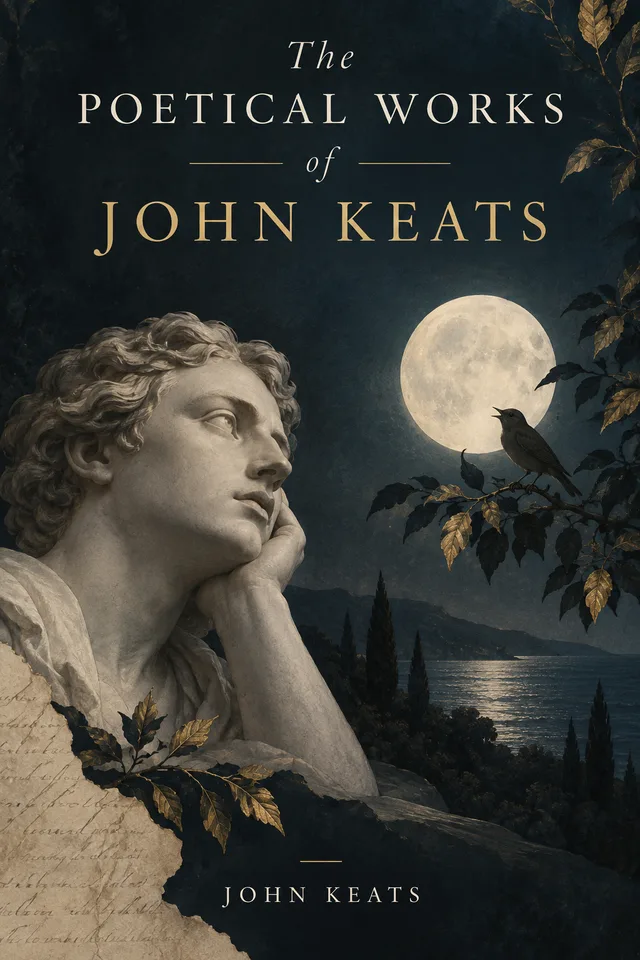
The Poetical Works of John Keats
英语 BooksWhale 版本 · John Keats
A substantial poetry collection tracing Keats’s sensuous language, classical imagination, and meditations on beauty and mortality.
- 预览
- 文本节选
- 格式
- 在线阅读, EPUB, PDF
- 访问
- Library 获取
图书简介
The Poetical Works of John Keats
From narrative poems and sonnets to the celebrated odes, this collection follows Keats’s development as one of English Romanticism’s defining voices. Its recurring questions—how beauty endures, what art can preserve, and how pleasure meets loss—give the poems their lasting force.
BooksWhale 版本
此版本如何整理
此版本基于公版文本,并由 BooksWhale 整理为适合数字阅读的版本。
公版依据
为什么此版本可以分享
The collection uses a turn-of-the-century edition of poems written by John Keats, who died in 1821. The poems are public domain; confirm that the selected edition contains no protected modern editorial notes or additions.
阅读预览
文本节选
预览选自整理后的阅读文本。
预览章节Full text阅读预览
The Poetical Works of John Keats
John Keats
THE
POETICAL WORKS
OF
JOHN KEATS.
BOSTON:
DeWOLFE, FISKE & COMPANY,
365 Washington Street.
1884.
CONTENTS.
KEATS'S POETICAL WORKS.
ENDYMION:
A POETIC ROMANCE.
INSCRIBED TO THE MEMORY OF THOMAS CHATTERTON .
THE STRETCHED METRE OF AN ANTIQUE SONG.
PREFACE.
Knowing within myself the manner in which this Poem has been produced, it is not without a feeling of regret that I make it public.
What manner I mean, will be quite clear to the reader, who must soon perceive great inexperience, immaturity, and every error denoting a feverish attempt, rather than a deed accomplished. The two first books, and indeed the two last, I feel sensible are not of such completion as to warrant their passing the press; nor should they if I thought a year's castigation would do them any good;- -it will not: the foundations are too sandy. It is just that this youngster should die away: a sad thought for me, if I had not some hope that while it is dwindling I may be plotting, and fitting myself for verses fit to live.
This may be speaking too presumptuously, and may deserve a punishment: but no feeling man will be forward to inflict it: he will leave me alone, with the conviction that there is not a fiercer hell than the failure in a great object. This is not written with the least atom of purpose to forestall criticisms of course, but from the desire I have to conciliate men who are competent to look, and who do look with a zealous eye, to the honor of English literature.
The imagination of a boy is healthy, and the mature imagination of a man is healthy; but there is a space of life between, in which the soul is in a ferment, the character undecided, the way of life uncertain, the ambition thick-sighted: thence proceeds mawkishness, and all the thousand bitters which those men I speak of must necessarily taste in going over the following pages.
I hope I have not in too late a day touched the beautiful mythology of Greece, and dulled its brightness: for I wish to try once more, before I bid it farewell.
Teignmouth , April 10, 1818.
BOOK I.
A thing of beauty is a joy forever: Its loveliness increases; it will never Pass into nothingness; but still will keep A bower quiet for us, and a sleep Full of sweet dreams, and health, and quiet breathing. Therefore, on every morrow, are we wreathing A flowery band to bind us to the earth, Spite of despondence, of the inhuman dearth Of noble natures, of the gloomy days, Of all the unhealthy and o'er-darken'd ways Made for our searching: yes, in spite of all, Some shape of beauty moves away the pall From our dark spirits. Such the sun, the moon, Trees old and young, sprouting a shady boon For simple sheep; and such are daffodils With the green world they live in; and clear rills That for themselves a cooling covert make 'Gainst the hot season; the mid-forest brake. Rich with a sprinkling of fair musk-rose blooms: And such too is the grandeur of the dooms We have imagined for the mighty dead; All lovely tales that we have heard or read: An endless fountain of immortal drink, Pouring unto us from the heaven's brink.
Nor do we merely feel these essences For one short hour; no, even as the trees That whisper round a temple become soon Dear as the temple's self, so does the moon, The passion poesy, glories infinite, Haunt us till they become a cheering light Unto our souls, and bound to us so fast, That, whether there be shine, or gloom o'ercast, They alway must be with us, or we die Therefore, 'tis with full happiness that I Will trace the story of Endymion. The very music of the name has gone Into my being, and each pleasant scene Is growing fresh before me as the green Of our own valleys: so I will begin Now while I cannot hear the city's din; Now while the early budders are just new, And run in mazes of the youngest hue About old forests; while the willow trails Its delicate amber; and the dairy pails Bring home increase of milk. And, as the year Grows lush in juicy stalks, I'll smoothly steer My little boat, for many quiet hours, With streams that deepen freshly into bowers. Many and many a verse I hope to write, Before the daisies, vermeil rimm'd and white, Hide in deep herbage ; and ere yet the bees Hum about globes of clover and sweet peas, I must be near the middle of my story. O may no wintry season, bare and hoary, See it half-finish'd: but let Autumn bold,
预览章节PART I.预览
Upon a time, before the faery broods Drove Nymph and Satyr from the prosperous woods, Before King Oberon's bright diadem, Sceptre, and mantle, clasp'd with dewy gem, Frighted away the Dryads and the Fauns From rushes green, and brakes, and cowslipp'd lawns, The ever-smitten Hermes empty left His golden throne, bent warm on amorous theft: From high Olympus had he stolen light, On this side of Jove's clouds, to escape the sight Of his great summoner, and made retreat Into a forest on the shores of Crete. For somewhere in that sacred island dwelt A nymph, to whom all hoofed Satyrs knelt; At whose white feet the languid Tritons pour'd Pearls, while on land they wither'd and adored Fast by the springs where she to bathe was wont, And in those meads where sometimes she might haunt, Were strewn rich gifts, unknown to any Muse, Though Fancy's casket were unlock'd to choose.
Ah, what a world of love was at her feet! So Hermes thought, and a celestial heat Burn'd from his winged heels to either ear, That from a whiteness, as the lily clear, Blush'd into roses 'mid his golden hair, Fallen in jealous curls about his shoulders bare. From vale to vale, from wood, to wood he flew, Breathing upon the flowers his passion new, And wound with many a river to its head, To find where this sweet nymph prepared her secret bed: In vain; the sweet nymph might nowhere be found, And so he rested, on the lonely ground, Pensive, and full of painful jealousies Of the Wood-Gods, and even the very trees. There as he stood, he heard a mournful voice, Such as once heard, in gentle heart, destroys All pain but pity: thus the lone voice spake: "When from this wreathed tomb shall I awake! When move in a sweet body fit for life, And love, and pleasure, and the ruddy strife Of hearts and lips! Ah, miserable me!" The God, dove-footed, glided silently Round bush and tree, soft-brushing, in his speed, The taller grasses and full-flowering weed, Until he found a palpitating snake, Bright, and cirque-couchant in a dusky brake. She was a gordian shape of dazzling hue, Vermilion-spotted, golden, green, and blue; Striped like a zebra, freckled like a pard, Eyed like a peacock, and all crimson barr'd;
And full of silver moons, that, as she breathed, Dissolved, or brighter shone, or interwreathed Their lustres with the gloomier tapestries— So rainbow-sided, touch'd with miseries, She seem'd at once, some penanced lady elf, Some demon's mistress, or the demon's self. Upon her crest she wore a wannish fire Sprinkled with stars, like Ariadne's tiar: Her head was serpent, but ah, bitter-sweet! She had a woman's mouth with all its pearls complete: And for her eyes—what could such eyes do there But weep, and weep, that they were born so fair? As Proserpine still weeps for her Sicilian air. Her throat was serpent, but the words she spake Came, as through bubbling honey, for Love's sake, And thus; while Hermes on his pinions lay, Like a stoop'd falcon ere he takes his prey: "Fair Hermes! crown'd with feathers, fluttering light, I had a splendid dream of thee last night; I saw thee sitting, on a throne of gold, Among the Gods, upon Olympus old, The only sad one; for thou didst not hear The soft, lute-finger'd Muses chanting clear, Nor even Apollo when he sang alone, Deaf to his throbbing throat's long, long melodious moan. I dreamt I saw thee, robed in purple flakes, Break amorous through the clouds, as morning breaks, And, swiftly as a bright Phœbean dart, Strike for the Cretan isle; and here thou art!
Too gentle Hermes, hast thou found the maid?" Whereat the star of Lethe not delay'd His rosy eloquence, and thus inquired: "Thou smooth-lipp'd serpent, surely high-inspired! Thou beauteous wreath, with melancholy eyes, Possess whatever bliss thou canst devise, Telling me only where my nymph is fled,— Where she doth breathe!" "Bright planet, thou hast said," Return'd the snake, "but seal with oaths, fair God!" "I swear," said Hermes, "by my serpent rod, And by thine eyes, and by thy starry crown!" Light flew his earnest words, among the blossoms blown. Then thus again the brilliance feminine: "Too frail of heart! for this lost nymph of thine, Free as the air, invisibly, she strays About these thornless wilds; her pleasant days She tastes unseen; unseen her nimble feet Leave traces in the grass and flowers sweet: From weary tendrils, and bow'd branches green, She plucks the fruit unseen, she bathes unseen: And by my power is her beauty veil'd To keep it unaffronted, unassail'd By the love-glances of unlovely eyes, Of Satyrs, Fauns, and blear'd Silenus' sighs. Pale grew her immortality, for woe Of all these lovers, and she grieved so I took compassion on her, bade her steep Her hair in weïrd syrops, that would keep Her loveliness invisible, yet free To wander as she loves, in liberty. Thou shalt behold her, Hermes, thou alone,
预览章节PART II.预览
Love in a hut, with water and a crust, Is—Love, forgive us!—cinders, ashes, dust; Love in a palace is perhaps at last More grievous torment than a hermit's fast:— That is a doubtful tale from faery land, Hard for the non-elect to understand. Had Lycius lived to hand his story down, He might have given the moral a fresh frown, Or clench'd it quite: but too short was their bliss To breed distrust and hate, that make the soft voice hiss. Besides, there, nightly, with terrific glare, Love, jealous grown of so complete a pair, Hover'd and buzz'd his wings, with fearful roar, Above the lintel of their chamber door, And down the passage cast a glow upon the floor.
For all this came a ruin: side by side They were enthroned, in the even tide, Upon a couch, near to a curtaining Whose airy texture, from a golden string, Floated into the room, and let appear Unveil'd the summer heaven, blue and clear, Betwixt two marble shafts:—there they reposed, Where use had made it sweet, with eyelids closed, Saving a tithe which love still open kept, That they might see each other while they almost slept; When from the slope side of a suburb hill, Deafening the swallow's twitter, came a thrill Of trumpets—Lycius started—the sounds fled, But left a thought, a buzzing in his head. For the first time, since first he harbor'd in That purple-lined palace of sweet sin, His spirit pass'd beyond its golden bourn Into the noisy world almost forsworn. The lady, ever watchful, penetrant, Saw this with pain, so arguing a want Of something more, more than her empery Of joys; and she began to moan and sigh Because he mused beyond her, knowing well That but a moment's thought is passion's passing bell. "Why do you sigh, fair creature?" whisper'd he: "Why, do you think?" return'd she tenderly: "You have deserted me; where am I now? Not in your heart while care weighs on your brow: No, no, you have dismiss'd me; and I go From your breast houseless: ay, it must be so."
He answer'd, bending to her open eyes, Where he was mirror'd small in paradise,— "My silver planet, both of eve and morn! Why will you plead yourself so sad forlorn, While I am striving how to fill my heart With deeper crimson, and a double smart? How to entangle, trammel up and snare Your soul in mine, and labyrinth you there, Like the hid scent in an unbudded rose? Ay, a sweet kiss—you see your mighty woes. My thoughts! shall I unveil them? Listen then! What mortal hath a prize, that other men May be confounded and abash'd withal, But lets it sometimes pace abroad majestical, And triumph, as in thee I should rejoice Amid the hoarse alarm of Corinth's voice Let my foes choke, and my friends shout afar, While through the thronged streets your bridal car Wheels round its dazzling spokes."—The lady's cheek Trembled; she nothing said, but, pale and meek, Arose and knelt before him, wept a rain Of sorrows at his words; at last with pain Beseeching him, the while his hand she wrung, To change his purpose. He thereat was stung Perverse, with stronger fancy to reclaim Her wild and timid nature to his aim; Besides, for all his love, in self despite, Against his better self, he took delight Luxurious in her sorrows, soft and new. His passion, cruel grown, took on a hue Fierce and sanguineous as 'twas possible
In one whose brow had no dark veins to swell. Fine was the mitigated fury, like Apollo's presence when in act to strike The serpent—Ha, the serpent! certes, she Was none. She burnt, she loved the tyranny, And, all subdued, consented to the hour When to the bridal he should lead his paramour. Whispering in midnight silence, said the youth, "Sure some sweet name thou hast, though, by my truth, I have not ask'd it, ever thinking thee Not mortal, but of heavenly progeny, As still I do. Hast any mortal name, Fit appellation for this dazzling frame? Or friends or kinsfolk on the citied earth, To share our marriage feast and nuptial mirth?" "I have no friends," said Lamia, "no, not one; My presence in wide Corinth hardly known: My parents' bones are in their dusty urns Sepulchred, where no kindled incense burns, Seeing all their luckless race are dead, save me, And I neglect the holy rite for thee. Even as you list invite your many guests; But if, as now it seems, your vision rests With any pleasure on me, do not bid Old Apollonius—from him keep me hid." Lycius perplex'd at words so blind and blank, Made close inquiry; from whose touch she shrank, Feigning a sleep; and he to the dull shade Of deep sleep in a moment was betray'd. It was the custom then to bring away
目录
本版本内容
- 01Full text
- 02PART I.
- 03PART II.
- 04I
- 05XXX
- 06Act I
- 07Act II
- 08Act III
- 09ACT I.
- 10ACT II.
- 11ACT III.
- 12ACT I.