英语 版本
文学
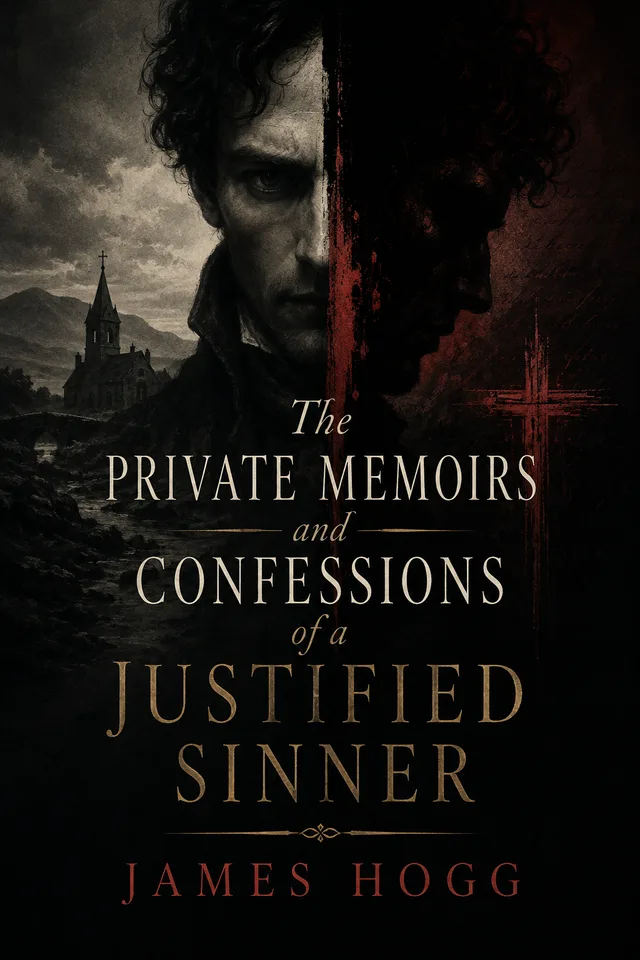
The Private Memoirs and Confessions of a Justified Sinner
英语 BooksWhale 版本 · James Hogg
A dark Scottish classic of fanaticism, double identity, guilt, and psychological pursuit.
- 预览
- 文本节选
- 格式
- 在线阅读, EPUB, PDF
- 访问
- Library 获取
图书简介
The Private Memoirs and Confessions of a Justified Sinner
James Hogg’s unsettling novel follows Robert Wringhim through religious obsession, moral certainty, possible supernatural influence, and murder. Its layered documents, unreliable voices, and uncanny double make it a landmark of Scottish Gothic fiction and psychological narrative.
BooksWhale 版本
此版本如何整理
此版本基于公版文本,并由 BooksWhale 整理为适合数字阅读的版本。
公版依据
为什么此版本可以分享
James Hogg died in 1835, and this novel was first published in 1824. These dates support the public-domain basis for the English source text used in this edition.
阅读预览
文本节选
预览选自整理后的阅读文本。
预览章节Part 1阅读预览
The Private Memoirs and Confessions of a Justified Sinner
THE PRIVATE MEMOIRS
AND CONFESSIONS
OF A JUSTIFIED SINNER
WRITTEN BY HIMSELF
WITH A DETAIL OF CURIOUS TRADITIONARY FACTS, AND
OTHER EVIDENCE, BY THE EDITOR
By
James Hogg
THE EDITOR'S NARRATIVE
It appears from tradition, as well as some parish registers still extant, that the lands of Dalcastle (or Dalchastel, as it is often spelled) were possessed by a family of the name of Colwan, about one hundred and fifty years ago, and for at least a century previous to that period. That family was supposed to have been a branch of the ancient family of Colquhoun, and it is certain that from it spring the Cowans that spread towards the Border. I find that, in the year 1687, George Colwan succeeded his uncle of the same name, in the lands of Dalchastel and Balgrennan; and, this being all I can gather of the family from history, to tradition I must appeal for the remainder of the motley adventures of that house. But, of the matter furnished by the latter of these powerful monitors, I have no reason to complain: It has been handed down to the world in unlimited abundance; and I am certain that, in recording the hideous events which follow, I am only relating to the greater part of the inhabitants of at least four counties of Scotland matters of which they were before perfectly well informed.
This George was a rich man, or supposed to be so, and was married, when considerably advanced in life, to the sole heiress and reputed daughter of a Baillie Orde, of Glasgow. This proved a conjunction anything but agreeable to the parties contracting. It is well known that the Reformation principles had long before that time taken a powerful hold of the hearts and affections of the people of Scotland, although the feeling was by no means general, or in equal degrees; and it so happened that this married couple felt completely at variance on the subject. Granting it to have been so, one would have thought that the laird, owing to his retiring situation, would have been the one that inclined to the stern doctrines of the reformers; and that the young and gay dame from the city would have adhered to the free principles cherished by the court party, and indulged in rather to extremity, in opposition to their severe and carping contemporaries.
The contrary, however, happened to be the case. The laird was what his country neighbours called "a droll, careless chap", with a very limited proportion of the fear of God in his heart, and very nearly as little of the fear of man. The laird had not intentionally wronged or offended either of the parties, and perceived not the necessity of deprecating their vengeance. He had hitherto believed that he was living in most cordial terms with the greater part of the inhabitants of the earth, and with the powers above in particular: but woe be unto him if he was not soon convinced of the fallacy of such damning security! for his lady was the most severe and gloomy of all bigots to the principles of the Reformation. Hers were not the tenets of the great reformers, but theirs mightily overstrained and deformed. Theirs was an unguent hard to be swallowed; but hers was that unguent embittered and overheated until nature could not longer bear it. She had imbibed her ideas from the doctrines of one flaming predestinarian divine alone; and these were so rigid that they became a stumbling block to many of his brethren, and a mighty handle for the enemies of his party to turn the machine of the state against them.
The wedding festivities at Dalcastle partook of all the gaiety, not of that stern age, but of one previous to it. There was feasting, dancing, piping, and singing: the liquors were handed, around in great fulness, the ale in large wooden bickers, and the brandy in capacious horns of oxen. The laird gave full scope to his homely glee. He danced--he snapped his fingers to the music--clapped his hands and shouted at the turn of the tune. He saluted every girl in the hall whose appearance was anything tolerable, and requested of their sweethearts to take the same freedom with his bride, by way of retaliation. But there she sat at the head of the hall in still and blooming beauty, absolutely refusing to tread a single measure with any gentleman there. The only enjoyment in which she appeared to partake was in now and then stealing a word of sweet conversation with her favourite pastor about divine things; for he had accompanied her home after marrying her to her husband, to see her fairly settled in her new dwelling. He addressed her several times by her new name, Mrs. Colwan; but she turned away her head disgusted, and looked with pity and contempt towards the old inadvertent sinner, capering away in the height of his unregenerated mirth. The minister perceived the workings of her pious mind, and thenceforward addressed her by the courteous title of Lady Dalcastle, which sounded somewhat better, as not coupling her name with one of the wicked: and there is too great reason to believe that, for all the solemn vows she had come under, and these were of no ordinary binding, particularly on the laird's part, she at that time despised, if not abhorred him, in her heart.
预览章节Part 2预览
That hero, after a considerable lapse of time, at length made his appearance. Matters were not hard to adjust; for his lady found that there was no refuge for her in her father's house; and so, after some sighs and tears, she accompanied her husband home. For all that had passed, things went on no better. She WOULD convert the laird in spite of his teeth: the laird would not be converted. She WOULD have the laird to say family prayers, both morning and evening: the laird would neither pray morning nor evening. He would not even sing psalms, and kneel beside her while she performed the exercise; neither would he converse at all times, and in all places, about the sacred mysteries of religion, although his lady took occasion to contradict flatly every assertion that he made, in order that she might spiritualize him by drawing him into argument.
The laird kept his temper a long while, but at length his patience wore out; he cut her short in all her futile attempts at spiritualization, and mocked at her wire-drawn degrees of faith, hope, and repentance. He also dared to doubt of the great standard doctrine of absolute predestination, which put the crown on the lady's Christian resentment. She declared her helpmate to be a limb of Antichrist, and one with whom no regenerated person could associate. She therefore bespoke a separate establishment, and, before the expiry of the first six months, the arrangements of the separation were amicably adjusted. The upper, or third, story of the old mansion-house was awarded to the lady for her residence. She had a separate door, a separate stair, a separate garden, and walks that in no instance intersected the laird's; so that one would have thought the separation complete. They had each their own parties, selected from their own sort of people; and, though the laird never once chafed himself about the lady's companies, it was not long before she began to intermeddle about some of his.
"Who is that fat bouncing dame that visits the laird so often, and
always by herself?" said she to her maid Martha one day.
"Oh dear, mem, how can I ken? We're banished frae our acquaintances
here, as weel as frae the sweet gospel ordinances."
"Find me out who that jolly dame is, Martha. You, who hold communion with the household of this ungodly man, can be at no loss to attain this information. I observe that she always casts her eye up toward our windows, both in coming and going; and I suspect that she seldom departs from the house emptyhanded."
That same evening Martha came with the information that this august
visitor was a Miss Logan, an old an intimate acquaintance of the
laird's, and a very worthy respectable lady, of good connections, whose
parents had lost their patrimony in the civil wars.
"Ha! very well!" said the lady; "very well, Martha! But, nevertheless,
go thou and watch this respectable lady's motions and behaviour the
next time she comes to visit the laird--and the next after that. You
will not, I see, lack opportunities."
Martha's information turned out of that nature that prayers were said in the uppermost story of Dalcastle house against the Canaanitish woman, every night and every morning; and great discontent prevailed there, even to anathemas and tears. Letter after letter was dispatched to Glasgow; and at length, to the lady's great consolation, the Rev. Mr. Wringhim arrived safely and devoutly in her elevated sanctuary. Marvellous was the conversation between these gifted people. Wringhim had held in his doctrines that there were eight different kinds of FAITH, all perfectly distinct in their operations and effects. But the lady, in her secluded state, had discovered another five, making twelve in all: the adjusting of the existence or fallacy of these five faiths served for a most enlightened discussion of nearly seventeen hours; in the course of which the two got warm in their arguments, always in proportion as they receded from nature, utility, and common sense. Wringhim at length got into unwonted fervour about some disputed point between one of these faiths and TRUST: when the lady, fearing that zeal was getting beyond its wonted barrier, broke in on his vehement asseverations with the following abrupt discomfiture: "But, Sir, as long as I remember, what is to be done with this case of open and avowed iniquity?"
预览章节Part 3预览
But, after experiencing a specimen of their tenets and manner in his wife, from a secret favourer of them and their doctrines, he grew alarmed at the prevalence of such stern and factious principles, now that there was no check or restraint upon them; and from that time he began to set himself against them, joining with the Cavalier party of that day in all their proceedings.
It so happened that, under the influence of the Earls of Seafield and Tullibardine, he was returned for a Member of Parliament in the famous session that sat at Edinburgh when the Duke of Queensberry was commissioner, and in which party spirit ran to such an extremity. The young laird went with his father to the court, and remained in town all the time that the session lasted; and, as all interested people of both factions flocked to the town at that period, so the important Mr. Wringhim was there among the rest, during the greater part of the time, blowing the coal of revolutionary principles with all his might, in every society to which he could obtain admission. He was a great favourite with some of the west country gentlemen of that faction, by reason of his unbending impudence. No opposition could for a moment cause him either to blush, or retract one item that he had advanced. Therefore the Duke of Argyle and his friends made such use of him as sportsmen often do of terriers, to start the game, and make a great yelping noise to let them know whither the chase is proceeding. They often did this out of sport, in order to tease their opponent; for of all pesterers that ever fastened on man he was the most insufferable: knowing that his coat protected him from manual chastisement, he spared no acrimony, and delighted in the chagrin and anger of those with whom he contended. But he was sometimes likewise of real use to the heads of the Presbyterian faction, and therefore was admitted to their tables, and of course conceived himself a very great man.
His ward accompanied him; and, very shortly after their arrival in Edinburgh, Robert, for the first time, met with the young laird his brother, in a match at tennis. The prowess and agility of the young squire drew forth the loudest plaudits of approval from his associates, and his own exertion alone carried the game every time on the one side, and that so far as all I along to count three for their one. The hero's name soon ran round the circle, and when his brother Robert, who was an onlooker, learned who it was that was gaining so much applause, he came and stood close beside him all the time that the game lasted, always now and then putting in a cutting remark by way of mockery.
George could not help perceiving him, not only on account of his impertinent remarks, but he, moreover, stood so near him that he several times impeded him in his rapid evolutions, and of course got himself shoved aside in no very ceremonious way. Instead of making him keep his distance, these rude shocks and pushes, accompanied sometimes with hasty curses, only made him cling the closer to this king of the game. He seemed determined to maintain his right to his place as an onlooker, as well as any of those engaged in the game, and, if they had tried him at an argument, he would have carried his point; or perhaps he wished to quarrel with this spark of his jealousy and aversion, and draw the attention of the gay crowd to himself by these means; for, like his guardian, he knew no other pleasure but what consisted in opposition. George took him for some impertinent student of divinity, rather set upon a joke than anything else. He perceived a lad with black clothes, and a methodistical face, whose countenance and eye he disliked exceedingly, several times in his way, and that was all the notice he took of him the first time they two met. But the next day, and every succeeding one, the same devilish-looking youth attended him as constantly as his shadow; was always in his way as with intention to impede him and ever and anon his deep and malignant eye met those of his elder brother with a glance so fierce that it sometimes startled him.
目录
本版本内容
- 01Part 1
- 02Part 2
- 03Part 3
- 04Part 4
- 05Part 5
- 06Part 6
- 07Part 7
- 08Part 8
- 09Part 9
- 10Part 10
- 11Part 11
- 12Part 12
- 13Part 13
- 14Part 14
- 15Part 15
- 16Part 16
- 17Part 17
- 18Part 18
- 19Part 19
- 20Part 20
- 21Part 21
- 22Part 22
- 23Part 23
- 24Part 24
- 25Part 25
- 26Part 26
- 27Part 27
- 28Part 28