英语 版本
文学
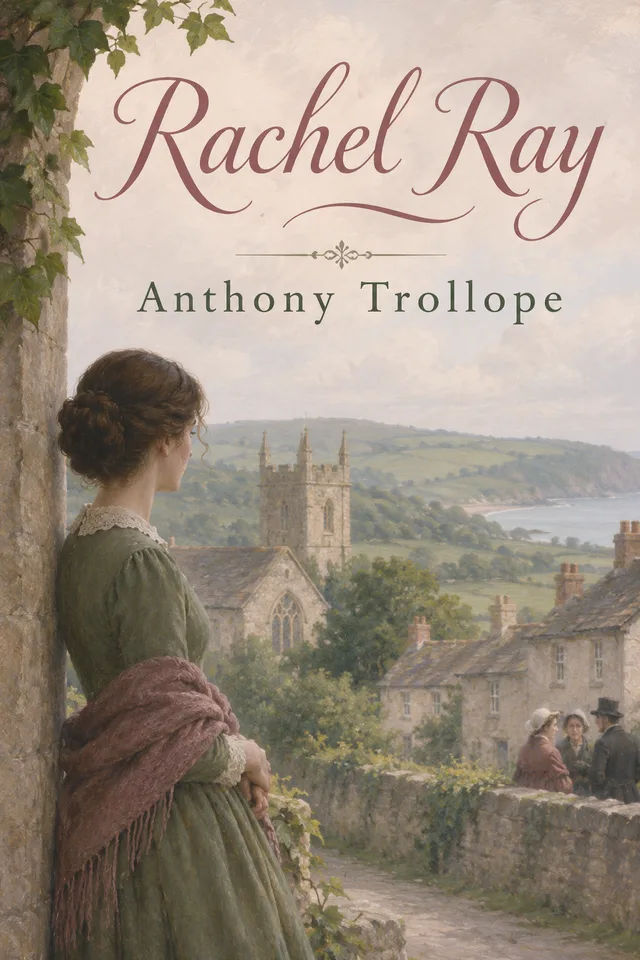
Rachel Ray
英语 BooksWhale 版本 · Anthony Trollope
A young woman in provincial Devon faces religious prejudice, family pressure, and damaging rumours about the man she loves.
- 预览
- 文本节选
- 格式
- 在线阅读, EPUB, PDF
- 访问
- Library 获取
图书简介
Rachel Ray
Rachel Ray lives quietly with her mother and sternly religious sister until Luke Rowan’s arrival draws her into the social life of a Devon town. Their growing attachment becomes entangled in brewery business, local gossip, and competing ideas of respectability. Anthony Trollope follows the consequences of mistrust through domestic conversations, church rivalries, and an election, giving an intimate account of love under provincial scrutiny.
BooksWhale 版本
此版本如何整理
此版本基于公版文本,并由 BooksWhale 整理为适合数字阅读的版本。
公版依据
为什么此版本可以分享
Anthony Trollope died in 1882; this work was first published in 1863. This edition uses the public-domain English text, excluding modern editorial notes.
阅读预览
文本节选
预览选自整理后的阅读文本。
预览章节Full text阅读预览
Rachel Ray
预览章节Volume I — CHAPTER I. — THE RAY FAMILY.预览
There are women who cannot grow alone as standard trees;—for whom the support and warmth of some wall, some paling, some post, is absolutely necessary;—who, in their growth, will bend and incline themselves towards some such prop for their life, creeping with their tendrils along the ground till they reach it when the circumstances of life have brought no such prop within their natural and immediate reach. Of most women it may be said that it would be well for them that they should marry,—as indeed of most men also, seeing that man and wife will each lend the other strength, and yet in lending lose none; but to the women of whom I now speak some kind of marriage is quite indispensable, and by them some kind of marriage is always made, though the union is often unnatural. A woman in want of a wall against which to nail herself will swear conjugal obedience sometimes to her cook, sometimes to her grandchild, sometimes to her lawyer. Any standing corner, post, or stump, strong enough to bear her weight will suffice; but to some standing corner, post, or stump, she will find her way and attach herself, and there will she be married.
Such a woman was our Mrs. Ray. As her name imports, she had been married in the way most popular among ladies, with bell, book, and parson. She had been like a young peach tree that, in its early days, is carefully taught to grow against a propitious southern wall. Her natural prop had been found for her, and all had been well. But her heaven had been made black with storms; the heavy winds had come, and the warm sheltering covert against which she had felt herself so safe had been torn away from her branches as they were spreading themselves forth to the fulness of life. She had been married at eighteen, and then, after ten years of wedded security, she had become a widow.
Her husband had been some years older than herself,—a steady, sober, hardworking, earnest man, well fitted to act as a protecting screen to such a woman as he had chosen. They had lived in Exeter, both of them having belonged to Devonshire from their birth; and Mr. Ray, though not a clergyman himself, had been employed in matters ecclesiastical. He was a lawyer,—but a lawyer of that sort that is so nearly akin to the sacerdotal profession, as to make him quite clerical and almost a clergyman. He managed the property of the dean and chapter, and knew what were the rights, and also what were the wrongs, of prebendaries and minor canons,—of vicars choral, and even of choristers. But he had been dead many years before our story commences, and so much as this is now said of him simply to explain under what circumstances Mrs. Ray had received the first tinge of that colouring which was given to her life by church matters.
They had been married somewhat over ten years when he died, and she was left with two surviving daughters, the eldest and the youngest of the children she had borne. The eldest, Dorothea, was then more than nine years old, and as she took much after her father, being stern, sober, and steady, Mrs. Ray immediately married herself to her eldest child. Dorothea became the prop against which she would henceforth grow. And against Dorothea she had grown ever since, with the exception of one short year. In that year Dorothea had taken a husband to herself and had lost him;—so that there were two widows in the same house. She, like her mother, had married early, having joined her lot to that of a young clergyman near Baslehurst; but he had lived but a few months, and Mrs. Ray's eldest child had come back to her mother's cottage, black, and stiff, and stern, in widow's weeds,—Mrs. Prime by name. Black, and stiff, and stern, in widow's weeds, she had remained since, for nine years following, and those nine years will bring us to the beginning of our story.
预览章节Volume I — CHAPTER II. — THE YOUNG MAN FROM THE BREWERY.预览
There were during the summer months four Dorcas afternoons held weekly in Baslehurst, at all of which Mrs. Prime presided. It was her custom to start soon after dinner, so as to reach the working room before three o'clock, and there she would remain till nine, or as long as the daylight remained. The meeting was held in a sitting room belonging to Miss Pucker, for the use of which the Institution paid some moderate rent. The other ladies, all belonging to Baslehurst, were accustomed to go home to tea in the middle of their labours; but, as Mrs. Prime could not do this because of the distance, she remained with Miss Pucker, paying for such refreshment as she needed. In this way there came to be a great friendship between Mrs. Prime and Miss Pucker;—or rather, perhaps, Mrs. Prime thus obtained the services of a most obedient minister. Rachel had on various occasions gone with her sister to the Dorcas meetings, and once or twice had remained at Miss Pucker's house, drinking tea there. But this she greatly disliked. She was aware, when she did so, that her sister paid for her, and she thought that Dorothea showed by her behaviour that she was mistress of the entertainment. And then Rachel greatly disliked Miss Pucker. She disliked that lady's squint, she disliked the tone of her voice, she disliked her subservience to Mrs. Prime, and she especially disliked the vehemence of her objection to—young men. When Rachel had last left Miss Pucker's room she had resolved that she would never again drink tea there. She had not said to herself positively that she would attend no more of the Dorcas meetings;—but as regarded their summer arrangement this resolve against the tea-drinking amounted almost to the same thing.
It was on this account, I protest, and by no means on account of that young man from the brewery, that Rachel had with determination opposed her sister's request on this special Saturday. And the refusal had been made in an unaccustomed manner, owing to the request also having been pressed with unusual vigour.
"Rachel, I particularly wish it, and I think that you ought to come," Dorothea had said.
"I had rather not come, Dolly."
"That means," continued Mrs. Prime, "that you prefer your pleasure to your duty;—that you boldly declare yourself determined to neglect that which you know you ought to do."
"I don't know any such thing," said Rachel.
"If you think of it you will know it," said Mrs. Prime.
"At any rate I don't mean to go to Miss Pucker's this afternoon."—Then Rachel left the room.
It was immediately after this conversation that Mrs. Prime uttered to Mrs. Ray that terrible hint about the young man; and at the same time uttered another hint by which she strove to impress upon her mother that Rachel ought to be kept in subordination,—in fact, that the power should not belong to Rachel of choosing whether she would or would not go to Dorcas meetings. In all such matters, according to Dorothea's view of the case, Rachel should do as she was bidden. But then how was Rachel to be made to do as she was bidden? How was her sister to enforce her attendance? Obedience in this world depends as frequently on the weakness of him who is governed as on the strength of him who governs. That man who was going to the left is ordered by you with some voice of command to go to the right. When he hesitates you put more command into your voice, more command into your eyes,—and then he obeys. Mrs. Prime had tried this, but Rachel had not turned to the right. When Mrs. Prime applied for aid to their mother, it was a sign that the power of command was going from herself. After dinner the elder sister made another little futile attempt, and then, when she had again failed, she trudged off with her basket.
目录
本版本内容
- 01Full text
- 02Volume I — CHAPTER I. — THE RAY FAMILY.
- 03Volume I — CHAPTER II. — THE YOUNG MAN FROM THE BREWERY.
- 04Volume I — CHAPTER III. — THE ARM IN THE CLOUDS.
- 05Volume I — CHAPTER IV. — WHAT SHALL BE DONE ABOUT IT?
- 06Volume I — CHAPTER V. — MR. COMFORT GIVES HIS ADVICE.
- 07Volume I — CHAPTER VI. — PREPARATIONS FOR MRS. TAPPITT'S PARTY.
- 08Volume I — CHAPTER VII. — AN ACCOUNT OF MRS. TAPPITT'S BALL—COMMENCED.
- 09Volume I — CHAPTER VIII. — AN ACCOUNT OF MRS. TAPPITT'S BALL—CONCLUDED.
- 10Volume I — CHAPTER IX. — MR. PRONG AT HOME.
- 11Volume I — CHAPTER X. — LUKE ROWAN DECLARES HIS PLANS AS TO THE BREWERY.
- 12Volume I — CHAPTER XI. — LUKE ROWAN TAKES HIS TEA QUITE LIKE A STEADY YOUNG MAN.
- 13Volume I — CHAPTER XII. — RACHEL RAY THINKS "SHE DOES LIKE HIM."
- 14Volume I — CHAPTER XIII. — MR. TAPPITT IN HIS COUNTING-HOUSE.
- 15Volume I — CHAPTER XIV. — LUKE ROWAN PAYS A SECOND VISIT TO BRAGG'S END.
- 16Volume I — CHAPTER XV. — MATERNAL ELOQUENCE.
- 17Volume II — CHAPTER I. — RACHEL RAY'S FIRST LOVE-LETTER.
- 18Volume II — CHAPTER II. — ELECTIONEERING.
- 19Volume II — CHAPTER III. — DR. HARFORD.
- 20Volume II — CHAPTER IV. — MR. COMFORT CALLS AT THE COTTAGE.
- 21Volume II — CHAPTER V. — SHOWING WHAT RACHEL RAY THOUGHT WHEN SHE SAT ON THE STILE, AND HOW SHE WROTE HER LETTER AFTERWARDS.
- 22Volume II — CHAPTER VI. — MRS. RAY GOES TO EXETER, AND MEETS A FRIEND.
- 23Volume II — CHAPTER VII. — DOMESTIC POLITICS AT THE BREWERY.
- 24Volume II — CHAPTER VIII. — MRS. RAY'S PENITENCE.
- 25Volume II — CHAPTER IX. — THE ELECTION AT BASLEHURST.
- 26Volume II — CHAPTER X. — THE BASLEHURST GAZETTE.
- 27Volume II — CHAPTER XI. — CORNBURY GRANGE.
- 28Volume II — CHAPTER XII. — IN WHICH THE QUESTION OF THE BREWERY IS SETTLED.
- 29Volume II — CHAPTER XIII. — WHAT TOOK PLACE AT BRAGG'S END FARM.
- 30Volume II — CHAPTER XIV. — MRS. PRIME READS HER RECANTATION.
- 31Volume II — CHAPTER XV. — CONCLUSION.