英语 版本
科学
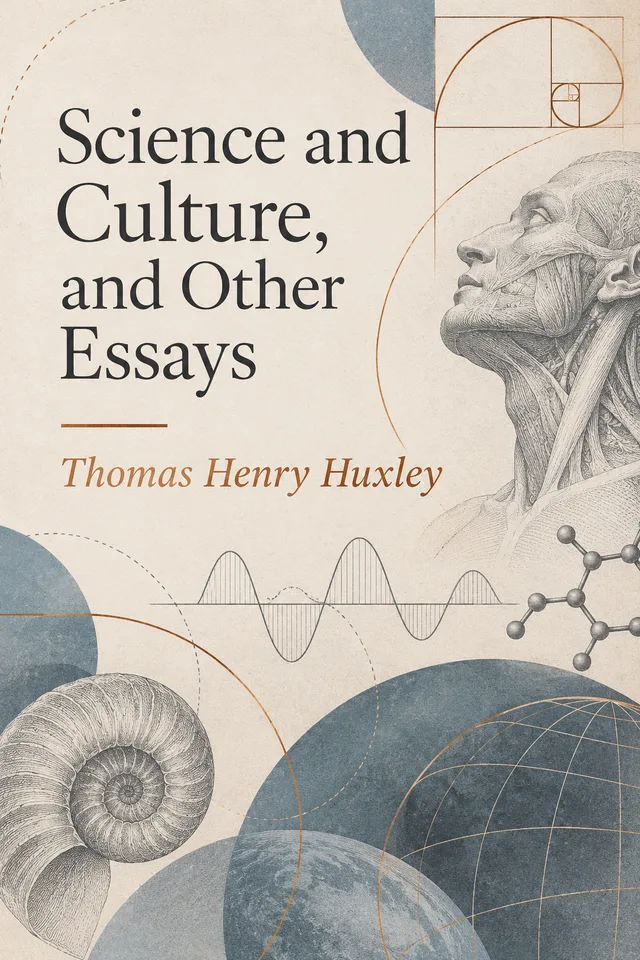
Science and Culture, and Other Essays
英语 BooksWhale 版本 · Thomas Henry Huxley
Thirteen essays connect scientific education with intellectual culture, biological investigation, and debates about the place of science in society.
- 预览
- 文本节选
- 格式
- 在线阅读, EPUB, PDF
- 访问
- Library 获取
图书简介
Science and Culture, and Other Essays
Thomas Henry Huxley argues for scientific training as a central part of education while examining universities, technical instruction, physiology, and the history of biological ideas. The collection includes discussions of Joseph Priestley, Darwinian evolution, animal automatism, and the relationship between biology and medicine. These addresses and essays show how a Victorian scientist explained his methods and defended the cultural value of empirical inquiry.
BooksWhale 版本
此版本如何整理
此版本基于公版文本,并由 BooksWhale 整理为适合数字阅读的版本。
公版依据
为什么此版本可以分享
Thomas Henry Huxley died in 1895; this work was first published in 1881. This edition uses the public-domain English text, excluding modern editorial notes.
阅读预览
文本节选
预览选自整理后的阅读文本。
预览章节Full text阅读预览
Science and Culture, and Other Essays
预览章节PREFACE.预览
The Addresses, Lectures, and Essays gathered together in this volume have appeared at intervals during the past seven years, and I can give no better reason for republishing them in their present form, than the fact that three earlier collections of a similar nature have been received with favour, and, indeed, have not yet ceased to be in request.
I beg leave to offer my best thanks to the Editors and Publishers of the various publications in which these pieces have appeared, for their kindly accorded permission to reprint them.
London. October 1881.
预览章节I. SCIENCE AND CULTURE.预览
Six years ago, as some of my present hearers may remember, I had the privilege of addressing a large assemblage of the inhabitants of this city, who had gathered together to do honour to the memory of their famous townsman, Joseph Priestley; and, if any satisfaction attaches to posthumous glory, we may hope that the manes of the burnt-out philosopher were then finally appeased.
No man, however, who is endowed with a fair share of common sense, and not more than a fair share of vanity, will identify either contemporary or posthumous fame with the highest good; and Priestley’s life leaves no doubt that he, at any rate, set a much higher value upon the advancement of knowledge, and the promotion of that freedom of thought which is at once the cause and the consequence of intellectual progress.
Hence I am disposed to think that, if Priestley could be amongst us to-day, the occasion of our meeting would afford him even greater pleasure than the proceedings which celebrated the centenary of his chief discovery. The kindly heart would be moved, the high sense of social duty would be satisfied, by the spectacle of well-earned wealth, neither squandered in tawdry luxury and vainglorious show, nor scattered with the careless charity which blesses neither him that gives nor him that takes, but expended in the execution of a well-considered plan for the aid of present and future generations of those who are willing to help themselves.
We shall all be of one mind thus far. But it is needful to share Priestley’s keen interest in physical science; and to have learned, as he had learned, the value of scientific training in fields of inquiry apparently far remote from physical science; in order to appreciate, as he would have appreciated, the value of the noble gift which Sir Josiah Mason has bestowed upon the inhabitants of the Midland district.
For us children of the nineteenth century, however, the establishment of a college under the conditions of Sir Josiah Mason’s Trust, has a significance apart from any which it could have possessed a hundred years ago. It appears to be an indication that we are reaching the crisis of the battle, or rather of the long series of battles, which have been fought over education in a campaign which began long before Priestley’s time, and will probably not be finished just yet.
In the last century, the combatants were the champions of ancient literature, on the one side, and those of modern literature on the other; but, some thirty years ago, the contest became complicated by the appearance of a third army, ranged round the banner of Physical Science.
I am not aware that any one has authority to speak in the name of this new host. For it must be admitted to be somewhat of a guerilla force, composed largely of irregulars, each of whom fights pretty much for his own hand. But the impressions of a full private, who has seen a good deal of service in the ranks, respecting the present position of affairs and the conditions of a permanent peace, may not be devoid of interest; and I do not know that I could make a better use of the present opportunity than by laying them before you.
From the time that the first suggestion to introduce physical science into ordinary education was timidly whispered, until now, the advocates of scientific education have met with opposition of two kinds. On the one hand, they have been pooh-poohed by the men of business who pride themselves on being the representatives of practicality; while, on the other hand, they have been excommunicated by the classical scholars, in their capacity of Levites in charge of the ark of culture and monopolists of liberal education.
The practical men believed that the idol whom they worship—rule of thumb—has been the source of the past prosperity, and will suffice for the future welfare of the arts and manufactures. They were of opinion that science is speculative rubbish; that theory and practice have nothing to do with one another; and that the scientific habit of mind is an impediment, rather than an aid, in the conduct of ordinary affairs.
目录
本版本内容
- 01Full text
- 02PREFACE.
- 03I. SCIENCE AND CULTURE.
- 04II. UNIVERSITIES: ACTUAL AND IDEAL.
- 05III. TECHNICAL EDUCATION.
- 06IV. ON ELEMENTARY INSTRUCTION IN PHYSIOLOGY.
- 07V. JOSEPH PRIESTLEY.
- 08VI. ON THE METHOD OF ZADIG:
- 09VII. ON THE BORDER TERRITORY BETWEEN THE ANIMAL AND THE VEGETABLE KINGDOMS.
- 10VIII. ON CERTAIN ERRORS RESPECTING THE STRUCTURE OF THE HEART ATTRIBUTED TO ARISTOTLE.
- 11IX. ON THE HYPOTHESIS THAT ANIMALS ARE AUTOMATA, AND ITS HISTORY.
- 12X. ON SENSATION AND THE UNITY OF STRUCTURE OF SENSIFEROUS ORGANS.
- 13XI. EVOLUTION IN BIOLOGY.
- 14I. The Evolution of the Individual.
- 15II. The Evolution of the Sum of Living Beings.
- 16XII. THE COMING OF AGE OF “THE ORIGIN OF SPECIES.”
- 17XIII. THE CONNECTION OF THE BIOLOGICAL SCIENCES WITH MEDICINE.