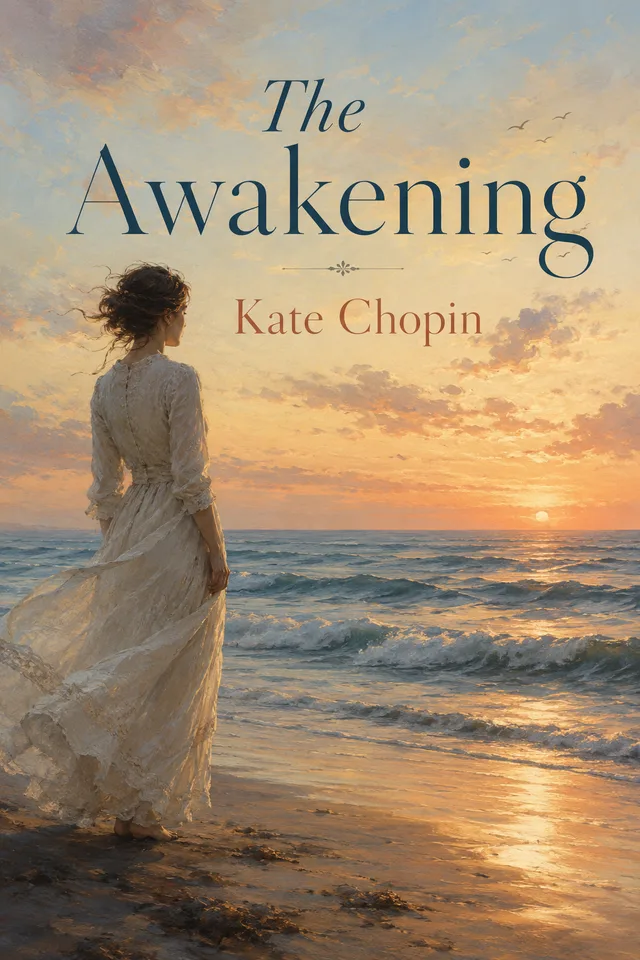
英语 版本
文学
The Awakening and Selected Stories
英语 BooksWhale 版本 · Kate Chopin
Kate Chopin’s classic novel of selfhood and desire presented with selected short stories.
- 预览
- 文本节选
- 格式
- 在线阅读, EPUB, PDF
- 访问
- Library 获取
图书简介
The Awakening and Selected Stories
The Awakening and Selected Stories presents Kate Chopin’s classic novel alongside selected short fiction, exploring selfhood, desire, marriage, social constraint, and inner freedom. This English edition reflects the public-domain text prepared for focused digital reading.
BooksWhale 版本
此版本如何整理
此版本基于公版文本,并由 BooksWhale 整理为适合数字阅读的版本。
公版依据
为什么此版本可以分享
Kate Chopin died in 1904, and The Awakening was first published in 1899. These dates support the public-domain basis for the English source text used in this edition.
阅读预览
文本节选
预览选自整理后的阅读文本。
预览章节Full text阅读预览
The Awakening and Selected Stories
Kate Chopin
预览章节The Awakening预览
I
A green and yellow parrot, which hung in a cage outside the door, kept repeating over and over:
“Allez vous-en! Allez vous-en! Sapristi! That’s all right!”
He could speak a little Spanish, and also a language which nobody understood, unless it was the mockingbird that hung on the other side of the door, whistling his fluty notes out upon the breeze with maddening persistence.
Mr. Pontellier, unable to read his newspaper with any degree of comfort, arose with an expression and an exclamation of disgust. He walked down the gallery and across the narrow “bridges” which connected the Lebrun cottages one with the other. He had been seated before the door of the main house. The parrot and the mockingbird were the property of Madame Lebrun, and they had the right to make all the noise they wished. Mr. Pontellier had the privilege of quitting their society when they ceased to be entertaining.
He stopped before the door of his own cottage, which was the fourth one from the main building and next to the last Seating himself in a wicker rocker which was there, he once more applied himself to the task of reading the newspaper. The day was Sunday; the paper was a day old. The Sunday papers had not yet reached Grand Isle. He was already acquainted with the market reports, and he glanced restlessly over the editorials and bits of news which he had not had time to read before quitting New Orleans the day before.
Mr. Pontellier wore eye-glasses. He was a man of forty, of medium height and rather slender build; he stooped a little. His hair was brown and straight, parted on one side. His beard was neatly and closely trimmed.
Once in a while he withdrew his glance from the newspaper and looked about him. There was more noise than ever over at the house. The main building was called “the house,” to distinguish it from the cottages. The chattering and whistling birds were still at it Two young girls, the Farival twins, were playing a duet from “Zampa” upon the piano. Madame Lebrun was bustling in and out, giving orders in a high key to a yard-boy whenever she got inside the house, and directions in an equally high voice to a dining-room servant whenever she got outside. She was a fresh, pretty woman, clad always in white with elbow sleeves. Her starched skirts crinkled as she came and went. Farther down, before one of the cottages, a lady in black was walking demurely up and down, telling her beads. A good many persons of the pension had gone over to the Chênière Caminada in Beaudelet’s lugger to hear mass. Some young people were out under the water-oaks playing croquet. Mr. Pontellier’s two children were there—sturdy little fellows of four and five. A quadroon nurse followed them about with a faraway, meditative air.
Mr. Pontellier finally lit a cigar and began to smoke, letting the paper drag idly from his hand. He fixed his gaze upon a white sunshade that was advancing at snail’s pace from the beach. He could see it plainly between the gaunt trunks of the water-oaks and across the stretch of yellow camomile. The Gulf looked far away, melting hazily into the blue of the horizon. The sunshade continued to approach slowly. Beneath its pink-lined shelter were his wife, Mrs. Pontellier, and young Robert Lebrun. When they reached the cottage, the two seated themselves with some appearance of fatigue upon the upper step of the porch, facing each other, each leaning against a supporting post.
“What folly! to bathe at such an hour in such heat!” exclaimed Mr. Pontellier. He himself had taken a plunge at daylight. That was why the morning seemed long to him.
“You are burnt beyond recognition,” he added, looking at his wife as one looks at a valuable piece of personal property which has suffered some damage. She held up her hands, strong, shapely hands, and surveyed them critically, drawing up her lawn sleeves above the wrists. Looking at them reminded her of her rings, which she had given to her husband before leaving for the beach. She silently reached out to him, and he, understanding, took the rings from his vest pocket and dropped them into her open palm. She slipped them upon her fingers; then clasping her knees, she looked across at Robert and began to laugh. The rings sparkled upon her fingers. He sent back an answering smile.
预览章节II预览
Mrs. Pontellier’s eyes were quick and bright; they were a yellowish brown, about the color of her hair. She had a way of turning them swiftly upon an object and holding them there as if lost in some inward maze of contemplation or thought.
Her eyebrows were a shade darker than her hair. They were thick and almost horizontal, emphasizing the depth of her eyes. She was rather handsome than beautiful. Her face was captivating by reason of a certain frankness of expression and a contradictory subtle play of features. Her manner was engaging.
Robert rolled a cigarette. He smoked cigarettes because he could not afford cigars, he said. He had a cigar in his pocket which Mr. Pontellier had presented him with, and he was saving it for his after-dinner smoke.
This seemed quite proper and natural on his part. In coloring he was not unlike his companion. A clean-shaved face made the resemblance more pronounced than it would otherwise have been. There rested no shadow of care upon his open countenance. His eyes gathered in and reflected the light and languor of the summer day.
Mrs. Pontellier reached over for a palm-leaf fan that lay on the porch and began to fan herself, while Robert sent between his lips light puffs from his cigarette. They chatted incessantly: about the things around them; their amusing adventure out in the water—it had again assumed its entertaining aspect; about the wind, the trees, the people who had gone to the Chênière; about the children playing croquet under the oaks, and the Farival twins, who were now performing the overture to “The Poet and the Peasant.”
Robert talked a good deal about himself. He was very young, and did not know any better. Mrs. Pontellier talked a little about herself for the same reason. Each was interested in what the other said. Robert spoke of his intention to go to Mexico in the autumn, where fortune awaited him. He was always intending to go to Mexico, but some way never got there. Meanwhile he held on to his modest position in a mercantile house in New Orleans, where an equal familiarity with English, French and Spanish gave him no small value as a clerk and correspondent.
He was spending his summer vacation, as he always did, with his mother at Grand Isle. In former times, before Robert could remember, “the house” had been a summer luxury of the Lebruns. Now, flanked by its dozen or more cottages, which were always filled with exclusive visitors from the “Quartier Français,” it enabled Madame Lebrun to maintain the easy and comfortable existence which appeared to be her birthright.
Mrs. Pontellier talked about her father’s Mississippi plantation and her girlhood home in the old Kentucky blue-grass country. She was an American woman, with a small infusion of French which seemed to have been lost in dilution. She read a letter from her sister, who was away in the East, and who had engaged herself to be married. Robert was interested, and wanted to know what manner of girls the sisters were, what the father was like, and how long the mother had been dead.
When Mrs. Pontellier folded the letter it was time for her to dress for the early dinner.
“I see Léonce isn’t coming back,” she said, with a glance in the direction whence her husband had disappeared. Robert supposed he was not, as there were a good many New Orleans club men over at Klein’s.
When Mrs. Pontellier left him to enter her room, the young man descended the steps and strolled over toward the croquet players, where, during the half-hour before dinner, he amused himself with the little Pontellier children, who were very fond of him.
目录
本版本内容
- 01Full text
- 02The Awakening
- 03II
- 04III
- 05IV
- 06V
- 07VI
- 08VII
- 09VIII
- 10IX
- 11X
- 12XI
- 13XII
- 14XIII
- 15XIV
- 16XV
- 17XVI
- 18XVII
- 19XVIII
- 20XIX
- 21XX
- 22XXI
- 23XXII
- 24XXIII
- 25XXIV
- 26XXV
- 27XXVI
- 28XXVII
- 29XXVIII
- 30XXIX
- 31XXX
- 32XXXI
- 33XXXII
- 34XXXIII
- 35XXXIV
- 36XXXV
- 37XXXVI
- 38XXXVII
- 39XXXVIII
- 40XXXIX
- 41Beyond the Bayou
- 42Ma’ame Pélagie
- 43II
- 44III
- 45IV
- 46Désirée’s Baby
- 47A Respectable Woman
- 48The Kiss
- 49A Pair of Silk Stockings
- 50The Locket
- 51II
- 52A Reflection
- 53At the ’Cadian Ball
- 54The Storm: A Sequel to “At the ’Cadian Ball”
- 55II
- 56III
- 57IV
- 58V