英语 版本
文学
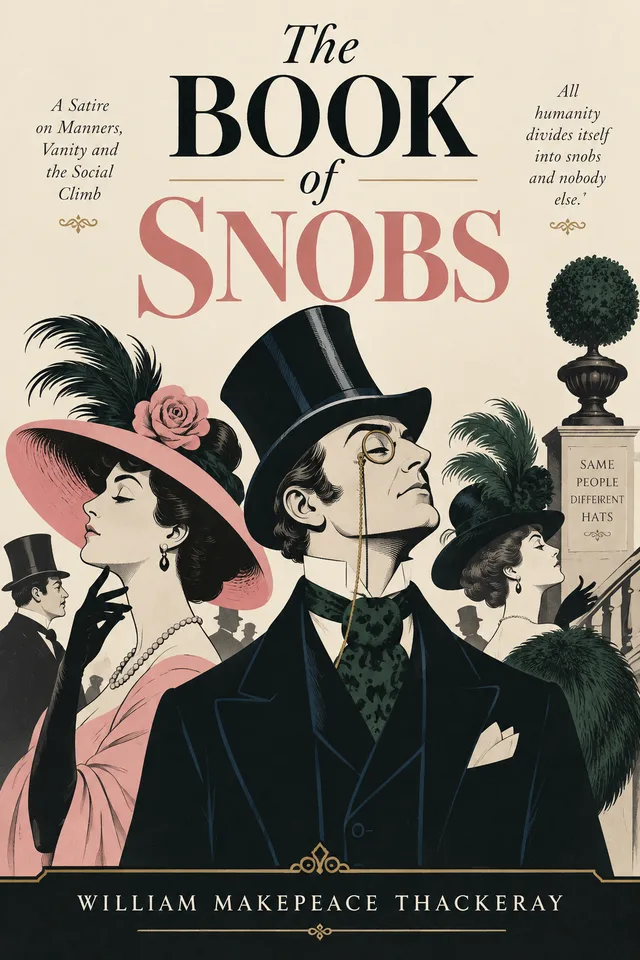
The Book of Snobs
英语 BooksWhale 版本 · William Makepeace Thackeray
A witty anatomy of status-seeking, social vanity, inherited privilege, and the elaborate performance of respectability.
- 预览
- 文本节选
- 格式
- 在线阅读, EPUB, PDF
- 访问
- Library 获取
图书简介
The Book of Snobs
Thackeray’s satirical portraits expose the rituals by which people pursue rank and approval. From aristocratic pretension to commercial ambition, the book turns English social manners into a gallery of comic and revealing types.
BooksWhale 版本
此版本如何整理
此版本基于公版文本,并由 BooksWhale 整理为适合数字阅读的版本。
公版依据
为什么此版本可以分享
William Makepeace Thackeray died in 1863; the English satirical work was first published in 1848 and is public domain.
阅读预览
文本节选
预览选自整理后的阅读文本。
预览章节Full text阅读预览
The Book of Snobs
William Makepeace Thackeray
预览章节CONCLUDING OBSERVATIONS ON SNOBS预览
(The necessity of a work on Snobs, demonstrated from History, and proved by felicitous illustrations:—I am the individual destined to write that work—My vocation is announced in terms of great eloquence—I show that the world has been gradually preparing itself for the WORK and the MAN—Snobs are to be studied like other objects of Natural Science, and are a part of the Beautiful (with a large B). They pervade all classes—Affecting instance of Colonel Snobley.)
We have all read a statement, (the authenticity of which I take leave to doubt entirely, for upon what calculations I should like to know is it founded?)—we have all, I say, been favoured by perusing a remark, that when the times and necessities of the world call for a Man, that individual is found. Thus at the French Revolution (which the reader will be pleased to have introduced so early), when it was requisite to administer a corrective dose to the nation, Robespierre was found; a most foul and nauseous dose indeed, and swallowed eagerly by the patient, greatly to the latter's ultimate advantage: thus, when it became necessary to kick John Bull out of America, Mr. Washington stepped forward, and performed that job to satisfaction: thus, when the Earl of Aldborough was unwell, Professor Holloway appeared with his pills, and cured his lordship, as per advertisement, &c. &c.. Numberless instances might be adduced to show that when a nation is in great want, the relief is at hand; just as in the Pantomime (that microcosm) where when CLOWN wants anything—a warming-pan, a pump-handle, a goose, or a lady's tippet—a fellow comes sauntering out from behind the side-scenes with the very article in question.
Again, when men commence an undertaking, they always are prepared to show that the absolute necessities of the world demanded its completion.—Say it is a railroad: the directors begin by stating that 'A more intimate communication between Bathershins and Derrynane Beg is necessary for the advancement of civilization, and demanded by the multitudinous acclamations of the great Irish people.' Or suppose it is a newspaper: the prospectus states that 'At a time when the Church is in danger, threatened from without by savage fanaticism and miscreant unbelief, and undermined from within by dangerous Jesuitism, and suicidal Schism, a Want has been universally felt—a suffering people has looked abroad—for an Ecclesiastical Champion and Guardian. A body of Prelates and Gentlemen have therefore stepped forward in this our hour of danger, and determined on establishing the BEADLE newspaper,' &c. &c. One or other of these points at least is incontrovertible: the public wants a thing, therefore it is supplied with it; or the public is supplied with a thing, therefore it wants it.
I have long gone about with a conviction on my mind that I had a work to do—a Work, if you like, with a great W; a Purpose to fulfil; a chasm to leap into, like Curtius, horse and foot; a Great Social Evil to Discover and to Remedy. That Conviction Has Pursued me for Years. It has Dogged me in the Busy Street; Seated Itself By Me in The Lonely Study; Jogged My Elbow as it Lifted the Wine-cup at The Festive Board; Pursued me through the Maze of Rotten Row; Followed me in Far Lands. On Brighton's Shingly Beach, or Margate's Sand, the Voice Outpiped the Roaring of the Sea; it Nestles in my Nightcap, and It Whispers, 'Wake, Slumberer, thy Work Is Not Yet Done.' Last Year, By Moonlight, in the Colosseum, the Little Sedulous Voice Came To Me and Said, 'Smith, or Jones' (The Writer's Name is Neither Here nor There), 'Smith or Jones, my fine fellow, this is all very well, but you ought to be at home writing your great work on SNOBS.
When a man has this sort of vocation it is all nonsense attempting to elude it. He must speak out to the nations; he must unbusm himself, as Jeames would say, or choke and die. 'Mark to yourself,' I have often mentally exclaimed to your humble servant, 'the gradual way in which you have been prepared for, and are now led by an irresistible necessity to enter upon your great labour. First, the World was made: then, as a matter of course, Snobs; they existed for years and years, and were no more known than America. But presently,—INGENS PATEBAT TELLUS,—the people became darkly aware that there was such a race. Not above five-and-twenty years since, a name, an expressive monosyllable, arose to designate that race. That name has spread over England like railroads subsequently; Snobs are known and recognized throughout an Empire on which I am given to understand the Sun never sets. PUNCH appears at the ripe season, to chronicle their history: and the individual comes forth to write that history in PUNCH.'
预览章节Notes.预览
(1) I have since heard that this aristocratic lady's father was a livery-button maker in St. Martin's Lane: where he met with misfortunes, and his daughter acquired her taste for heraldry. But it may be told to her credit, that out of her earnings she has kept the bed-ridden old bankrupt in great comfort and secrecy at Pentonville; and furnished her brother's outfit for the Cadetship which her patron, Lord Swigglebiggle, gave her when he was at the Board of Control. I have this information from a friend. To hear Miss Wirt herself, you would fancy that her Papa was a Rothschild, and that the markets of Europe were convulsed when he went into the GAZETTE.
'Be hanged to your aristocrats!' Ponto said, in some conversation we had regarding the family at Carabas, between whom and the Evergreens there was a feud. 'When I first came into the county—it was the year before Sir John Buff contested in the Blue interest—the Marquis, then Lord St. Michaels, who, of course, was Orange to the core, paid me and Mrs. Ponto such attentions, that I fairly confess I was taken in by the old humbug, and thought that I'd met with a rare neighbour. 'Gad, Sir, we used to get pines from Carabas, and pheasants from Carabas, and it was—“Ponto, when will you come over and shoot?”—and—“Ponto, our pheasants want thinning,”—and my Lady would insist upon her dear Mrs. Ponto coming over to Carabas to sleep, and put me I don't know to what expense for turbans and velvet gowns for my wife's toilette. Well, Sir, the election takes place, and though I was always a Liberal, personal friendship of course induces me to plump for St. Michaels, who comes in at the head of the poll. Next year, Mrs. P. insists upon going to town—with lodgings in Clarges Street at ten pounds a week, with a hired brougham, and new dresses for herself and the girls, and the deuce and all to pay. Our first cards were to Carabas House; my Lady's are returned by a great big flunkey; and I leave you to fancy my poor Betsy's discomfiture as the lodging-house maid took in the cards, and Lady St. Michaels drives away, though she actually saw us at the drawing-room window. Would you believe it, Sir, that though we called four times afterwards, those infernal aristocrats never returned our visit; that though Lady St. Michaels gave nine dinner-parties and four DEJEUNERS that season, she never asked us to one; and that she cut us dead at the Opera, though Betsy was nodding to her the whole night? We wrote to her for tickets for Almack's; she writes to say that all hers were promised; and said, in the presence of Wiggins, her lady's-maid, who told it to Diggs, my wife's woman, that she couldn't conceive how people in our station of life could so far forget themselves as to wish to appear in any such place! Go to Castle Carabas! I'd sooner die than set my foot in the house of that impertinent, insolvent, insolent jackanapes—and I hold him in scorn!' After this, Ponto gave me some private information regarding Lord Carabas's pecuniary affairs; how he owed money all over the county; how Jukes the carpenter was utterly ruined and couldn't get a shilling of his bill; how Biggs the butcher hanged himself for the same reason; how the six big footmen never received a guinea of wages, and Snaffle, the state coachman, actually took off his blown-glass wig of ceremony and flung it at Lady Carabas's feet on the terrace before the Castle; all which stories, as they are private, I do not think proper to divulge. But these details did not stifle my desire to see the famous mansion of Castle Carabas, nay, possibly excited my interest to know more about that lordly house and its owners.
目录
本版本内容
- 01Full text
- 02CONCLUDING OBSERVATIONS ON SNOBS
- 03Notes.
- 04THE SOUTH GALLERY.
- 05Excuse this scrawl, but I always write headlong. (8)
- 06So WE (as this wretched prig said) began again:—
- 07PAPWORTHY.—'Poppins, I'm thinking of dining early; is there any cold game in the house?'
- 08PAPWORTHY.—'Hem! What's your best claret now, Poppins?—in pints, I mean.'
- 09Some fortnight afterwards I saw Sackville Maine under the following circumstances:—