英语 版本
文学
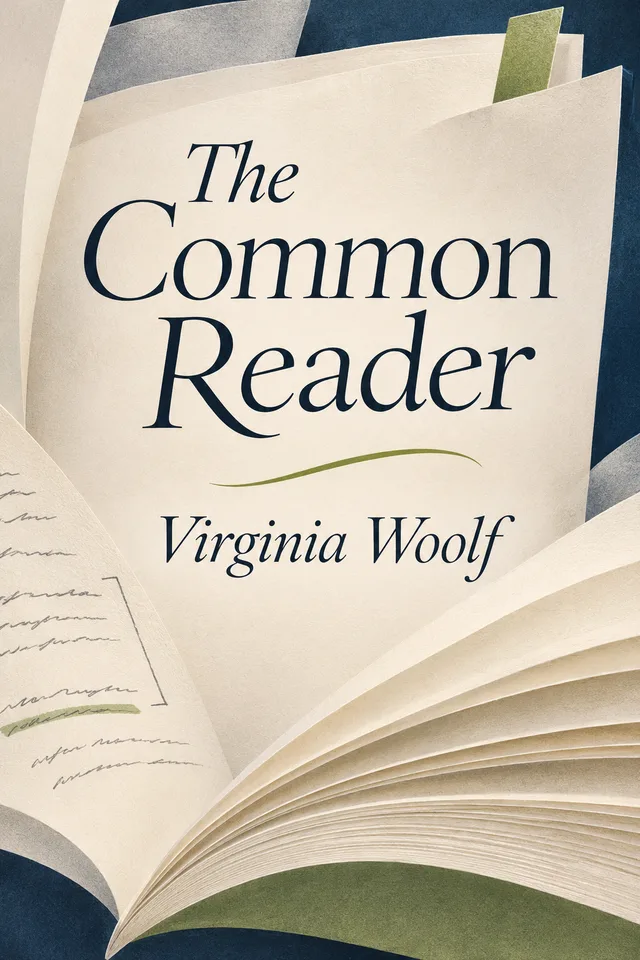
The Common Reader
英语 BooksWhale 版本 · Virginia Woolf
Virginia Woolf’s first collection follows the pleasures and puzzles of reading from Chaucer and Montaigne to Austen and Conrad.
- 预览
- 文本节选
- 格式
- 在线阅读, EPUB, PDF
- 访问
- Library 获取
图书简介
The Common Reader
Woolf reads across centuries in the company of the ordinary reader. She revisits Chaucer and the Pastons, tests what English readers can hear in Greek, and reads Jane Austen, George Eliot, and Joseph Conrad alongside less familiar figures. This edition gathers the essays and shorter portraits of the first series, published in 1925.
BooksWhale 版本
此版本如何整理
此版本基于公版文本,并由 BooksWhale 整理为适合数字阅读的版本。
公版依据
为什么此版本可以分享
Virginia Woolf died in 1941. The original English text was published in 1925.
阅读预览
文本节选
预览选自整理后的阅读文本。
预览章节Full text阅读预览
The Common Reader
". . . I rejoice to concur with the common reader; for by the common sense of readers, uncorrupted by literary prejudices, after all the refinements of subtlety and the dogmatism of learning, must be generally decided all claim to poetical honors."
DR. JOHNSON, Life of Gray.
To Lytton Strachey
预览章节The Common Reader预览
There is a sentence in Dr. Johnson's Life of Gray which might well be written up in all those rooms, too humble to be called libraries, yet full of books, where the pursuit of reading is carried on by private people. ". . . I rejoice to concur with the common reader; for by the common sense of readers, uncorrupted by literary prejudices, after all the refinements of subtilty and the dogmatism of learning, must be finally decided all claim to poetical honours." It defines their qualities; it dignifies their aims; it bestows upon a pursuit which devours a great deal of time, and is yet apt to leave behind it nothing very substantial, the sanction of the great man's approval.
The common reader, as Dr. Johnson implies, differs from the critic and the scholar. He is worse educated, and nature has not gifted him so generously. He reads for his own pleasure rather than to impart knowledge or correct the opinions of others. Above all, he is guided by an instinct to create for himself, out of whatever odds and ends he can come by, some kind of whole—a portrait of a man, a sketch of an age, a theory of the art of writing. He never ceases, as he reads, to run up some rickety and ramshackle fabric which shall give him the temporary satisfaction of looking sufficiently like the real object to allow of affection, laughter, and argument. Hasty, inaccurate, and superficial, snatching now this poem, now that scrap of old furniture without caring where he finds it or of what nature it may be so long as it serves his purpose and rounds his structure, his deficiencies as a critic are too obvious to be pointed out; but if he has, as Dr. Johnson maintained, some say in the final distribution of poetical honours, then, perhaps, it may be worth while to write down a few of the ideas and opinions which, insignificant in themselves, yet contribute to so mighty a result.
预览章节The Pastons and Chaucer预览
The tower of Caister Castle still rises ninety feet into the air, and the arch still stands from which Sir John Fastolf's barges sailed out to fetch stone for the building of the great castle. But now jackdaws nest on the tower, and of the castle, which once covered six acres of ground, only ruined walls remain, pierced by loop-holes and surmounted by battlements, though there are neither archers within nor cannon without. As for the "seven religious men" and the "seven poor folk" who should, at this very moment, be praying for the souls of Sir John and his parents, there is no sign of them nor sound of their prayers. The place is a ruin. Antiquaries speculate and differ.
Not so very far off lie more ruins—the ruins of Bromholm Priory, where John Paston was buried, naturally enough, since his house was only a mile or so away, lying on low ground by the sea, twenty miles north of Norwich. The coast is dangerous, and the land, even in our time, inaccessible. Nevertheless the little bit of wood at Bromholm, the fragment of the true Cross, brought pilgrims incessantly to the Priory, and sent them away with eyes opened and limbs straightened. But some of them with their newly-opened eyes saw a sight which shocked them—the grave of John Paston in Bromholm Priory without a tombstone. The news spread over the country-side. The Pastons had fallen; they that had been so powerful could no longer afford a stone to put above John Paston's head. Margaret, his widow, could not pay her debts; the eldest son, Sir John, wasted his property upon women and tournaments, while the younger, John also, though a man of greater parts, thought more of his hawks than of his harvests.
The pilgrims of course were liars, as people whose eyes have just been opened by a piece of the true Cross have every right to be; but their news, none the less, was welcome. The Pastons had risen in the world. People said even that they had been bondmen not so very long ago. At any rate, men still living could remember John's grandfather Clement tilling his own land, a hard-working peasant; and William, Clement's son, becoming a judge and buying land; and John, William's son, marrying well and buying more land and quite lately inheriting the vast new castle at Caister, and all Sir John's lands in Norfolk and Suffolk. People said that he had forged the old knight's will. What wonder, then, that he lacked a tombstone? But, if we consider the character of Sir John Paston, John's eldest son, and his upbringing and his surroundings, and the relations between himself and his father as the family letters reveal them, we shall see how difficult it was, and how likely to be neglected—this business of making his father's tombstone.
For let us imagine, in the most desolate part of England known to us at the present moment, a raw, new-built house, without telephone, bathroom, or drains, arm-chairs or newspapers, and one shelf perhaps of books, unwieldy to hold, expensive to come by. The windows look out upon a few cultivated fields and a dozen hovels, and beyond them there is the sea on one side, on the other a vast fen. A single road crosses the fen, but there is a hole in it, which, one of the farm hands reports, is big enough to swallow a carriage. And, the man adds, Tom Topcroft, the mad bricklayer, has broken loose again and ranges the country half-naked, threatening to kill any one who approaches him. That is what they talk about at dinner in the desolate house, while the chimney smokes horribly, and the draught lifts the carpets on the floor. Orders are given to lock all gates at sunset, and, when the long dismal evening has worn itself away, simply and solemnly, girt about with dangers as they are, these isolated men and women fall upon their knees in prayer.
目录
本版本内容
- 01Full text
- 02The Common Reader
- 03The Pastons and Chaucer
- 04On Not Knowing Greek
- 05The Elizabethan Lumber Room
- 06Notes on an Elizabethan Play
- 07Montaigne
- 08The Duchess of Newcastle
- 09Rambling Round Evelyn
- 10Defoe
- 11Addison
- 12The Lives of the Obscure
- 13I — THE TAYLORS AND THE EDGEWORTHS
- 14II — LAETITIA PILKINGTON
- 15III — MISS ORMEROD
- 16Jane Austen
- 17Modern Fiction
- 18Jane Eyre and Wuthering Heights
- 19George Eliot
- 20The Russian Point of View
- 21Outlines
- 22I — MISS MITFORD
- 23II — DR. BENTLEY
- 24III — LADY DOROTHY NEVILL
- 25IV — ARCHBISHOP THOMSON
- 26The Patron and the Crocus
- 27The Modern Essay
- 28Joseph Conrad
- 29How It Strikes a Contemporary