英语 版本
历史
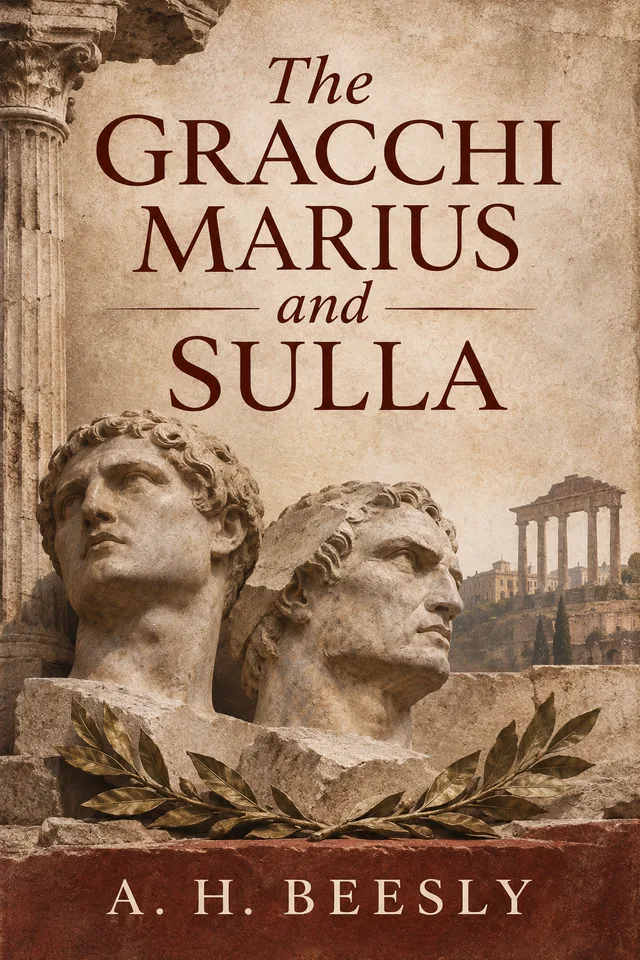
The Gracchi Marius and Sulla
英语 BooksWhale 版本 · A. H. Beesly
A study of the late Roman Republic from the land reforms of the Gracchi to Sulla’s dictatorship and institutional changes.
- 预览
- 文本节选
- 格式
- 在线阅读, EPUB, PDF
- 访问
- Library 获取
图书简介
The Gracchi Marius and Sulla
Beesly opens with the pressures created by Roman conquest and then follows the careers of Tiberius and Gaius Gracchus, Marius and Sulla. The narrative connects landholding and citizenship to the rivalry of generals and the outbreak of civil war. Its closing chapter examines the offices, courts and laws that Sulla tried to leave behind.
BooksWhale 版本
此版本如何整理
此版本基于公版文本,并由 BooksWhale 整理为适合数字阅读的版本。
公版依据
为什么此版本可以分享
A. H. Beesly died in 1909. This edition uses the historical English text of the work, published in 1877 and digitized by Project Gutenberg.
阅读预览
文本节选
预览选自整理后的阅读文本。
预览章节PREFACE阅读预览
It would be scarcely possible for anyone writing on the period embraced in this volume, to perform his task adequately without making himself familiar with Mr. Long's 'History of the Decline of the Roman Republic' and Mommsen's 'History of Rome.' To do over again (as though the work had never been attempted) what has been done once for all accurately and well, would be mere prudery of punctiliousness. But while I acknowledge my debt of gratitude to both these eminent historians, I must add that for the whole period I have carefully examined the original authorities, often coming to conclusions widely differing from those of Mr. Long. And I venture to hope that from the advantage I have had in being able to compare the works of two writers, one of whom has well-nigh exhausted the theories as the other has the facts of the subject, I have succeeded in giving a more consistent and faithful account of the leaders and legislation of the revolutionary era than has hitherto been written. Certainly there could be no more instructive commentary on either history than the study of the other, for each supplements the other and emphasizes its defects. If Mommsen at times pushes conjecture to the verge of invention, as in his account of the junction of the Helvetii and Cimbri, Mr. Long, in his dogged determination never to swerve from facts to inference, falls into the opposite extreme, resorting to somewhat Cyclopean architecture in his detestation of stucco. But my admiration for his history is but slightly qualified by such considerations, and to any student who may be stimulated by the volumes of this series to acquire what would virtually amount to an acquaintance first-hand with the narratives of ancient writers, I would say 'Read Mr. Long's history.' To do so is to learn not only knowledge but a lesson in historical study generally. For the writings of a man with whom style is not the first object are as refreshing as his scorn for romancing history is wholesome, and the grave irony with which he records its slips amusing.
A.H.B.
预览章节CHAPTER I. · ANTECEDENTS OF THE REVOLUTION.预览
During the last half of the second century before Christ Rome was undisputed mistress of the civilised world. A brilliant period of foreign conquest had succeeded the 300 years in which she had overcome her neighbours and made herself supreme in Italy. In 146 B.C. she had given the death-blow to her greatest rival, Carthage, and had annexed Greece. In 140 treachery had rid her of Viriathus, the stubborn guerilla who defied her generals and defeated her armies in Spain. In 133 the terrible fate of Numantia, and in 132 the merciless suppression of the Sicilian slave-revolt, warned all foes of the Republic that the sword, which the incompetence of many generals had made seem duller than of old, was still keen to smite; and except where some slave-bands were in desperate rebellion, and in Pergamus, where a pretender disputed with Rome the legacy of Attalus, every land along the shores of the Mediterranean was subject to or at the mercy of a town not half as large as the London of to-day. Almost exactly a century afterwards the Government under which this gigantic empire had been consolidated was no more.
Foreign wars will have but secondary importance in the following pages. The interest of the narrative centres mainly in home politics; and though the world did not cease to echo to the tramp of conquering legions, and the victorious soldier became a more and more important factor in the State, still military matters no longer, as in the Samnite and Punic wars, absorb the attention, dwarfed as they are by the great social struggle of which the metropolis was the arena. In treating of the first half of those hundred years of revolution, which began with the tribunate of Tiberius Gracchus and ended with the battle of Actium, it is mainly the fall of the Republican and the foreshadowing of the Imperial system of government which have to be described. But, in order to understand rightly the events of those fifty years, some survey, however brief, of the previous history of the Roman orders is indispensable.
When the mists of legend clear away we see a community which, if we do not take slaves into account, consisted of two parts—the governing body, or patres, to whom alone the term Populus Romanus strictly applied, and who constituted the Roman State, and the governed class, or clientes, who were outside its pale. The word patrician, more familiar to our ear than the substantive from which it is formed, came to imply much more than its original meaning. In its simplest and earliest sense it was applied to a man who was sprung from a Roman marriage, who stood towards his client on much the same footing which, in the mildest form of slavery, a master occupies towards his slave. As the patronus was to the libertus, when it became customary to liberate slaves, so in some measure were the Fathers to their retainers, the Clients. That the community was originally divided into these two sections is known. What is not known is how, besides this primary division of patres and clientes, there arose a second political class in the State, namely the plebs. The client as client had no political existence. But as a plebeian he had. Whether the plebs was formed of clients who had been released from their clientship, just as slaves might be manumitted; or of foreigners, as soldiers, traders, or artisans were admitted into the community; or partly of foreigners and partly of clients, the latter being equalised by the patres with the former in self-defence; and whether as a name it dated from or was antecedent to the so-called Tullian organization is uncertain. But we know that in one way or other a second political division in the State arose and that the constitution, of which Servius Tullius was the reputed author, made every freeman in Rome a citizen by giving him a vote in the Comitia Centuriata. Yet though the plebeian was a citizen, and as such acquired 'commercium,' or the right to hold and devise property, it was only after a prolonged struggle that he achieved political equality with the patres. Step by step he wrung from them the rights of intermarriage and of filling offices of state; and the great engine by which this was brought about was the tribunate, the historical importance of which dates from, even though as a plebeian magistracy it may have existed before, the first secession of the plebs in 494 B.C. The tribunate stood towards the freedom of the Roman people in something of the same relation which the press of our time occupies towards modern liberty: for its existence implied free criticism of the executive, and out of free speech grew free action.
预览章节CHAPTER II. · TIBERIUS GRACCHUS.预览
General expectation would have pointed to Scipio Aemilianus, the conqueror of Numantia and Carthage, and the foremost man at Rome. He was well-meaning and more than ordinarily able, strict and austere as a general, and as a citizen uniting Greek culture with the old Roman simplicity of life. He was full of scorn of the rabble, and did not scruple to express it. 'Silence,' he cried, when he was hissed for what he said about his brother-in-law's death, 'you step-children of Italy!' and when this enraged them still more, he went on: 'Do you think I shall fear you whom I brought to Italy in fetters now that you are loose?' He showed equal scorn for such pursuits as at Rome at least were associated with effeminacy and vice, and expressed in lively language his dislike of singing and dancing. 'Our children are taught disgraceful tricks. They go to actors' schools with sambucas and psalteries. They learn to sing—a thing which our ancestors considered to be a disgrace to freeborn children. When I was told this I could not believe that men of noble rank allowed their children to be taught such things. But being taken to a dancing school I saw—I did upon my honour—more than fifty boys and girls in the school; and among them one boy, quite a child, about twelve years of age, the son of a man who was at that time a candidate for office. And what I saw made me pity the Commonwealth. I saw the child dancing to the castanets, and it was a dance which one of our wretched, shameless slaves would not have danced.' On another occasion he showed a power of quick retort. As censor he had degraded a man named Asellus, whom Mummius afterwards restored to the equites. Asellus impeached Scipio, and taunted him with the unluckiness of his censorship—its mortality, &c. 'No wonder,' said Scipio, 'for the man who inaugurated it rehabilitated you.'
Such anecdotes show that he was a vigorous speaker. He was of a healthy constitution, temperate, brave, and honest in money matters; for he led a simple life, and with all his opportunities for extortion did not die rich. Polybius, the historian, Panaetius, the philosopher, Terence and Lucilius, the poets, and the orator and politician Laelius were his friends. From his position, his talents, and his associations, he seemed marked out as the one man who could and would desire to step forth as the saviour of his country. But such self-sacrifice is not exhibited by men of Scipio's type. Too able to be blind to the signs of the times, they are swayed by instincts too strong for their convictions. An aristocrat of aristocrats, Scipio was a reformer only so far as he thought reform might prolong the reign of his order. From any more radical measures he shrank with dislike, if not with fear. The weak spot often to be found in those cultured aristocrats who coquet with liberalism was fatal to his chance of being a hero. He was a trimmer to the core, who, without intentional dishonesty, stood facing both ways till the hour came when he was forced to range himself on one side or the other, and then he took the side which he must have known to be the wrong one. Palliation of the errors of a man placed in so terribly difficult a position is only just; but laudation of his statesmanship seems absurd. As a statesman he carried not one great measure, and if one was conceived in his circle, he cordially approved of its abandonment. To those who claim for him that he saw the impossibility of those changes which his brother-in-law advocated, it is sufficient to reply that Rome did not rest till those changes had been adopted, and that the hearty co-operation of himself and his friends would have gone far to turn failure into success. But his mind was too narrow to break through the associations which had environed him from his childhood. When Tiberius Gracchus, a nobler man than himself, had suffered martyrdom for the cause with which he had only dallied, he was base enough to quote from Homer [Greek: os apoloito kai allos hotis toiaita ge hoezoi]—'So perish all who do the like again.'
目录
本版本内容
- 01PREFACE
- 02CHAPTER I. · ANTECEDENTS OF THE REVOLUTION.
- 03CHAPTER II. · TIBERIUS GRACCHUS.
- 04CHAPTER III. · CAIUS GRACCHUS.
- 05CHAPTER IV. · THE JUGURTHINE WAR.
- 06CHAPTER V. · THE CIMBRI AND TEUTONES.
- 07CHAPTER VI. · THE ROMAN ARMY.
- 08CHAPTER VII. · SATURNINUS AND DRUSUS.
- 09CHAPTER VIII. · THE SOCIAL WAR
- 10CHAPTER IX. · SULPICIUS.
- 11CHAPTER X. · MARIUS AND CINNA.
- 12CHAPTER XI. · THE FIRST MITHRIDATIC WAR.
- 13CHAPTER XII. · SULLA IN GREECE AND ASIA.
- 14CHAPTER XIII. · SULLA IN ITALY.
- 15CHAPTER XIV. · THE PERSONAL RULE AND DEATH OF SULLA.
- 16CHAPTER XV. · SULLA'S REACTIONARY MEASURES.