英语 版本
历史
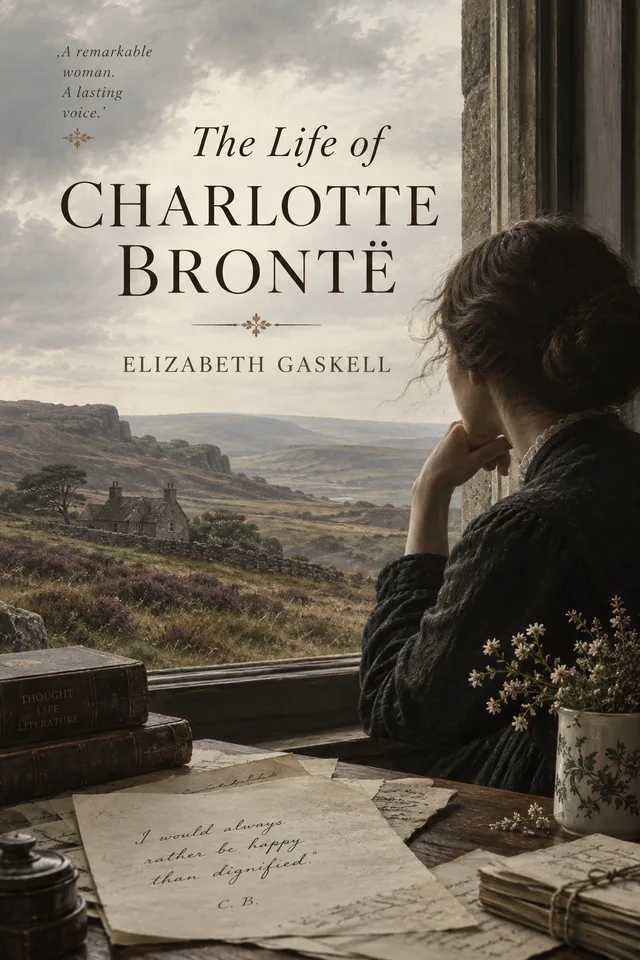
The Life of Charlotte Brontë
英语 BooksWhale 版本 · Elizabeth Gaskell
原题: Life of Charlotte Brontë
The pioneering biography of Charlotte Brontë, her family, Haworth life, literary ambition, illness, and grief.
- 预览
- 文本节选
- 格式
- 在线阅读, EPUB, PDF
- 访问
- Library 获取
图书简介
The Life of Charlotte Brontë
Elizabeth Gaskell combines personal testimony, family history, and literary portraiture to reconstruct Charlotte Brontë’s world: the Brontë household, Yorkshire isolation, the making of Jane Eyre, and the losses that shaped her life.
BooksWhale 版本
此版本如何整理
此版本基于公版文本,并由 BooksWhale 整理为适合数字阅读的版本。
公版依据
为什么此版本可以分享
Elizabeth Gaskell died in 1865; this English biography was first published in 1857 and is public domain.
阅读预览
文本节选
预览选自整理后的阅读文本。
预览章节Full text阅读预览
The Life of Charlotte Brontë
Elizabeth Gaskell
预览章节THE LIFE OF CHARLOTTE BRONTË—VOLUME 1预览
THE LIFE OF CHARLOTTE BRONTË—VOLUME 1
预览章节CHAPTER I预览
The Leeds and Skipton railway runs along a deep valley of the Aire; a slow and sluggish stream, compared to the neighbouring river of Wharfe. Keighley station is on this line of railway, about a quarter of a mile from the town of the same name. The number of inhabitants and the importance of Keighley have been very greatly increased during the last twenty years, owing to the rapidly extended market for worsted manufactures, a branch of industry that mainly employs the factory population of this part of Yorkshire, which has Bradford for its centre and metropolis.
Keighley is in process of transformation from a populous, old-fashioned village, into a still more populous and flourishing town. It is evident to the stranger, that as the gable-ended houses, which obtrude themselves corner-wise on the widening street, fall vacant, they are pulled down to allow of greater space for traffic, and a more modern style of architecture. The quaint and narrow shop-windows of fifty years ago, are giving way to large panes and plate-glass. Nearly every dwelling seems devoted to some branch of commerce. In passing hastily through the town, one hardly perceives where the necessary lawyer and doctor can live, so little appearance is there of any dwellings of the professional middle-class, such as abound in our old cathedral towns. In fact, nothing can be more opposed than the state of society, the modes of thinking, the standards of reference on all points of morality, manners, and even politics and religion, in such a new manufacturing place as Keighley in the north, and any stately, sleepy, picturesque cathedral town in the south. Yet the aspect of Keighley promises well for future stateliness, if not picturesqueness. Grey stone abounds; and the rows of houses built of it have a kind of solid grandeur connected with their uniform and enduring lines. The frame-work of the doors, and the lintels of the windows, even in the smallest dwellings, are made of blocks of stone. There is no painted wood to require continual beautifying, or else present a shabby aspect; and the stone is kept scrupulously clean by the notable Yorkshire housewives. Such glimpses into the interior as a passer-by obtains, reveal a rough abundance of the means of living, and diligent and active habits in the women. But the voices of the people are hard, and their tones discordant, promising little of the musical taste that distinguishes the district, and which has already furnished a Carrodus to the musical world. The names over the shops (of which the one just given is a sample) seem strange even to an inhabitant of the neighbouring county, and have a peculiar smack and flavour of the place.
The town of Keighley never quite melts into country on the road to Haworth, although the houses become more sparse as the traveller journeys upwards to the grey round hills that seem to bound his journey in a westerly direction. First come some villas; just sufficiently retired from the road to show that they can scarcely belong to any one liable to be summoned in a hurry, at the call of suffering or danger, from his comfortable fireside; the lawyer, the doctor, and the clergyman, live at hand, and hardly in the suburbs, with a screen of shrubs for concealment.
In a town one does not look for vivid colouring; what there may be of this is furnished by the wares in the shops, not by foliage or atmospheric effects; but in the country some brilliancy and vividness seems to be instinctively expected, and there is consequently a slight feeling of disappointment at the grey neutral tint of every object, near or far off, on the way from Keighley to Haworth. The distance is about four miles; and, as I have said, what with villas, great worsted factories, rows of workmen’s houses, with here and there an old-fashioned farmhouse and out-buildings, it can hardly be called “country” any part of the way. For two miles the road passes over tolerably level ground, distant hills on the left, a “beck” flowing through meadows on the right, and furnishing water power, at certain points, to the factories built on its banks. The air is dim and lightless with the smoke from all these habitations and places of business. The soil in the valley (or “bottom,” to use the local term) is rich; but, as the road begins to ascend, the vegetation becomes poorer; it does not flourish, it merely exists; and, instead of trees, there are only bushes and shrubs about the dwellings. Stone dykes are everywhere used in place of hedges; and what crops there are, on the patches of arable land, consist of pale, hungry-looking, grey green oats. Right before the traveller on this road rises Haworth village; he can see it for two miles before he arrives, for it is situated on the side of a pretty steep hill, with a back-ground of dun and purple moors, rising and sweeping away yet higher than the church, which is built at the very summit of the long narrow street. All round the horizon there is this same line of sinuous wave-like hills; the scoops into which they fall only revealing other hills beyond, of similar colour and shape, crowned with wild, bleak moors—grand, from the ideas of solitude and loneliness which they suggest, or oppressive from the feeling which they give of being pent-up by some monotonous and illimitable barrier, according to the mood of mind in which the spectator may be.
目录
本版本内容
- 01Full text
- 02THE LIFE OF CHARLOTTE BRONTË—VOLUME 1
- 03CHAPTER I
- 04CHAPTER II
- 05CHAPTER III
- 06I return to the father’s letter. He says:—
- 07CHAPTER IV
- 08CHAPTER V
- 09CATALOGUE OF MY BOOKS, WITH THE PERIOD OF THEIR COMPLETION, UP TO AUGUST 3RD, 1830.
- 10C. BRONTË, August 3, 1830
- 11THE HISTORY OF THE YEAR 1829.
- 12THE WOUNDED STAG.
- 13CHAPTER VI
- 14CHAPTER VII
- 15* * * * *
- 16CHAPTER VIII
- 17(TO EMILY, ABOUT THIS TIME.)
- 18On the 14th of August she still writes from Haworth:—
- 19CHAPTER IX
- 20C. B. C. B. C. B. C. B.
- 21CHAPTER X
- 22C. B.
- 23CHAPTER XI
- 24PHILLIPPO IIII. HISPAN. REGE. ISABELLA-CLARA-EUGENIA HISPAN. INFANS. MAGNÆ GULDÆ REGINA GULDÆ FRATRIBUS POSUIT.
- 25IMITATION.
- 26PORTRAIT DE PIERRE L’HERMITE. CHARLOTTE BRONTË
- 27{Vous avez commencé à parler de Pierre: vous êtes entrée dans le sujet: marchez au but.}
- 28CHAPTER XII
- 29On March 6th, 1843, she writes thus:—
- 30On the 23rd of the month she writes as follows:—
- 31CHAPTER XIII
- 32Again, at a later date, July 24th, in the same year, she writes:—
- 33A month later, she says:—
- 34CHAPTER XIV
- 35She writes again on February 15th; and on the 16th she says:—
- 36But few, I fear; for, three days later, she wrote the following:—
- 37On July 23rd she writes to the Messrs. Aylott:—