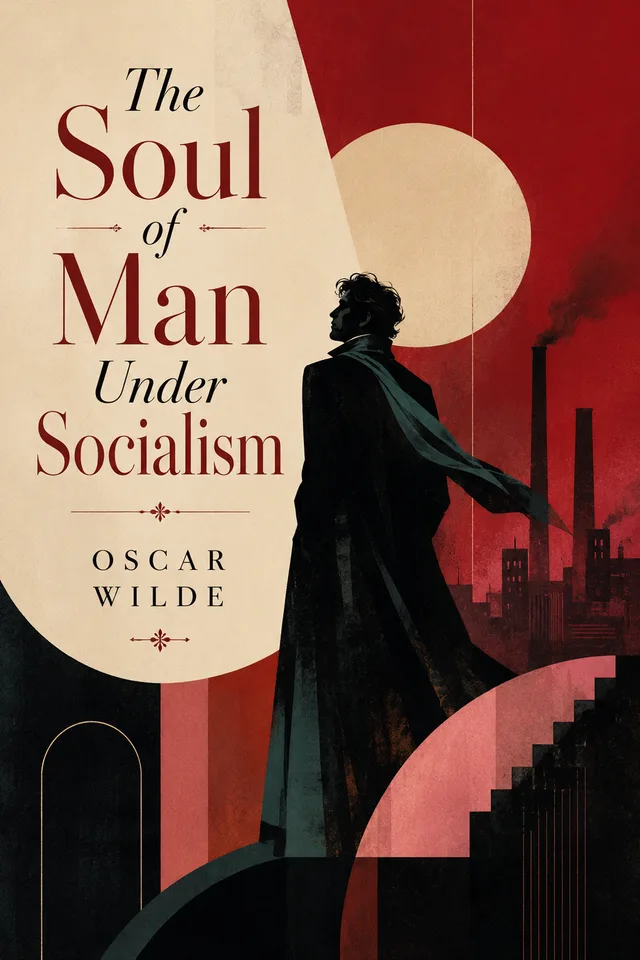
英语 版本
政治
The Soul of Man Under Socialism
英语 BooksWhale 版本 · Oscar Wilde
A public-domain classic on individualism, art, poverty, freedom, charity, and social criticism.
- 预览
- 文本节选
- 格式
- 在线阅读, EPUB, PDF
- 访问
- Library 获取
图书简介
The Soul of Man Under Socialism
The Soul of Man Under Socialism by Oscar Wilde remains a rewarding classic for readers interested in individualism, art, poverty, freedom, charity, and social criticism. This English edition presents the original public-domain text in a clean BooksWhale format for online reading, EPUB, and PDF, with the work’s historical context and literary value kept clear.
BooksWhale 版本
此版本如何整理
此版本基于公版文本,并由 BooksWhale 整理为适合数字阅读的版本。
公版依据
为什么此版本可以分享
The Soul of Man Under Socialism was first published in 1891. This edition uses the public-domain English original text, with publication date and rights status supporting public-domain use.
阅读预览
文本节选
预览选自整理后的阅读文本。
预览章节Full text阅读预览
The Soul of Man Under Socialism
Oscar Wilde
预览章节Part 1预览
[Picture: Book cover]
THE
SOUL OF MAN
LONDON
ARTHUR L. HUMPREYS
1900
_Second Impression_
THE SOUL OF MAN
预览章节Part 2预览
THE chief advantage that would result from the establishment of Socialism is, undoubtedly, the fact that Socialism would relieve us from that sordid necessity of living for others which, in the present condition of things, presses so hardly upon almost everybody. In fact, scarcely anyone at all escapes.
Now and then, in the course of the century, a great man of science, like Darwin; a great poet, like Keats; a fine critical spirit, like M. Renan; a supreme artist, like Flaubert, has been able to isolate himself, to keep himself out of reach of the clamorous claims of others, to stand ‘under the shelter of the wall,’ as Plato puts it, and so to realise the perfection of what was in him, to his own incomparable gain, and to the incomparable and lasting gain of the whole world. These, however, are exceptions. The majority of people spoil their lives by an unhealthy and exaggerated altruism—are forced, indeed, so to spoil them. They find themselves surrounded by hideous poverty, by hideous ugliness, by hideous starvation. It is inevitable that they should be strongly moved by all this. The emotions of man are stirred more quickly than man’s intelligence; and, as I pointed out some time ago in an article on the function of criticism, it is much more easy to have sympathy with suffering than it is to have sympathy with thought. Accordingly, with admirable, though misdirected intentions, they very seriously and very sentimentally set themselves to the task of remedying the evils that they see. But their remedies do not cure the disease: they merely prolong it. Indeed, their remedies are part of the disease.
They try to solve the problem of poverty, for instance, by keeping the poor alive; or, in the case of a very advanced school, by amusing the poor.
But this is not a solution: it is an aggravation of the difficulty. The proper aim is to try and reconstruct society on such a basis that poverty will be impossible. And the altruistic virtues have really prevented the carrying out of this aim. Just as the worst slave-owners were those who were kind to their slaves, and so prevented the horror of the system being realised by those who suffered from it, and understood by those who contemplated it, so, in the present state of things in England, the people who do most harm are the people who try to do most good; and at last we have had the spectacle of men who have really studied the problem and know the life—educated men who live in the East End—coming forward and imploring the community to restrain its altruistic impulses of charity, benevolence, and the like. They do so on the ground that such charity degrades and demoralises. They are perfectly right. Charity creates a multitude of sins.
There is also this to be said. It is immoral to use private property in order to alleviate the horrible evils that result from the institution of private property. It is both immoral and unfair.
Under Socialism all this will, of course, be altered. There will be no people living in fetid dens and fetid rags, and bringing up unhealthy, hunger-pinched children in the midst of impossible and absolutely repulsive surroundings. The security of society will not depend, as it does now, on the state of the weather. If a frost comes we shall not have a hundred thousand men out of work, tramping about the streets in a state of disgusting misery, or whining to their neighbours for alms, or crowding round the doors of loathsome shelters to try and secure a hunch of bread and a night’s unclean lodging. Each member of the society will share in the general prosperity and happiness of the society, and if a frost comes no one will practically be anything the worse.
Upon the other hand, Socialism itself will be of value simply because it will lead to Individualism.
目录
本版本内容
- 01Full text
- 02Part 1
- 03Part 2
- 04Part 3
- 05Part 4
- 06Part 5
- 07Part 6
- 08Part 7
- 09Part 8