英语 版本
科学
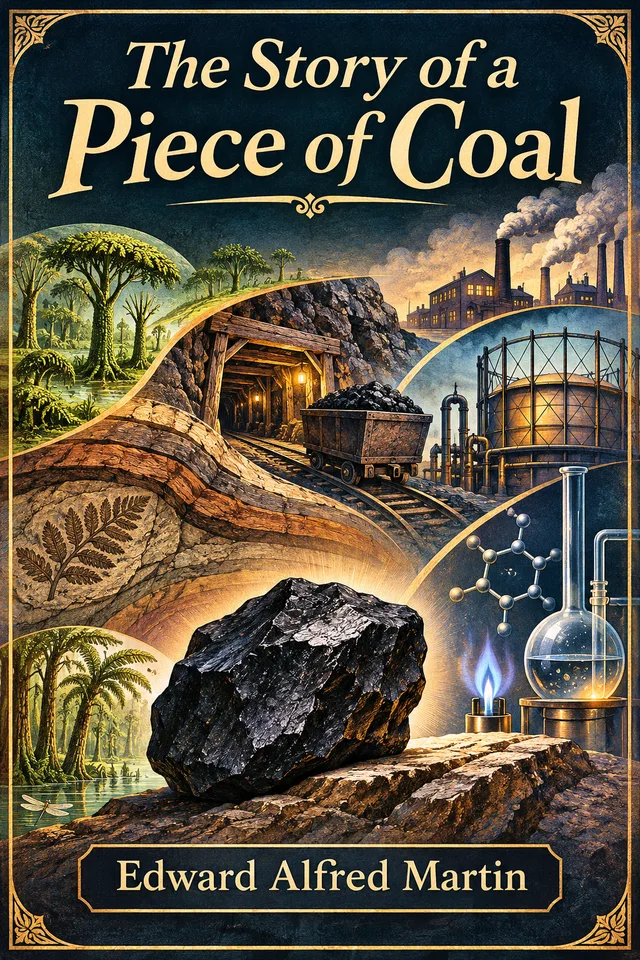
The Story of a Piece of Coal
英语 BooksWhale 版本 · Edward Alfred Martin
A nineteenth-century account follows coal from prehistoric vegetation through mining, gas production, chemical dyes and industrial use.
- 预览
- 文本节选
- 格式
- 在线阅读, EPUB, PDF
- 访问
- Library 获取
图书简介
The Story of a Piece of Coal
Edward Alfred Martin explains how ancient plants became coal and how that material supported an expanding industrial world. Eight chapters move from fossil vegetation and geological strata to mines, fuel consumption, gas manufacture, petroleum substitutes and coal-tar colours. Written in 1896, the book records the scientific explanations, technologies and resource expectations of its period, linking natural history with the industrial processes surrounding an apparently ordinary lump of fuel.
BooksWhale 版本
此版本如何整理
此版本基于公版文本,并由 BooksWhale 整理为适合数字阅读的版本。
公版依据
为什么此版本可以分享
Edward Alfred Martin died in 1943; this work was first published in 1896. This edition uses the historical English text supplied by Project Gutenberg, with later editorial matter and annotations removed.
阅读预览
文本节选
预览选自整理后的阅读文本。
预览章节Full text阅读预览
The Story of a Piece of Coal
Edward Alfred Martin
预览章节CHAPTER I. THE ORIGIN OF COAL AND THE PLANTS OF WHICH IT IS COMPOSED.预览
From the homely scuttle of coal at the side of the hearth to the gorgeously verdant vegetation of a forest of mammoth trees, might have appeared a somewhat far cry in the eyes of those who lived some fifty years ago. But there are few now who do not know what was the origin of the coal which they use so freely, and which in obedience to their demand has been brought up more than a thousand feet from the bowels of the earth; and, although familiarity has in a sense bred contempt for that which a few shillings will always purchase, in all probability a stray thought does occasionally cross one's mind, giving birth to feelings of a more or less thankful nature that such a store of heat and light was long ago laid up in this earth of ours for our use, when as yet man was not destined to put in an appearance for many, many ages to come. We can scarcely imagine the industrial condition of our country in the absence of so fortunate a supply of coal; and the many good things which are obtained from it, and the uses to which, as we shall see, it can be put, do indeed demand recognition.
Were our present forests uprooted and overthrown, to be covered by sedimentary deposits such as those which cover our coal-seams, the amount of coal which would be thereby formed for use in some future age, would amount to a thickness of perhaps two or three inches at most, and yet, in one coal-field alone, that of Westphalia, the 117 most important seams, if placed one above the other in immediate succession, would amount to no less than 294 feet of coal. From this it is possible to form a faint idea of the enormous growths of vegetation required to form some of our representative coal beds. But the coal is not found in one continuous bed. These numerous seams of coal are interspersed between many thousands of feet of sedimentary deposits, the whole of which form the "coal-measures." Now, each of these seams represents the growth of a forest, and to explain the whole series it is necessary to suppose that between each deposit the land became overwhelmed by the waters of the sea or lake, and after a long subaqueous period, was again raised into dry land, ready to become the birth-place of another forest, which would again beget, under similarly repeated conditions, another seam of coal. Of the conditions necessary to bring these changes about we will speak later on, but this instance is sufficient to show how inadequate the quantity of fuel would be, were we dependent entirely on our own existing forest growths.
However, we will leave for the present the fascinating pursuit of theorising as to the how and wherefore of these vast beds of coal, relegating the geological part of the study of the carboniferous system to a future chapter, where will be found some more detailed account of the position of the coal-seams in the strata which contain them. At present the actual details of the coal itself will demand our attention.
Coal is the mineral which has resulted, after the lapse of thousands of thousands of years, from the accumulations of vegetable material, caused by the steady yearly shedding of leaves, fronds and spores, from forests which existed in an early age; these accumulated where the trees grew that bore them, and formed in the first place, perhaps, beds of peat; the beds have since been subjected to an ever-increasing pressure of accumulating strata above them, compressing the sheddings of a whole forest into a thickness in some cases of a few inches of coal, and have been acted upon by the internal heat of the earth, which has caused them to part, to a varying degree, with some of their component gases. If we reason from analogy, we are compelled to admit that the origin of coal is due to the accumulation of vegetation, of which more scattered, but more distinct, representative specimens occur in the shales and clays above and below the coal-seams. But we are also able to examine the texture itself of the various coals by submitting extremely thin slices to a strong light under the microscope, and are thus enabled to decide whether the particular coal we are examining is formed of conifers, horse-tails, club-mosses, or ferns, or whether it consists simply of the accumulated sheddings of all, or perhaps, as in some instances, of innumerable spores.
预览章节CHAPTER II. A GENERAL VIEW OF THE COAL-BEARING STRATA.预览
In considering the source whence coal is derived, we must be careful to remember that coal itself is but a minor portion of the whole formation in which it occurs. The presence of coal has indeed given the name to the formation, the word "carboniferous" meaning "coal-bearing," but in taking a comprehensive view of the position which it occupies in the bowels of the earth, it will be necessary to take into consideration the strata in which it is found, and the conditions, so far as are known, under which these were deposited.
Geologically speaking, the Carboniferous formation occurs near the close of that group of systems which have been classed as "palaeozoic," younger in point of age than the well known Devonian and Old Red Sandstone strata, but older by far than the Oolites, the Wealden, or the Cretaceous strata.
In South Wales the coal-bearing strata have been estimated at between 11,000 and 12,000 feet, yet amongst this enormous thickness of strata, the whole of the various coal-seams, if taken together, probably does not amount to more than 120 feet. This great disproportion between the total thickness and the thickness of coal itself shows itself in every coal-field that has been worked, and when a single seam of coal is discovered attaining a thickness of 9 or 10 feet, it is so unusual a thing in Great Britain as to cause it to be known as the "nine" or "ten-foot seam," as the case may be. Although abroad many seams are found which are of greater thicknesses, yet similarly the other portions of the formation are proportionately greater.
It is not possible therefore to realise completely the significance of the coal-beds themselves unless there is also a knowledge of the remaining constituents of the whole formation. The strata found in the various coal-fields differ considerably amongst themselves in character. There are, however, certain well-defined characteristics which find representation in most of the principal coal-fields, whether British or European. Professor Hull classifies these carboniferous beds as follows:--
UPPER CARBONIFEROUS. Upper coal-measures. Reddish and purple sandstones, red and grey clays and shales, thin bands of coal, ironstone and limestone, with spirorbis and fish.
Middle coal-measures. Yellow and gray sandstones, blue and black clays and shales, bands of coal and ironstone, fossil plants, bivalves and fish, occasional marine bands.
MIDDLE CARBONIFEROUS. Gannister beds or Lower coal-measures. Millstone grit. Flagstone series in Ireland. Yoredale beds. Upper shale series of Ireland.
LOWER CARBONIFEROUS. Mountain limestone. Limestone shale.
Each of the three principal divisions has its representative in Scotland, Belgium, and Ireland, but, unfortunately for the last-named country, the whole of the upper coal-measures are there absent. It is from these measures that almost all our commercial coals are obtained.
This list of beds might be further curtailed for all practical purposes of the geologist, and the three great divisions of the system would thus stand:--
Upper Carboniferous, or Coal-measures proper.
Millstone grit.
Lower Carboniferous, or Mountain limestone.
In short, the formation consists of masses of sandstone, shale, limestone and coal, these also enclosing clays and ironstones, and, in the limestone, marbles and veins of the ores of lead, zinc, and antimony, and occasionally silver.
As the most apparent of the rocks of the system are sandstone, shale, limestone, and coal, it will be necessary to consider how these were deposited in the waters of the carboniferous ages, and this we can best do by considering the laws under which strata of a similar nature are now being deposited as sedimentary beds.
A great proportion consists of sandstone. Now sandstone is the result of sand which has been deposited in large quantities, having become indurated or hardened by various processes brought to bear upon it. It is necessary, therefore, first to ascertain whence came the sand, and whether there are any peculiarities in its method of deposition which will explain its stratification. It will be noticed at once that it bears a considerable amount of evidence of what is called "current-bedding," that is to say, that the strata, instead of being regularly deposited, exhibit series of wedge-shaped masses, which are constantly thinning out.
目录
本版本内容
- 01Full text
- 02CHAPTER I. THE ORIGIN OF COAL AND THE PLANTS OF WHICH IT IS COMPOSED.
- 03CHAPTER II. A GENERAL VIEW OF THE COAL-BEARING STRATA.
- 04CHAPTER III. VARIOUS FORMS OF COAL AND CARBON.
- 05CHAPTER IV. THE COAL-MINE AND ITS DANGERS.
- 06CHAPTER V. EARLY HISTORY--ITS USE AND ITS ABUSE.
- 07CHAPTER VI. HOW GAS IS MADE--ILLUMINATING OILS AND BYE-PRODUCTS.
- 08CHAPTER VII. THE COAL SUPPLIES OF THE WORLD.
- 09CHAPTER VIII. THE COAL-TAR COLOURS.