英语 版本
文学
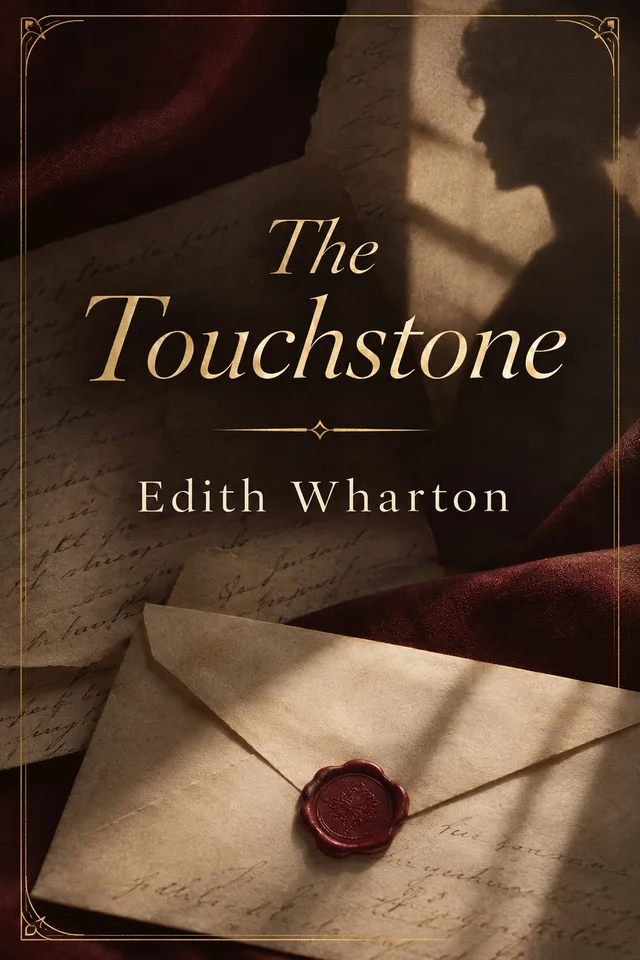
The Touchstone
英语 BooksWhale 版本 · Edith Wharton
A man sells a dead novelist’s private letters, then confronts the moral cost within his marriage and his memories.
- 预览
- 文本节选
- 格式
- 在线阅读, EPUB, PDF
- 访问
- Library 获取
图书简介
The Touchstone
Stephen Glennard discovers that letters once sent to him by the celebrated novelist Margaret Aubyn have become valuable. Selling them anonymously promises the money he needs to marry, but the transaction turns an intimate relationship into a public commodity. Edith Wharton’s novella traces the consequences through Glennard’s marriage to Alexa, testing the boundaries between possession, betrayal, remorse, and another person’s capacity to forgive.
BooksWhale 版本
此版本如何整理
此版本基于公版文本,并由 BooksWhale 整理为适合数字阅读的版本。
公版依据
为什么此版本可以分享
Edith Wharton died in 1937. This edition uses the public-domain English text supplied by Project Gutenberg, without later editorial introductions or notes.
阅读预览
文本节选
预览选自整理后的阅读文本。
预览章节Full text阅读预览
The Touchstone
预览章节I预览
“Professor Joslin, who, as our readers are doubtless aware, is engaged in writing the life of Mrs. Aubyn, asks us to state that he will be greatly indebted to any of the famous novelist’s friends who will furnish him with information concerning the period previous to her coming to England. Mrs. Aubyn had so few intimate friends, and consequently so few regular correspondents, that letters will be of special value. Professor Joslin’s address is 10 Augusta Gardens, Kensington, and he begs us to say that he will promptly return any documents entrusted to him.”
Glennard dropped the Spectator and sat looking into the fire. The club was filling up, but he still had to himself the small inner room, with its darkening outlook down the rain-streaked prospect of Fifth Avenue. It was all dull and dismal enough, yet a moment earlier his boredom had been perversely tinged by a sense of resentment at the thought that, as things were going, he might in time have to surrender even the despised privilege of boring himself within those particular four walls. It was not that he cared much for the club, but that the remote contingency of having to give it up stood to him, just then, perhaps by very reason of its insignificance and remoteness, for the symbol of his increasing abnegations; of that perpetual paring-off that was gradually reducing existence to the naked business of keeping himself alive. It was the futility of his multiplied shifts and privations that made them seem unworthy of a high attitude; the sense that, however rapidly he eliminated the superfluous, his cleared horizon was likely to offer no nearer view of the one prospect toward which he strained. To give up things in order to marry the woman one loves is easier than to give them up without being brought appreciably nearer to such a conclusion.
Through the open door he saw young Hollingsworth rise with a yawn from the ineffectual solace of a brandy-and-soda and transport his purposeless person to the window. Glennard measured his course with a contemptuous eye. It was so like Hollingsworth to get up and look out of the window just as it was growing too dark to see anything! There was a man rich enough to do what he pleased—had he been capable of being pleased—yet barred from all conceivable achievement by his own impervious dulness; while, a few feet off, Glennard, who wanted only enough to keep a decent coat on his back and a roof over the head of the woman he loved Glennard, who had sweated, toiled, denied himself for the scant measure of opportunity that his zeal would have converted into a kingdom—sat wretchedly calculating that, even when he had resigned from the club, and knocked off his cigars, and given up his Sundays out of town, he would still be no nearer attainment.
The Spectator had slipped to his feet and as he picked it up his eye fell again on the paragraph addressed to the friends of Mrs. Aubyn. He had read it for the first time with a scarcely perceptible quickening of attention: her name had so long been public property that his eye passed it unseeingly, as the crowd in the street hurries without a glance by some familiar monument.
“Information concerning the period previous to her coming to England....” The words were an evocation. He saw her again as she had looked at their first meeting, the poor woman of genius with her long pale face and short-sighted eyes, softened a little by the grace of youth and inexperience, but so incapable even then of any hold upon the pulses. When she spoke, indeed, she was wonderful, more wonderful, perhaps, than when later, to Glennard’s fancy at least, the consciousness of memorable things uttered seemed to take from even her most intimate speech the perfect bloom of privacy. It was in those earliest days, if ever, that he had come near loving her; though even then his sentiment had lived only in the intervals of its expression. Later, when to be loved by her had been a state to touch any man’s imagination, the physical reluctance had, inexplicably, so overborne the intellectual attraction, that the last years had been, to both of them, an agony of conflicting impulses. Even now, if, in turning over old papers, his hand lit on her letters, the touch filled him with inarticulate misery....
预览章节II预览
He dined alone and walked home to his rooms in the rain. As he turned into Fifth Avenue he caught the wet gleam of carriages on their way to the opera, and he took the first side street, in a moment of irritation against the petty restrictions that thwarted every impulse. It was ridiculous to give up the opera, not because one might possibly be bored there, but because one must pay for the experiment.
In his sitting-room, the tacit connivance of the inanimate had centred the lamp-light on a photograph of Alexa Trent, placed, in the obligatory silver frame, just where, as memory officiously reminded him, Margaret Aubyn’s picture had long throned in its stead. Miss Trent’s features cruelly justified the usurpation. She had the kind of beauty that comes of a happy accord of face and spirit. It is not given to many to have the lips and eyes of their rarest mood, and some women go through life behind a mask expressing only their anxiety about the butcher’s bill or their inability to see a joke. With Miss Trent, face and mind had the same high serious contour. She looked like a throned Justice by some grave Florentine painter; and it seemed to Glennard that her most salient attribute, or that at least to which her conduct gave most consistent expression, was a kind of passionate justice—the intuitive feminine justness that is so much rarer than a reasoned impartiality. Circumstances had tragically combined to develop this instinct into a conscious habit. She had seen more than most girls of the shabby side of life, of the perpetual tendency of want to cramp the noblest attitude. Poverty and misfortune had overhung her childhood and she had none of the pretty delusions about life that are supposed to be the crowning grace of girlhood. This very competence, which gave her a touching reasonableness, made Glennard’s situation more difficult than if he had aspired to a princess bred in the purple. Between them they asked so little—they knew so well how to make that little do—but they understood also, and she especially did not for a moment let him forget, that without that little the future they dreamed of was impossible.
The sight of her photograph quickened Glennard’s exasperation. He was sick and ashamed of the part he was playing. He had loved her now for two years, with the tranquil tenderness that gathers depth and volume as it nears fulfilment; he knew that she would wait for him—but the certitude was an added pang. There are times when the constancy of the woman one cannot marry is almost as trying as that of the woman one does not want to.
Glennard turned up his reading-lamp and stirred the fire. He had a long evening before him and he wanted to crowd out thought with action. He had brought some papers from his office and he spread them out on his table and squared himself to the task....
It must have been an hour later that he found himself automatically fitting a key into a locked drawer. He had no more notion than a somnambulist of the mental process that had led up to this action. He was just dimly aware of having pushed aside the papers and the heavy calf volumes that a moment before had bounded his horizon, and of laying in their place, without a trace of conscious volition, the parcel he had taken from the drawer.
The letters were tied in packets of thirty or forty. There were a great many packets. On some of the envelopes the ink was fading; on others, which bore the English post-mark, it was still fresh. She had been dead hardly three years, and she had written, at lengthening intervals, to the last....
He undid one of the earlier packets—little notes written during their first acquaintance at Hillbridge. Glennard, on leaving college, had begun life in his uncle’s law office in the old university town. It was there that, at the house of her father, Professor Forth, he had first met the young lady then chiefly distinguished for having, after two years of a conspicuously unhappy marriage, returned to the protection of the paternal roof.
目录
本版本内容
- 01Full text
- 02I
- 03II
- 04III
- 05IV
- 06V
- 07VI
- 08VII
- 09VIII
- 10IX
- 11X
- 12XI
- 13XII
- 14XIII
- 15XIV