英语 版本
政治
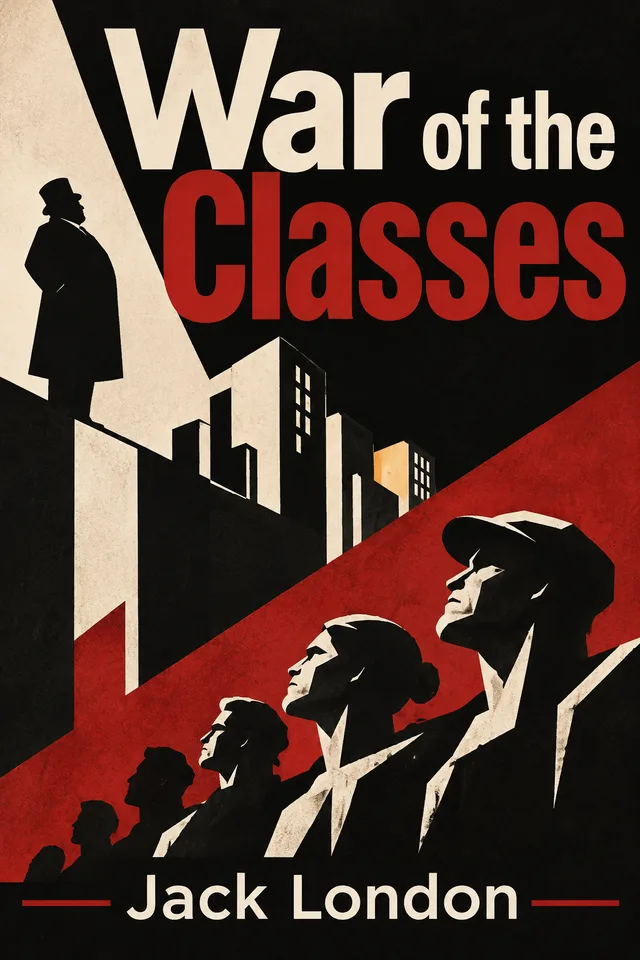
War of the Classes
英语 BooksWhale 版本 · Jack London
Jack London examines class conflict, socialism, industrial power, and working lives through seven forceful essays and an author’s preface.
- 预览
- 文本节选
- 格式
- 在线阅读, EPUB, PDF
- 访问
- Library 获取
图书简介
War of the Classes
In War of the Classes, Jack London sets out his views on capitalism, labor, and the possibility of social transformation. The seven essays range from arguments about competition and political organization to personal accounts of work and his adoption of socialism. The collection offers direct access to the social convictions behind much of his fiction.
BooksWhale 版本
此版本如何整理
此版本基于公版文本,并由 BooksWhale 整理为适合数字阅读的版本。
公版依据
为什么此版本可以分享
Jack London died in 1916. This edition uses the original English text supplied by Project Gutenberg, identified there as public domain in the United States, without added illustrations or editorial notes.
阅读预览
文本节选
预览选自整理后的阅读文本。
预览章节Full text阅读预览
War of the Classes
Jack London
预览章节PREFACE预览
When I was a youngster I was looked upon as a weird sort of creature, because, forsooth, I was a socialist. Reporters from local papers interviewed me, and the interviews, when published, were pathological studies of a strange and abnormal specimen of man. At that time (nine or ten years ago), because I made a stand in my native town for municipal ownership of public utilities, I was branded a “red-shirt,” a “dynamiter,” and an “anarchist”; and really decent fellows, who liked me very well, drew the line at my appearing in public with their sisters.
But the times changed. There came a day when I heard, in my native town, a Republican mayor publicly proclaim that “municipal ownership was a fixed American policy.” And in that day I found myself picking up in the world. No longer did the pathologist study me, while the really decent fellows did not mind in the least the propinquity of myself and their sisters in the public eye. My political and sociological ideas were ascribed to the vagaries of youth, and good-natured elderly men patronized me and told me that I would grow up some day and become an unusually intelligent member of the community. Also they told me that my views were biassed by my empty pockets, and that some day, when I had gathered to me a few dollars, my views would be wholly different,—in short, that my views would be their views.
And then came the day when my socialism grew respectable,—still a vagary of youth, it was held, but romantically respectable. Romance, to the bourgeois mind, was respectable because it was not dangerous. As a “red-shirt,” with bombs in all his pockets, I was dangerous. As a youth with nothing more menacing than a few philosophical ideas, Germanic in their origin, I was an interesting and pleasing personality.
Through all this experience I noted one thing. It was not I that changed, but the community. In fact, my socialistic views grew solider and more pronounced. I repeat, it was the community that changed, and to my chagrin I discovered that the community changed to such purpose that it was not above stealing my thunder. The community branded me a “red-shirt” because I stood for municipal ownership; a little later it applauded its mayor when he proclaimed municipal ownership to be a fixed American policy. He stole my thunder, and the community applauded the theft. And today the community is able to come around and give me points on municipal ownership.
What happened to me has been in no wise different from what has happened to the socialist movement as a whole in the United States. In the bourgeois mind socialism has changed from a terrible disease to a youthful vagary, and later on had its thunder stolen by the two old parties,—socialism, like a meek and thrifty workingman, being exploited became respectable.
Only dangerous things are abhorrent. The thing that is not dangerous is always respectable. And so with socialism in the United States. For several years it has been very respectable,—a sweet and beautiful Utopian dream, in the bourgeois mind, yet a dream, only a dream. During this period, which has just ended, socialism was tolerated because it was impossible and non-menacing. Much of its thunder had been stolen, and the workingmen had been made happy with full dinner-pails. There was nothing to fear. The kind old world spun on, coupons were clipped, and larger profits than ever were extracted from the toilers. Coupon-clipping and profit-extracting would continue to the end of time. These were functions divine in origin and held by divine right. The newspapers, the preachers, and the college presidents said so, and what they say, of course, is so—to the bourgeois mind.
Then came the presidential election of 1904. Like a bolt out of a clear sky was the socialist vote of 435,000,—an increase of nearly 400 per cent in four years, the largest third-party vote, with one exception, since the Civil War. Socialism had shown that it was a very live and growing revolutionary force, and all its old menace revived. I am afraid that neither it nor I are any longer respectable. The capitalist press of the country confirms me in my opinion, and herewith I give a few post-election utterances of the capitalist press:—
预览章节THE CLASS STRUGGLE预览
Unfortunately or otherwise, people are prone to believe in the reality of the things they think ought to be so. This comes of the cheery optimism which is innate with life itself; and, while it may sometimes be deplored, it must never be censured, for, as a rule, it is productive of more good than harm, and of about all the achievement there is in the world. There are cases where this optimism has been disastrous, as with the people who lived in Pompeii during its last quivering days; or with the aristocrats of the time of Louis XVI, who confidently expected the Deluge to overwhelm their children, or their children’s children, but never themselves. But there is small likelihood that the case of perverse optimism here to be considered will end in such disaster, while there is every reason to believe that the great change now manifesting itself in society will be as peaceful and orderly in its culmination as it is in its present development.
Out of their constitutional optimism, and because a class struggle is an abhorred and dangerous thing, the great American people are unanimous in asserting that there is no class struggle. And by “American people” is meant the recognized and authoritative mouth-pieces of the American people, which are the press, the pulpit, and the university. The journalists, the preachers, and the professors are practically of one voice in declaring that there is no such thing as a class struggle now going on, much less that a class struggle will ever go on, in the United States. And this declaration they continually make in the face of a multitude of facts which impeach, not so much their sincerity, as affirm, rather, their optimism.
There are two ways of approaching the subject of the class struggle. The existence of this struggle can be shown theoretically, and it can be shown actually. For a class struggle to exist in society there must be, first, a class inequality, a superior class and an inferior class (as measured by power); and, second, the outlets must be closed whereby the strength and ferment of the inferior class have been permitted to escape.
That there are even classes in the United States is vigorously denied by many; but it is incontrovertible, when a group of individuals is formed, wherein the members are bound together by common interests which are peculiarly their interests and not the interests of individuals outside the group, that such a group is a class. The owners of capital, with their dependents, form a class of this nature in the United States; the working people form a similar class. The interest of the capitalist class, say, in the matter of income tax, is quite contrary to the interest of the laboring class; and, vice versa, in the matter of poll-tax.
If between these two classes there be a clear and vital conflict of interest, all the factors are present which make a class struggle; but this struggle will lie dormant if the strong and capable members of the inferior class be permitted to leave that class and join the ranks of the superior class. The capitalist class and the working class have existed side by side and for a long time in the United States; but hitherto all the strong, energetic members of the working class have been able to rise out of their class and become owners of capital. They were enabled to do this because an undeveloped country with an expanding frontier gave equality of opportunity to all. In the almost lottery-like scramble for the ownership of vast unowned natural resources, and in the exploitation of which there was little or no competition of capital, (the capital itself rising out of the exploitation), the capable, intelligent member of the working class found a field in which to use his brains to his own advancement. Instead of being discontented in direct ratio with his intelligence and ambitions, and of radiating amongst his fellows a spirit of revolt as capable as he was capable, he left them to their fate and carved his own way to a place in the superior class.
目录
本版本内容
- 01Full text
- 02PREFACE
- 03THE CLASS STRUGGLE
- 04THE TRAMP
- 05THE SCAB
- 06THE QUESTION OF THE MAXIMUM
- 07A REVIEW
- 08WANTED: A NEW LAW OF DEVELOPMENT
- 09HOW I BECAME A SOCIALIST