English Edition
Literature
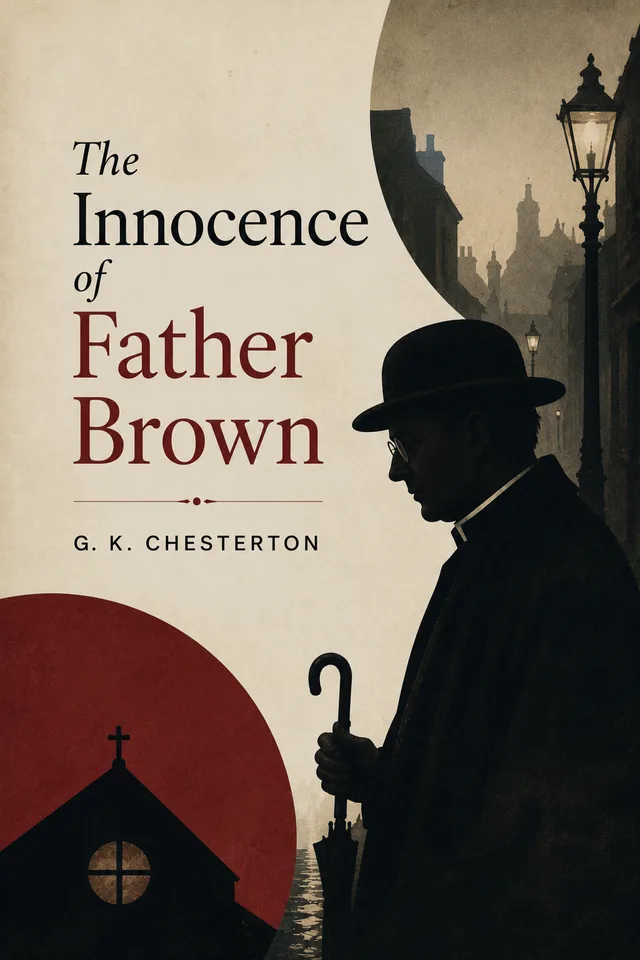
The Innocence of Father Brown
English BooksWhale Edition by G. K. Chesterton
Detective stories where paradox, moral insight, and quiet observation solve strange crimes.
- Preview
- A sample from the prepared text
- Formats
- Online reader, EPUB, PDF
- Access
- Library claim
Book introduction
The Innocence of Father Brown
The Innocence of Father Brown introduces a priest-detective whose knowledge of human weakness lets him solve crimes others misunderstand. Chesterton combines mystery, wit, and moral imagination.
BooksWhale edition
How this edition was prepared
This edition is based on a public domain text and has been prepared for digital reading by BooksWhale.
Public domain basis
Why this edition can be shared
G. K. Chesterton died in 1936, and The Innocence of Father Brown was first published in 1911; these dates support the public-domain basis for this English edition.
Read preview
A sample from the prepared text
Preview selected from the prepared reader text.
Preview chapterFull textRead preview
The Innocence of Father Brown
G. K. Chesterton
Preview chapterThe Blue CrossPreview
Between the silver ribbon of morning and the green glittering ribbon of sea, the boat touched Harwich and let loose a swarm of folk like flies, among whom the man we must follow was by no means conspicuous--nor wished to be. There was nothing notable about him, except a slight contrast between the holiday gaiety of his clothes and the official gravity of his face. His clothes included a slight, pale grey jacket, a white waistcoat, and a silver straw hat with a grey-blue ribbon. His lean face was dark by contrast, and ended in a curt black beard that looked Spanish and suggested an Elizabethan ruff. He was smoking a cigarette with the seriousness of an idler. There was nothing about him to indicate the fact that the grey jacket covered a loaded revolver, that the white waistcoat covered a police card, or that the straw hat covered one of the most powerful intellects in Europe. For this was Valentin himself, the head of the Paris police and the most famous investigator of the world; and he was coming from Brussels to London to make the greatest arrest of the century.
Flambeau was in England. The police of three countries had tracked the great criminal at last from Ghent to Brussels, from Brussels to the Hook of Holland; and it was conjectured that he would take some advantage of the unfamiliarity and confusion of the Eucharistic Congress, then taking place in London. Probably he would travel as some minor clerk or secretary connected with it; but, of course, Valentin could not be certain; nobody could be certain about Flambeau.
It is many years now since this colossus of crime suddenly ceased keeping the world in a turmoil; and when he ceased, as they said after the death of Roland, there was a great quiet upon the earth. But in his best days (I mean, of course, his worst) Flambeau was a figure as statuesque and international as the Kaiser. Almost every morning the daily paper announced that he had escaped the consequences of one extraordinary crime by committing another. He was a Gascon of gigantic stature and bodily daring; and the wildest tales were told of his outbursts of athletic humour; how he turned the juge d’instruction upside down and stood him on his head, “to clear his mind”; how he ran down the Rue de Rivoli with a policeman under each arm. It is due to him to say that his fantastic physical strength was generally employed in such bloodless though undignified scenes; his real crimes were chiefly those of ingenious and wholesale robbery. But each of his thefts was almost a new sin, and would make a story by itself. It was he who ran the great Tyrolean Dairy Company in London, with no dairies, no cows, no carts, no milk, but with some thousand subscribers. These he served by the simple operation of moving the little milk cans outside people’s doors to the doors of his own customers. It was he who had kept up an unaccountable and close correspondence with a young lady whose whole letter-bag was intercepted, by the extraordinary trick of photographing his messages infinitesimally small upon the slides of a microscope. A sweeping simplicity, however, marked many of his experiments. It is said that he once repainted all the numbers in a street in the dead of night merely to divert one traveller into a trap. It is quite certain that he invented a portable pillar-box, which he put up at corners in quiet suburbs on the chance of strangers dropping postal orders into it. Lastly, he was known to be a startling acrobat; despite his huge figure, he could leap like a grasshopper and melt into the tree-tops like a monkey. Hence the great Valentin, when he set out to find Flambeau, was perfectly aware that his adventures would not end when he had found him.
Preview chapterThe Secret GardenPreview
Aristide Valentin, Chief of the Paris Police, was late for his dinner, and some of his guests began to arrive before him. These were, however, reassured by his confidential servant, Ivan, the old man with a scar, and a face almost as grey as his moustaches, who always sat at a table in the entrance hall--a hall hung with weapons. Valentin’s house was perhaps as peculiar and celebrated as its master. It was an old house, with high walls and tall poplars almost overhanging the Seine; but the oddity--and perhaps the police value--of its architecture was this: that there was no ultimate exit at all except through this front door, which was guarded by Ivan and the armoury. The garden was large and elaborate, and there were many exits from the house into the garden. But there was no exit from the garden into the world outside; all round it ran a tall, smooth, unscalable wall with special spikes at the top; no bad garden, perhaps, for a man to reflect in whom some hundred criminals had sworn to kill.
As Ivan explained to the guests, their host had telephoned that he was detained for ten minutes. He was, in truth, making some last arrangements about executions and such ugly things; and though these duties were rootedly repulsive to him, he always performed them with precision. Ruthless in the pursuit of criminals, he was very mild about their punishment. Since he had been supreme over French--and largely over European--policial methods, his great influence had been honourably used for the mitigation of sentences and the purification of prisons. He was one of the great humanitarian French freethinkers; and the only thing wrong with them is that they make mercy even colder than justice.
When Valentin arrived he was already dressed in black clothes and the red rosette--an elegant figure, his dark beard already streaked with grey. He went straight through his house to his study, which opened on the grounds behind. The garden door of it was open, and after he had carefully locked his box in its official place, he stood for a few seconds at the open door looking out upon the garden. A sharp moon was fighting with the flying rags and tatters of a storm, and Valentin regarded it with a wistfulness unusual in such scientific natures as his. Perhaps such scientific natures have some psychic prevision of the most tremendous problem of their lives. From any such occult mood, at least, he quickly recovered, for he knew he was late, and that his guests had already begun to arrive. A glance at his drawing-room when he entered it was enough to make certain that his principal guest was not there, at any rate. He saw all the other pillars of the little party; he saw Lord Galloway, the English Ambassador--a choleric old man with a russet face like an apple, wearing the blue ribbon of the Garter. He saw Lady Galloway, slim and threadlike, with silver hair and a face sensitive and superior. He saw her daughter, Lady Margaret Graham, a pale and pretty girl with an elfish face and copper-coloured hair. He saw the Duchess of Mont St. Michel, black-eyed and opulent, and with her her two daughters, black-eyed and opulent also. He saw Dr. Simon, a typical French scientist, with glasses, a pointed brown beard, and a forehead barred with those parallel wrinkles which are the penalty of superciliousness, since they come through constantly elevating the eyebrows. He saw Father Brown, of Cobhole, in Essex, whom he had recently met in England. He saw--perhaps with more interest than any of these--a tall man in uniform, who had bowed to the Galloways without receiving any very hearty acknowledgment, and who now advanced alone to pay his respects to his host. This was Commandant O’Brien, of the French Foreign Legion. He was a slim yet somewhat swaggering figure, clean-shaven, dark-haired, and blue-eyed, and, as seemed natural in an officer of that famous regiment of victorious failures and successful suicides, he had an air at once dashing and melancholy. He was by birth an Irish gentleman, and in boyhood had known the Galloways--especially Margaret Graham. He had left his country after some crash of debts, and now expressed his complete freedom from British etiquette by swinging about in uniform, sabre and spurs. When he bowed to the Ambassador’s family, Lord and Lady Galloway bent stiffly, and Lady Margaret looked away.
Table of contents
Inside this edition
- 01Full text
- 02The Blue Cross
- 03The Secret Garden
- 04The Queer Feet
- 05The Flying Stars
- 06The Invisible Man
- 07The Honour of Israel Gow
- 08The Wrong Shape
- 09The Sins of Prince Saradine
- 10The Hammer of God
- 11The Eye of Apollo
- 12The Sign of the Broken Sword
- 13The Three Tools of Death
Language availability
Other languages
Additional language editions are not published yet. This section will link to other BooksWhale editions when they become available.
Request another language