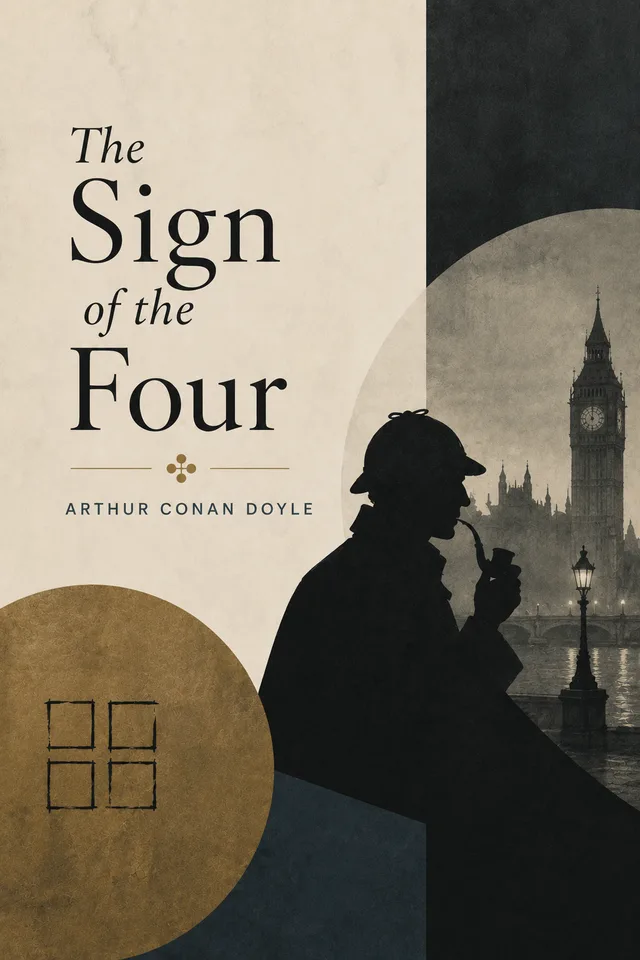
English Edition
Literature
The Sign of the Four
English BooksWhale Edition by Arthur Conan Doyle
A Sherlock Holmes novel of mystery, treasure, pursuit, deduction, and imperial shadows.
- Preview
- A sample from the prepared text
- Formats
- Online reader, EPUB, PDF
- Access
- Library claim
Book introduction
The Sign of the Four
The Sign of the Four sends Sherlock Holmes and Dr. Watson into a case involving a strange message, hidden treasure, and a chain of past violence. Conan Doyle blends detection, adventure, and atmosphere.
BooksWhale edition
How this edition was prepared
This edition is based on a public domain text and has been prepared for digital reading by BooksWhale.
Public domain basis
Why this edition can be shared
Arthur Conan Doyle died in 1930, and The Sign of the Four was first published in 1890; these dates support the public-domain basis for this English edition.
Read preview
A sample from the prepared text
Preview selected from the prepared reader text.
Preview chapterFull textRead preview
The Sign of the Four
Arthur Conan Doyle
Preview chapterChapter IPreview
Chapter I
Preview chapterThe Science of DeductionPreview
Sherlock Holmes took his bottle from the corner of the mantel-piece and his hypodermic syringe from its neat morocco case. With his long, white, nervous fingers he adjusted the delicate needle, and rolled back his left shirt-cuff. For some little time his eyes rested thoughtfully upon the sinewy forearm and wrist all dotted and scarred with innumerable puncture-marks. Finally he thrust the sharp point home, pressed down the tiny piston, and sank back into the velvet-lined arm-chair with a long sigh of satisfaction.
Three times a day for many months I had witnessed this performance, but custom had not reconciled my mind to it. On the contrary, from day to day I had become more irritable at the sight, and my conscience swelled nightly within me at the thought that I had lacked the courage to protest. Again and again I had registered a vow that I should deliver my soul upon the subject, but there was that in the cool, nonchalant air of my companion which made him the last man with whom one would care to take anything approaching to a liberty. His great powers, his masterly manner, and the experience which I had had of his many extraordinary qualities, all made me diffident and backward in crossing him.
Yet upon that afternoon, whether it was the Beaune which I had taken with my lunch, or the additional exasperation produced by the extreme deliberation of his manner, I suddenly felt that I could hold out no longer.
“Which is it to-day?” I asked,—“morphine or cocaine?”
He raised his eyes languidly from the old black-letter volume which he had opened. “It is cocaine,” he said,—“a seven-per-cent. solution. Would you care to try it?”
“No, indeed,” I answered, brusquely. “My constitution has not got over the Afghan campaign yet. I cannot afford to throw any extra strain upon it.”
He smiled at my vehemence. “Perhaps you are right, Watson,” he said. “I suppose that its influence is physically a bad one. I find it, however, so transcendently stimulating and clarifying to the mind that its secondary action is a matter of small moment.”
“But consider!” I said, earnestly. “Count the cost! Your brain may, as you say, be roused and excited, but it is a pathological and morbid process, which involves increased tissue-change and may at last leave a permanent weakness. You know, too, what a black reaction comes upon you. Surely the game is hardly worth the candle. Why should you, for a mere passing pleasure, risk the loss of those great powers with which you have been endowed? Remember that I speak not only as one comrade to another, but as a medical man to one for whose constitution he is to some extent answerable.”
He did not seem offended. On the contrary, he put his finger-tips together and leaned his elbows on the arms of his chair, like one who has a relish for conversation.
“My mind,” he said, “rebels at stagnation. Give me problems, give me work, give me the most abstruse cryptogram or the most intricate analysis, and I am in my own proper atmosphere. I can dispense then with artificial stimulants. But I abhor the dull routine of existence. I crave for mental exaltation. That is why I have chosen my own particular profession,—or rather created it, for I am the only one in the world.”
“The only unofficial detective?” I said, raising my eyebrows.
“The only unofficial consulting detective,” he answered. “I am the last and highest court of appeal in detection. When Gregson or Lestrade or Athelney Jones are out of their depths—which, by the way, is their normal state—the matter is laid before me. I examine the data, as an expert, and pronounce a specialist’s opinion. I claim no credit in such cases. My name figures in no newspaper. The work itself, the pleasure of finding a field for my peculiar powers, is my highest reward. But you have yourself had some experience of my methods of work in the Jefferson Hope case.”
Table of contents
Inside this edition
- 01Full text
- 02Chapter I
- 03The Science of Deduction
- 04Chapter II
- 05The Statement of the Case
- 06Chapter III
- 07In Quest of a Solution
- 08Chapter IV
- 09The Story of the Bald-Headed Man
- 10Chapter V
- 11The Tragedy of Pondicherry Lodge
- 12Chapter VI
- 13Sherlock Holmes Gives a Demonstration
- 14Chapter VII
- 15The Episode of the Barrel
- 16Chapter VIII
- 17The Baker Street Irregulars
- 18Chapter IX
- 19A Break in the Chain
- 20Chapter X
- 21The End of the Islander
- 22Chapter XI
- 23The Great Agra Treasure
- 24Chapter XII
- 25The Strange Story of Jonathan Small
Language availability
Other languages
Additional language editions are not published yet. This section will link to other BooksWhale editions when they become available.
Request another language