Englisch Ausgabe
Psychologie
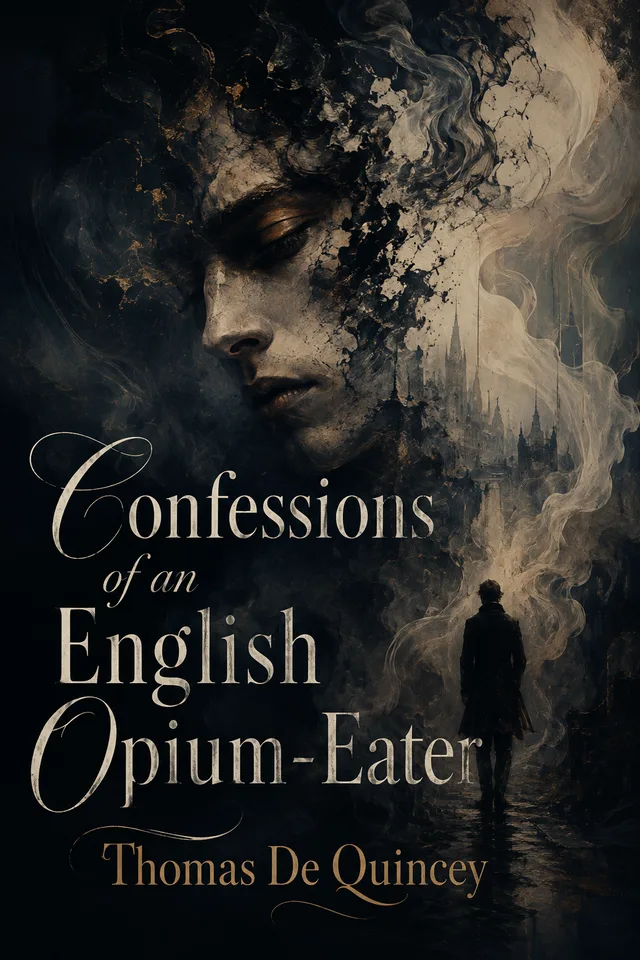
Confessions of an English Opium-Eater
BooksWhale-Ausgabe auf Englisch von Thomas De Quincey
A haunting Romantic memoir of memory, addiction, dreams, suffering, and the inner life.
- Vorschau
- Auszug aus dem vorbereiteten Text
- Formate
- Online-Reader, EPUB, PDF
- Zugriff
- Bibliotheks-Claim
Bucheinführung
Confessions of an English Opium-Eater
Confessions of an English Opium-Eater explores pleasure, dependence, pain, nightmares, and consciousness in a prose style that shaped later psychological and literary writing. This edition is for readers of memoir, Romantic literature, addiction narratives, and dream psychology.
BooksWhale-Ausgabe
Wie diese Ausgabe vorbereitet wurde
Diese Ausgabe basiert auf einem gemeinfreien Text und wurde von BooksWhale für digitales Lesen vorbereitet.
Public-Domain-Grundlage
Warum diese Ausgabe geteilt werden kann
Thomas De Quincey died in 1859, and Confessions of an English Opium-Eater was first published in 1821. These dates support the public-domain basis for the source text used in this English edition.
Vorschau lesen
Auszug aus dem vorbereiteten Text
Vorschau aus dem vorbereiteten Lesetext.
VorschaukapitelFull textVorschau lesen
Confessions of an English Opium-Eater
Thomas De Quincey
VorschaukapitelTO THE READERVorschau
I here present you, courteous reader, with the record of a remarkable period in my life: according to my application of it, I trust that it will prove not merely an interesting record, but in a considerable degree useful and instructive. In _that_ hope it is that I have drawn it up; and _that_ must be my apology for breaking through that delicate and honourable reserve which, for the most part, restrains us from the public exposure of our own errors and infirmities. Nothing, indeed, is more revolting to English feelings than the spectacle of a human being obtruding on our notice his moral ulcers or scars, and tearing away that “decent drapery” which time or indulgence to human frailty may have drawn over them; accordingly, the greater part of _our_ confessions (that is, spontaneous and extra-judicial confessions) proceed from demireps, adventurers, or swindlers: and for any such acts of gratuitous self-humiliation from those who can be supposed in sympathy with the decent and self-respecting part of society, we must look to French literature, or to that part of the German which is tainted with the spurious and defective sensibility of the French. All this I feel so forcibly, and so nervously am I alive to reproach of this tendency, that I have for many months hesitated about the propriety of allowing this or any part of my narrative to come before the public eye until after my death (when, for many reasons, the whole will be published); and it is not without an anxious review of the reasons for and against this step that I have at last concluded on taking it.
Guilt and misery shrink, by a natural instinct, from public notice: they court privacy and solitude: and even in their choice of a grave will sometimes sequester themselves from the general population of the churchyard, as if declining to claim fellowship with the great family of man, and wishing (in the affecting language of Mr. Wordsworth)
“—Humbly to express A penitential loneliness.”
It is well, upon the whole, and for the interest of us all, that it should be so: nor would I willingly in my own person manifest a disregard of such salutary feelings, nor in act or word do anything to weaken them; but, on the one hand, as my self-accusation does not amount to a confession of guilt, so, on the other, it is possible that, if it _did_, the benefit resulting to others from the record of an experience purchased at so heavy a price might compensate, by a vast overbalance, for any violence done to the feelings I have noticed, and justify a breach of the general rule. Infirmity and misery do not of necessity imply guilt. They approach or recede from shades of that dark alliance, in proportion to the probable motives and prospects of the offender, and the palliations, known or secret, of the offence; in proportion as the temptations to it were potent from the first, and the resistance to it, in act or in effort, was earnest to the last. For my own part, without breach of truth or modesty, I may affirm that my life has been, on the whole, the life of a philosopher: from my birth I was made an intellectual creature, and intellectual in the highest sense my pursuits and pleasures have been, even from my schoolboy days. If opium-eating be a sensual pleasure, and if I am bound to confess that I have indulged in it to an excess not yet _recorded_ of any other man, it is no less true that I have struggled against this fascinating enthralment with a religious zeal, and have at length accomplished what I never yet heard attributed to any other man—have untwisted, almost to its final links, the accursed chain which fettered me. Such a self-conquest may reasonably be set off in counterbalance to any kind or degree of self-indulgence. Not to insist that in my case the self-conquest was unquestionable, the self-indulgence open to doubts of casuistry, according as that name shall be extended to acts aiming at the bare relief of pain, or shall be restricted to such as aim at the excitement of positive pleasure.
VorschaukapitelPRELIMINARY CONFESSIONSVorschau
These preliminary confessions, or introductory narrative of the youthful adventures which laid the foundation of the writer’s habit of opium-eating in after-life, it has been judged proper to premise, for three several reasons:
1. As forestalling that question, and giving it a satisfactory answer, which else would painfully obtrude itself in the course of the Opium Confessions—“How came any reasonable being to subject himself to such a yoke of misery; voluntarily to incur a captivity so servile, and knowingly to fetter himself with such a sevenfold chain?”—a question which, if not somewhere plausibly resolved, could hardly fail, by the indignation which it would be apt to raise as against an act of wanton folly, to interfere with that degree of sympathy which is necessary in any case to an author’s purposes.
2. As furnishing a key to some parts of that tremendous scenery which afterwards peopled the dreams of the Opium-eater.
3. As creating some previous interest of a personal sort in the confessing subject, apart from the matter of the confessions, which cannot fail to render the confessions themselves more interesting. If a man “whose talk is of oxen” should become an opium-eater, the probability is that (if he is not too dull to dream at all) he will dream about oxen; whereas, in the case before him, the reader will find that the Opium-eater boasteth himself to be a philosopher; and accordingly, that the phantasmagoria of _his_ dreams (waking or sleeping, day-dreams or night-dreams) is suitable to one who in that character
Humani nihil a se alienum putat.
For amongst the conditions which he deems indispensable to the sustaining of any claim to the title of philosopher is not merely the possession of a superb intellect in its _analytic_ functions (in which part of the pretensions, however, England can for some generations show but few claimants; at least, he is not aware of any known candidate for this honour who can be styled emphatically _a subtle thinker_, with the exception of _Samuel Taylor Coleridge_, and in a narrower department of thought with the recent illustrious exception of _David Ricardo_) but also on such a constitution of the _moral_ faculties as shall give him an inner eye and power of intuition for the vision and the mysteries of our human nature: _that_ constitution of faculties, in short, which (amongst all the generations of men that from the beginning of time have deployed into life, as it were, upon this planet) our English poets have possessed in the highest degree, and Scottish professors in the lowest.
I have often been asked how I first came to be a regular opium-eater, and have suffered, very unjustly, in the opinion of my acquaintance from being reputed to have brought upon myself all the sufferings which I shall have to record, by a long course of indulgence in this practice purely for the sake of creating an artificial state of pleasurable excitement. This, however, is a misrepresentation of my case. True it is that for nearly ten years I did occasionally take opium for the sake of the exquisite pleasure it gave me; but so long as I took it with this view I was effectually protected from all material bad consequences by the necessity of interposing long intervals between the several acts of indulgence, in order to renew the pleasurable sensations. It was not for the purpose of creating pleasure, but of mitigating pain in the severest degree, that I first began to use opium as an article of daily diet. In the twenty-eighth year of my age a most painful affection of the stomach, which I had first experienced about ten years before, attacked me in great strength. This affection had originally been caused by extremities of hunger, suffered in my boyish days. During the season of hope and redundant happiness which succeeded (that is, from eighteen to twenty-four) it had slumbered; for the three following years it had revived at intervals; and now, under unfavourable circumstances, from depression of spirits, it attacked me with a violence that yielded to no remedies but opium. As the youthful sufferings which first produced this derangement of the stomach were interesting in themselves, and in the circumstances that attended them, I shall here briefly retrace them.
Inhaltsverzeichnis
In dieser Ausgabe
- 01Full text
- 02TO THE READER
- 03PRELIMINARY CONFESSIONS
- 04PART II
- 05THE PLEASURES OF OPIUM
- 06INTRODUCTION TO THE PAINS OF OPIUM
- 07THE PAINS OF OPIUM
- 08APPENDIX
Sprachverfügbarkeit
Andere Sprachen
Weitere Sprachausgaben sind noch nicht veröffentlicht. Sobald verfügbar, werden sie hier verlinkt.
Andere Sprache anfragen