Englisch Ausgabe
Geschichte
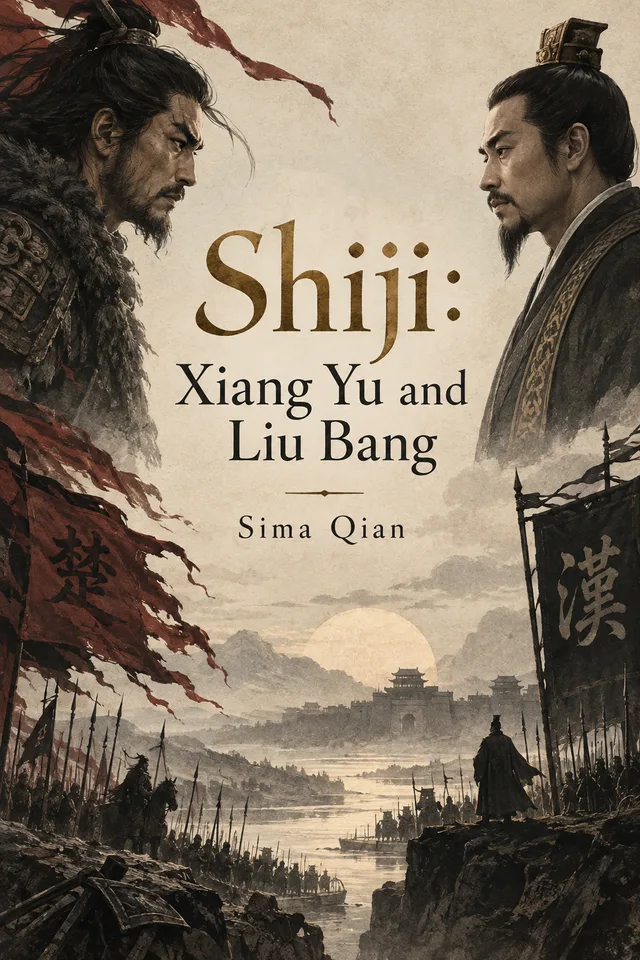
Shiji: Xiang Yu and Liu Bang
BooksWhale-Ausgabe auf Englisch von Sima Qian
Originaltitel: 史记:项羽和刘邦
Xiang Yu and Liu Bang’s rivalry reveals how ambition, military leadership, loyalty and political judgment shaped the founding of the Han dynasty.
- Vorschau
- Auszug aus dem vorbereiteten Text
- Formate
- Online-Reader, EPUB, PDF
- Zugriff
- Bibliotheks-Claim
Bucheinführung
Shiji: Xiang Yu and Liu Bang
This selection from Sima Qian’s Shiji follows the rivalry between Xiang Yu and Liu Bang as the Qin order collapses and a new dynasty emerges. Battles, alliances and shifting loyalties reveal the relationship between personal character and political judgment. The narratives contrast ambition, courage and strategic adaptability, making the struggle for empire a study of both leadership and the consequences of individual decisions.
BooksWhale-Ausgabe
Wie diese Ausgabe vorbereitet wurde
Diese Ausgabe ist eine KI-gestützte, menschlich geprüfte Übersetzung von BooksWhale, geprüft auf Lesbarkeit, Formatierung und Konsistenz.
Public-Domain-Grundlage
Warum diese Ausgabe geteilt werden kann
Sima Qian’s Shiji is an ancient Chinese work composed in the first century BCE. This English edition is an independent AI-assisted translation supplied by its creator, who has confirmed human revision and completion for publication.
Vorschau lesen
Auszug aus dem vorbereiteten Text
Vorschau aus dem vorbereiteten Lesetext.
VorschaukapitelFull textVorschau lesen
Shiji: Xiang Yu and Liu Bang
Sima Qian
VorschaukapitelXiang YuVorschau
Xiang Ji was a native of Xiaxiang, and his courtesy name was Ziyu. When he first began his great undertaking, he was only twenty-four years old. His uncle was named Xiang Liang, whose father was Xiang Yan, a general of the State of Chu who had been killed by the Qin general Wang Li. For generations, the Xiang family had served as generals of Chu. Because they had been granted a fief in Xiang County, they took Xiang as their family name.
In his youth, Xiang Ji studied reading and writing but achieved little success, so he abandoned his studies and took up swordsmanship. Yet he failed to master that as well. Xiang Liang became angry with him. Xiang Ji said, “Reading and writing are useful only for recording one's name. Even if a man masters swordsmanship, he can fight only one opponent at a time. Such skills are not worth learning. I want to learn how to defeat ten thousand men.” Xiang Liang therefore began teaching him military strategy and the art of warfare. Xiang Ji was greatly delighted, but after grasping the general principles, he again refused to complete his studies.
Xiang Liang was once implicated in a criminal case and imprisoned in Liyang. He therefore asked Cao Jiu, a prison official of Qi County, to write a letter appealing on his behalf to Sima Xin, a prison official in Liyang. Through this intervention, he was released from the charges against him.
Later, Xiang Liang killed a man and fled with Xiang Ji to the Wuzhong region to escape retaliation from his enemies. The worthy scholars and officials of Wuzhong held him in high regard. Whenever there were major public labor projects or funerals in the region, Xiang Liang frequently served as the organizer. Secretly, he used military principles to organize and assign duties to his guests and the young men who followed him. In this way, the people of Wuzhong came to recognize his abilities.
When the First Emperor of Qin made an inspection tour of Kuaiji and crossed the Zhejiang River, Xiang Liang and Xiang Ji went together to watch him. Xiang Ji declared, “I could take that man's place.” Xiang Liang immediately covered his mouth and said, “Do not speak recklessly! Such words could bring extermination upon our entire family!” From that moment, Xiang Liang regarded Xiang Ji as an extraordinary man. Xiang Ji stood more than eight feet tall and possessed the strength to lift a great bronze cauldron. His talent and courage surpassed those of ordinary men. Although the young men of Wuzhong were fierce and fond of fighting, they all feared him.
In the seventh month of the first year of the Second Emperor of Qin, Chen She and others rose in rebellion at Daze Township. In the ninth month of that year, Yin Tong, the governor of Kuaiji Commandery, said to Xiang Liang, “The regions west of the Yangtze River have all risen in rebellion. This is the moment when Heaven intends to destroy Qin. I have heard that those who act first can control others, while those who act later will be controlled by others. I intend to raise troops against Qin and appoint you and Huan Chu as generals.”
At that time, Huan Chu was a fugitive hiding in the wilderness. Xiang Liang replied, “Huan Chu is now in hiding, and no one knows where he is. Only Xiang Ji knows his whereabouts.”
Xiang Liang then went outside and instructed Xiang Ji to wait beyond the chamber with his sword. He returned inside and sat again with the governor.
He said, “Please summon Xiang Ji so that he may receive your orders to bring Huan Chu here.”
The governor replied, “Very well.”
Xiang Liang called Xiang Ji inside. After a short while, he signaled to him and said, “Now is the time to act!”
Xiang Ji immediately drew his sword and cut off the governor's head. Xiang Liang took the governor's head in his hand and fastened the governor's official seal and insignia to his own belt. The governor's attendants were thrown into confusion and terror. Xiang Ji killed or wounded nearly a hundred of them. Everyone in the government offices fell prostrate in fear, and not a single person dared to rise and resist.
VorschaukapitelLiu BangVorschau
Liu Bang was a native of Zhongyang Village in Feng Township, Pei County. His surname was Liu, and his courtesy name was Ji. His father was known as the Grand Duke, and his mother was called Lady Liu.
Before Liu Bang was born, Lady Liu once rested and fell asleep on the bank of a great marsh. In a dream, she had intercourse with a divine being. At that moment, the sky grew dark with thunder and lightning. The Grand Duke came to look for her and saw a dragon-like creature lying upon her body. Soon afterward, Lady Liu became pregnant and gave birth to Liu Bang.
Liu Bang had a high nose, a face resembling that of a dragon, and a handsome beard. On his left thigh were seventy-two black moles. By nature, he was generous and benevolent, loved people, and enjoyed giving things away. He was broad-minded and free-spirited, always displaying great ambition and an expansive disposition. He was unwilling to engage in the ordinary occupations of farming and managing a household.
When he reached adulthood, he entered government service and became the headman of a pavilion in Sishui. He treated the officials of the local administration with casual disrespect, showing little deference to any of them.
He enjoyed drinking wine and was fond of women. He frequently bought wine on credit from the establishments operated by Lady Wang and Widow Wu.
Whenever Liu Bang became drunk and fell asleep, Lady Wang and Widow Wu often saw what appeared to be a dragon hovering above him. They found this extremely strange.
Whenever Liu Bang came to drink, their wine sales increased several times over. After witnessing the mysterious phenomenon that accompanied his drunken sleep, the two women would often break the bamboo slips recording his debts at the end of the year, thereby canceling the money he owed them.
Liu Bang once traveled to Xianyang while performing compulsory labor service. There he saw the First Emperor of Qin, a sight that greatly broadened his horizons.
He sighed with deep emotion and exclaimed, “Ah! This is how a great man ought to live!”
Lord Lü, a native of Shanfu, was a close friend of the magistrate of Pei County. To escape his enemies, he accompanied the magistrate to Pei County, where he settled.
When the distinguished men and officials of Pei heard that the magistrate had received an honored guest, they all came to offer their congratulations.
Xiao He, who served as an official under the county magistrate, was responsible for collecting the congratulatory gifts.
He announced to the guests, “Anyone whose gift is worth less than one thousand coins must sit below the main hall.”
Liu Bang, who was then a pavilion headman and habitually looked down upon the county officials, wrote on his gift card, “A congratulatory offering of ten thousand coins,” although he had not brought a single coin.
When he entered and presented himself, Lord Lü was greatly astonished by his appearance. He rose and personally welcomed Liu Bang at the entrance.
Lord Lü enjoyed studying people's facial features to predict their fortunes. Upon examining Liu Bang's appearance, he showed him great respect and invited him to sit in a place of honor.
Xiao He remarked, “Liu Ji is always making extravagant claims, but he accomplishes very little.”
Because Lord Lü treated him with such respect, Liu Bang behaved casually and showed little regard for the other guests. He took the highest seat without displaying any modesty.
When the banquet had reached its height, Lord Lü signaled with his eyes, asking Liu Bang to remain after the others had departed.
Liu Bang stayed until the end.
Lord Lü said to him:
“Since my youth, I have enjoyed reading people's faces. I have examined the appearances of many men, but I have never seen anyone whose features are as extraordinary as yours, Liu Ji.
“I hope you will take good care of yourself.
Inhaltsverzeichnis
In dieser Ausgabe
- 01Full text
- 02Xiang Yu
- 03Liu Bang
- 04Empress Dowager Lü
- 05Between Qin and Chu
- 06The Feudal Kings Since the Rise of Han
- 07Liu Bang's Meritorious Ministers and Generals
Sprachverfügbarkeit
Andere Sprachen
Weitere Sprachausgaben sind noch nicht veröffentlicht. Sobald verfügbar, werden sie hier verlinkt.
Andere Sprache anfragen