Englisch Ausgabe
Geschichte
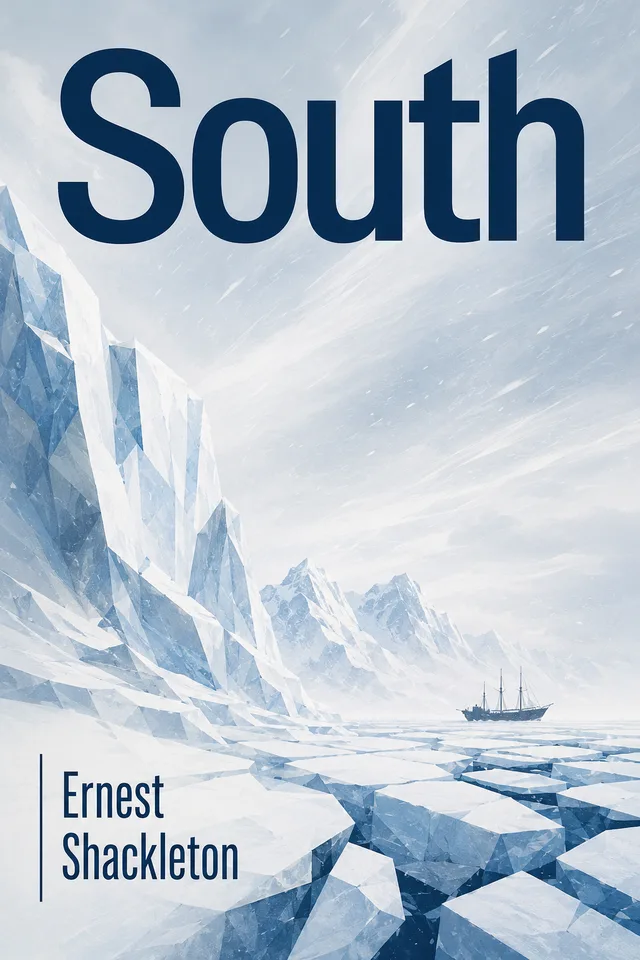
South
BooksWhale-Ausgabe auf Englisch von Ernest Shackleton
Shackleton’s firsthand Antarctic account of endurance, leadership, exploration, disaster, and survival.
- Vorschau
- Auszug aus dem vorbereiteten Text
- Formate
- Online-Reader, EPUB, PDF
- Zugriff
- Bibliotheks-Claim
Bucheinführung
South
South records Ernest Shackleton’s Imperial Trans-Antarctic Expedition, the loss of the Endurance, and one of the most famous survival journeys in exploration history. This English original is essential for readers of polar history, adventure, leadership, maritime survival, and expedition writing.
BooksWhale-Ausgabe
Wie diese Ausgabe vorbereitet wurde
Diese Ausgabe basiert auf einem gemeinfreien Text und wurde von BooksWhale für digitales Lesen vorbereitet.
Public-Domain-Grundlage
Warum diese Ausgabe geteilt werden kann
Ernest Shackleton died in 1922, and South was first published in 1919. These dates support the public-domain basis for this English original edition.
Vorschau lesen
Auszug aus dem vorbereiteten Text
Vorschau aus dem vorbereiteten Lesetext.
VorschaukapitelFull textVorschau lesen
South
Ernest Shackleton
South
THE STORY OF SHACKLETON’S LAST EXPEDITION 1914–1917
by Sir Ernest Shackleton C.V.O.
Colour Photograph by F. Hurley]
TO
MY COMRADES
WHO FELL IN THE WHITE WARFARE OF THE SOUTH AND ON THE RED FIELDS OF FRANCE AND FLANDERS
PREFACE I. INTO THE WEDDELL SEA II. NEW LAND III. WINTER MONTHS IV. LOSS OF THE _ENDURANCE_ V. OCEAN CAMP VI. THE MARCH BETWEEN VII. PATIENCE CAMP VIII. ESCAPE FROM THE ICE IX. THE BOAT JOURNEY X. ACROSS SOUTH GEORGIA XI. THE RESCUE XII. ELEPHANT ISLAND XIII. THE ROSS SEA PARTY XIV. WINTERING IN McMURDO SOUND XV. LAYING THE DEPOTS XVI. THE _AURORA’S_ DRIFT XVII. THE LAST RELIEF XVIII. THE FINAL PHASE
APPENDIX I:
SCIENTIFIC WORK SEA-ICE NOMENCLATURE METEOROLOGY PHYSICS SOUTH ATLANTIC WHALES AND WHALING
APPENDIX II:
THE EXPEDITION HUTS AT McMURDO SOUND
LIST OF ILLUSTRATIONS
IN THE PRIDE OF HER YOUTH. Colour Photograph by F. Hurley The Leader The Weddell Sea Party Young Emperor Penguins A Huge Floe of Consolidated Pack Samson Ice-Flowers Midnight off the New Land New Land: Caird Coast Close Under the Barrier Trying to cut a way for the Ship through the Ice to a Lead ahead (February 14, 1915)
The Night Watchman’s Story The Dying Sun: The _Endurance_ firmly frozen in The Rampart Berg A Bi-Weekly Performance: Scrubbing out the “Ritz”
Pylon Avenue The Long, Long Night The Pups Ice-Pressure Approaching the Ship Ice-Rafting The Returning Sun Wild and Shackleton in the Heavy Pressure Exercising the Dogs Crab-eater Seals The Beginning of the End “Within a few Seconds she heeled over until she had a List of Thirty Degrees to Port”
Almost Overwhelmed [Attack of the floes] “The Driving Floe, moving laterally across the Stern, split the Rudder and tore out the Rudder-Post and Stern-Post”
The End A Week Later “The Wreckage lies around in Dismal Confusion”
The First Attempt to reach the Land 346 Miles Away Ocean Camp The Look-out at Ocean Camp The Emergency Sledges being packed in case of a sudden break up of the Ice The Sledges packed and ready Relaying the _James Caird_ Potash and Perlmutter “Loneliness”: Patience Camp The Kitchen at Patience Camp The Stove at Patience Camp constructed out of old Oil-drums Worsley taking Observations of the Sun to determine our Position “We cut Steps in this Twenty-five Foot Slab and it makes a fine Look-out”
“There was no Sleep for us that Night, so we lit the Blubber Stove”
Hauling up the Boats for the Night The Reeling Berg Sailing South Again The First Landing ever made on Elephant Island, April 15, 1916 “We Pulled the Three Boats a little Higher on the Beach”
Rough sketch map of landing place and first camp at C. Valentine, Elephant Island The First Drink and Hot Food for Three-and-a-Half Days Mount Frank Houlder, Elephant Island Launching the _James Caird_ The _Stancomb Wills_ In Sight of our Goal: Nearing South Georgia Landing on South Georgia [Cave Cove on South Georgia] [Surroundings of King Haakon Bay] [Plan of Sleeping Berths in Cave] Sea Elephants on South Georgia The Cliffs we descended whilst crossing the Island One of the Glaciers we Crossed A Typical View in South Georgia [Rough Memory Map of Route Across South Georgia] Panorama of South Georgia The _Yelcho_ Arrival at Punta Arenas with the Rescued Men Frank Wild, Second in Command of the Expedition Our Dugout The Hut on Elephant Island View of Interior of Hut on Elephant Island Marooned on Elephant Island Elephant Island The Rescue Ship Sighted “All Safe! All Well!”
View through a Cave on Elephant Island The Aurora Ice Stalactites at the Entrance to a Cave on Elephant Island A Newly-frozen Lead The Ross Sea Party Mackintosh and Spencer-Smith being dragged on the sledge “The Rudder was bent over to Starboard and Smashed”
“Next Morning the Jury-Rudder was Shipped”
Ice Nomenclature: 1. Young Ice (Bay Ice of Scoresby) in the Middle Distance 2. Light Pack 3. Heavy Hummocked Pack 4. Hummocky Pack and Frozen Lead of Young-Ice 5. Close Pack 6. Open Pack 7. Very Open Pack, approximating to Drift-ice 8. Drift-Ice “The Rookery”
VorschaukapitelPREFACEVorschau
After the conquest of the South Pole by Amundsen, who, by a narrow margin of days only, was in advance of the British Expedition under Scott, there remained but one great main object of Antarctic journeyings—the crossing of the South Polar continent from sea to sea.
When I returned from the _Nimrod_ Expedition on which we had to turn back from our attempt to plant the British flag on the South Pole, being beaten by stress of circumstances within ninety-seven miles of our goal, my mind turned to the crossing of the continent, for I was morally certain that either Amundsen or Scott would reach the Pole on our own route or a parallel one. After hearing of the Norwegian success I began to make preparations to start a last great journey—so that the first crossing of the last continent should be achieved by a British Expedition.
We failed in this object, but the story of our attempt is the subject for the following pages, and I think that though failure in the actual accomplishment must be recorded, there are chapters in this book of high adventure, strenuous days, lonely nights, unique experiences, and, above all, records of unflinching determination, supreme loyalty, and generous self-sacrifice on the part of my men which, even in these days that have witnessed the sacrifices of nations and regardlessness of self on the part of individuals, still will be of interest to readers who now turn gladly from the red horror of war and the strain of the last five years to read, perhaps with more understanding minds, the tale of the White Warfare of the South. The struggles, the disappointments, and the endurance of this small party of Britishers, hidden away for nearly two years in the fastnesses of the Polar ice, striving to carry out the ordained task and ignorant of the crises through which the world was passing, make a story which is unique in the history of Antarctic exploration.
Owing to the loss of the _Endurance_ and the disaster to the _Aurora_, certain documents relating mainly to the organization and preparation of the Expedition have been lost; but, anyhow, I had no intention of presenting a detailed account of the scheme of preparation, storing, and other necessary but, to the general reader, unimportant affairs, as since the beginning of this century, every book on Antarctic exploration has dealt fully with this matter. I therefore briefly place before you the inception and organization of the Expedition, and insert here the copy of the programme which I prepared in order to arouse the interest of the general public in the Expedition.
“_The Trans-continental Party._
“The first crossing of the Antarctic continent, from sea to sea via the Pole, apart from its historic value, will be a journey of great scientific importance.
“The distance will be roughly 1800 miles, and the first half of this, from the Weddell Sea to the Pole, will be over unknown ground. Every step will be an advance in geographical science. It will be learned whether the great Victoria chain of mountains, which has been traced from the Ross Sea to the Pole, extends across the continent and thus links up (except for the ocean break) with the Andes of South America, and whether the great plateau around the Pole dips gradually towards the Weddell Sea.
“Continuous magnetic observations will be taken on the journey. The route will lead towards the Magnetic Pole, and the determination of the dip of the magnetic needle will be of importance in practical magnetism. The meteorological conditions will be carefully noted, and this should help to solve many of our weather problems.
“The glaciologist and geologist will study ice formations and the nature of the mountains, and this report will prove of great scientific interest.
“_Scientific Work by Other Parties._
“While the Trans-continental party is carrying out, for the British Flag, the greatest Polar journey ever attempted, the other parties will be engaged in important scientific work.
VorschaukapitelCHAPTER I INTO THE WEDDELL SEAVorschau
I decided to leave South Georgia about December 5, and in the intervals of final preparation scanned again the plans for the voyage to winter quarters. What welcome was the Weddell Sea preparing for us? The whaling captains at South Georgia were generously ready to share with me their knowledge of the waters in which they pursued their trade, and, while confirming earlier information as to the extreme severity of the ice conditions in this sector of the Antarctic, they were able to give advice that was worth attention.
It will be convenient to state here briefly some of the considerations that weighed with me at that time and in the weeks that followed. I knew that the ice had come far north that season and, after listening to the suggestions of the whaling captains, had decided to steer to the South Sandwich Group, round Ultima Thule, and work as far to the eastward as the fifteenth meridian west longitude before pushing south.
The whalers emphasized the difficulty of getting through the ice in the neighbourhood of the South Sandwich Group. They told me they had often seen the floes come right up to the group in the summer-time, and they thought the Expedition would have to push through heavy pack in order to reach the Weddell Sea. Probably the best time to get into the Weddell Sea would be the end of February or the beginning of March. The whalers had gone right round the South Sandwich Group and they were familiar with the conditions. The predictions they made induced me to take the deck-load of coal, for if we had to fight our way through to Coats’ Land we would need every ton of fuel the ship could carry.
I hoped that by first moving to the east as far as the fifteenth meridian west we would be able to go south through looser ice, pick up Coats’ Land and finally reach Vahsel Bay, where Filchner made his attempt at landing in 1912. Two considerations were occupying my mind at this juncture. I was anxious for certain reasons to winter the _Endurance_ in the Weddell Sea, but the difficulty of finding a safe harbour might be very great. If no safe harbour could be found, the ship must winter at South Georgia. It seemed to me hopeless now to think of making the journey across the continent in the first summer, as the season was far advanced and the ice conditions were likely to prove unfavourable. In view of the possibility of wintering the ship in the ice, we took extra clothing from the stores at the various stations in South Georgia.
The other question that was giving me anxious thought was the size of the shore party. If the ship had to go out during the winter, or if she broke away from winter quarters, it would be preferable to have only a small, carefully selected party of men ashore after the hut had been built and the stores landed. These men could proceed to lay out depots by man-haulage and make short journeys with the dogs, training them for the long early march in the following spring. The majority of the scientific men would live aboard the ship, where they could do their work under good conditions. They would be able to make short journeys if required, using the _Endurance_ as a base. All these plans were based on an expectation that the finding of winter quarters was likely to be difficult. If a really safe base could be established on the continent, I would adhere to the original programme of sending one party to the south, one to the west round the head of the Weddell Sea towards Graham Land, and one to the east towards Enderby Land.
We had worked out details of distances, courses, stores required, and so forth. Our sledging ration, the result of experience as well as close study, was perfect. The dogs gave promise, after training, of being able to cover fifteen to twenty miles a day with loaded sledges.
Inhaltsverzeichnis
In dieser Ausgabe
- 01Full text
- 02PREFACE
- 03CHAPTER I INTO THE WEDDELL SEA
- 04CHAPTER II NEW LAND
- 05CHAPTER III WINTER MONTHS
- 06CHAPTER IV LOSS OF THE _ENDURANCE_
- 07CHAPTER V OCEAN CAMP
- 08CHAPTER VI THE MARCH BETWEEN
- 09CHAPTER VII PATIENCE CAMP
- 10CHAPTER VIII ESCAPE FROM THE ICE
- 11CHAPTER IX THE BOAT JOURNEY
- 12CHAPTER X ACROSS SOUTH GEORGIA
- 13CHAPTER XI THE RESCUE
- 14CHAPTER XII ELEPHANT ISLAND
- 15CHAPTER XIII THE ROSS SEA PARTY
- 16CHAPTER XIV WINTERING IN McMURDO SOUND
- 17CHAPTER XV LAYING THE DEPOTS
- 18CHAPTER XVI THE _AURORA’S_ DRIFT
- 19CHAPTER XVII THE LAST RELIEF
- 20CHAPTER XVIII THE FINAL PHASE
Sprachverfügbarkeit
Andere Sprachen
Weitere Sprachausgaben sind noch nicht veröffentlicht. Sobald verfügbar, werden sie hier verlinkt.
Andere Sprache anfragen