Englisch Ausgabe
Literatur
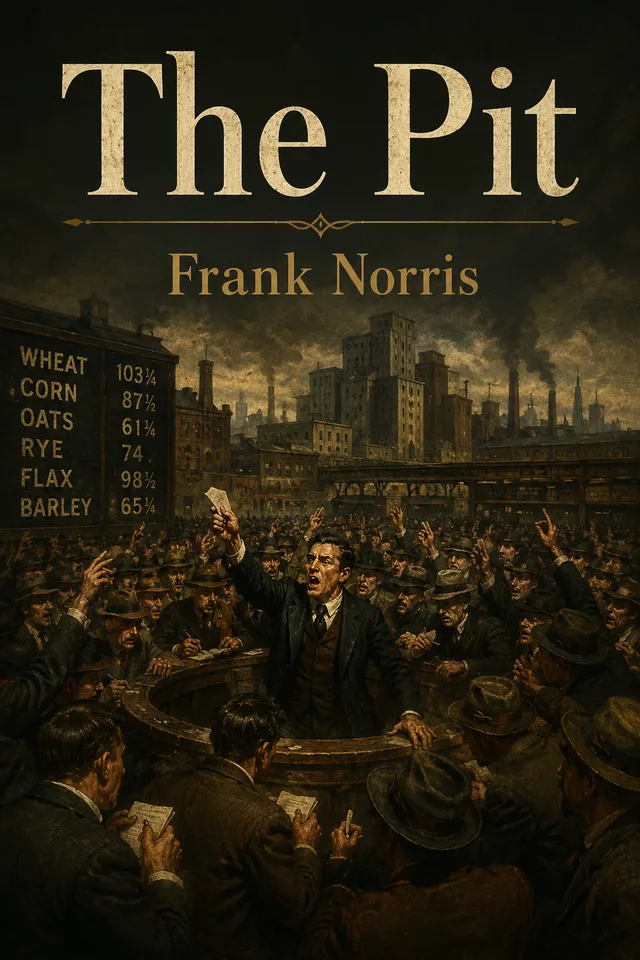
The Pit
BooksWhale-Ausgabe auf Englisch von Frank Norris
A Chicago novel of wheat speculation, finance, marriage, ambition, and market obsession.
- Vorschau
- Auszug aus dem vorbereiteten Text
- Formate
- Online-Reader, EPUB, PDF
- Zugriff
- Bibliotheks-Claim
Bucheinführung
The Pit
The Pit turns the Chicago grain exchange into a stage for desire, speculation, wealth, and social pressure. Frank Norris’s English novel is a powerful naturalist study of markets, marriage, risk, and modern American capitalism.
BooksWhale-Ausgabe
Wie diese Ausgabe vorbereitet wurde
Diese Ausgabe basiert auf einem gemeinfreien Text und wurde von BooksWhale für digitales Lesen vorbereitet.
Public-Domain-Grundlage
Warum diese Ausgabe geteilt werden kann
Frank Norris died in 1902, and The Pit was published in 1903 from his completed work. These dates support the public-domain basis for this English edition.
Vorschau lesen
Auszug aus dem vorbereiteten Text
Vorschau aus dem vorbereiteten Lesetext.
VorschaukapitelFull textVorschau lesen
The Pit
Frank Norris
VorschaukapitelIVorschau
At eight o'clock in the inner vestibule of the Auditorium Theatre by the window of the box office, Laura Dearborn, her younger sister Page, and their aunt--Aunt Wess'--were still waiting for the rest of the theatre-party to appear. A great, slow-moving press of men and women in evening dress filled the vestibule from one wall to another. A confused murmur of talk and the shuffling of many feet arose on all sides, while from time to time, when the outside and inside doors of the entrance chanced to be open simultaneously, a sudden draught of air gushed in, damp, glacial, and edged with the penetrating keenness of a Chicago evening at the end of February.
The Italian Grand Opera Company gave one of the most popular pieces of its repertoire on that particular night, and the Cresslers had invited the two sisters and their aunt to share their box with them. It had been arranged that the party should assemble in the Auditorium vestibule at a quarter of eight; but by now the quarter was gone and the Cresslers still failed to arrive.
"I don't see," murmured Laura anxiously for the last time, "what can be keeping them. Are you sure Page that Mrs. Cressler meant here--inside?"
She was a tall young girl of about twenty-two or three, holding herself erect and with fine dignity. Even beneath the opera cloak it was easy to infer that her neck and shoulders were beautiful. Her almost extreme slenderness was, however, her characteristic; the curves of her figure, the contour of her shoulders, the swell of hip and breast were all low; from head to foot one could discover no pronounced salience. Yet there was no trace, no suggestion of angularity. She was slender as a willow shoot is slender--and equally graceful, equally erect.
Next to this charming tenuity, perhaps her paleness was her most noticeable trait. But it was not a paleness of lack of colour. Laura Dearborn's pallour was in itself a colour. It was a tint rather than a shade, like ivory; a warm white, blending into an exquisite, delicate brownness towards the throat. Set in the middle of this paleness of brow and cheek, her deep brown eyes glowed lambent and intense. They were not large, but in some indefinable way they were important. It was very natural to speak of her eyes, and in speaking to her, her friends always found that they must look squarely into their pupils. And all this beauty of pallid face and brown eyes was crowned by, and sharply contrasted with, the intense blackness of her hair, abundant, thick, extremely heavy, continually coruscating with sombre, murky reflections, tragic, in a sense vaguely portentous,--the coiffure of a heroine of romance, doomed to dark crises.
On this occasion at the side of the topmost coil, a white aigrette scintillated and trembled with her every movement. She was unquestionably beautiful. Her mouth was a little large, the lips firm set, and one would not have expected that she would smile easily; in fact, the general expression of her face was rather serious.
"Perhaps," continued Laura, "they would look for us outside." But Page shook her head. She was five years younger than Laura, just turned seventeen. Her hair, dressed high for the first time this night, was brown. But Page's beauty was no less marked than her sister's. The seriousness of her expression, however, was more noticeable. At times it amounted to undeniable gravity. She was straight, and her figure, all immature as yet, exhibited hardly any softer outlines than that of a boy.
"No, no," she said, in answer to Laura's question. "They would come in here; they wouldn't wait outside--not on such a cold night as this. Don't you think so, Aunt Wess'?"
But Mrs. Wessels, a lean, middle-aged little lady, with a flat, pointed nose, had no suggestions to offer. She disengaged herself from any responsibility in the situation and, while waiting, found a vague amusement in counting the number of people who filtered in single file through the wicket where the tickets were presented. A great, stout gentleman in evening dress, perspiring, his cravatte limp, stood here, tearing the checks from the tickets, and without ceasing, maintaining a continuous outcry that dominated the murmur of the throng:
VorschaukapitelIIVorschau
Laura Dearborn's native town was Barrington, in Worcester County, Massachusetts. Both she and Page had been born there, and there had lived until the death of their father, at a time when Page was ready for the High School. The mother, a North Carolina girl, had died long before.
Laura's education had been unusual. After leaving the High School her father had for four years allowed her a private tutor (an impecunious graduate from the Harvard Theological School). She was ambitious, a devoted student, and her instructor's task was rather to guide than to enforce her application. She soon acquired a reading knowledge of French, and knew her Racine in the original almost as well as her Shakespeare. Literature became for her an actual passion. She delved into Tennyson and the Victorian poets, and soon was on terms of intimacy with the poets and essayists of New England. The novelists of the day she ignored almost completely, and voluntarily. Only occasionally, and then as a concession, she permitted herself a reading of Mr. Howells.
Moderately prosperous while he himself was conducting his little mill, Dearborn had not been able to put by any money to speak of, and when Laura and the local lawyer had come to close up the business, to dispose of the mill, and to settle the claims against what the lawyer grandiloquently termed "the estate," there was just enough money left to pay for Page's tickets to Chicago and a course of tuition for her at a seminary.
The Cresslers on the event of Dearborn's death had advised both sisters to come West, and had pledged themselves to look after Page during the period of her schooling. Laura had sent the little girl on at once, but delayed taking the step herself.
Fortunately, the two sisters were not obliged to live upon their inheritance. Dearborn himself had a sister--a twin of Aunt Wess'--who had married a wealthy woollen merchant of Boston, and this one, long since, had provided for the two girls. A large sum had been set aside, which was to be made over to them when the father died. For years now this sum had been accumulating interest. So that when Laura and Page faced the world, alone, upon the steps of the Barrington cemetery, they had the assurance that, at least, they were independent.
For two years, in the solidly built colonial dwelling, with its low ceilings and ample fireplaces, where once the minute-men had swung their kettles, Laura, alone, thought it all over. Mother and father were dead; even the Boston aunt was dead. Of all her relations, Aunt Wess' alone remained. Page was at her finishing school at Geneva Lake, within two hours of Chicago. The Cresslers were the dearest friends of the orphan girls. Aunt Wess', herself a widow, living also in Chicago, added her entreaties to Mrs. Cressler's. All things seemed to point her westward, all things seemed to indicate that one phase of her life was ended.
Then, too, she had her ambitions. These hardly took definite shape in her mind; but vaguely she chose to see herself, at some far-distant day, an actress, a tragedienne, playing the roles of Shakespeare's heroines. This idea of hers was more a desire than an ambition, but it could not be realised in Barrington, Massachusetts. For a year she temporised, procrastinated, loth to leave the old home, loth to leave the grave in the cemetery back of the Methodist-Episcopal chapel. Twice during this time she visited Page, and each time the great grey city threw the spell of its fascination about her. Each time she returned to Barrington the town dwindled in her estimation. It was picturesque, but lamentably narrow. The life was barren, the "New England spirit" prevailed in all its severity; and this spirit seemed to her a veritable cult, a sort of religion, wherein the Old Maid was the priestess, the Spinster the officiating devotee, the thing worshipped the Great Unbeautiful, and the ritual unremitting, unrelenting Housework. She detested it.
Inhaltsverzeichnis
In dieser Ausgabe
- 01Full text
- 02I
- 03II
- 04III
- 05IV
- 06V
- 07VI
- 08VII
- 09VIII
- 10IX
- 11X
Sprachverfügbarkeit
Andere Sprachen
Weitere Sprachausgaben sind noch nicht veröffentlicht. Sobald verfügbar, werden sie hier verlinkt.
Andere Sprache anfragen