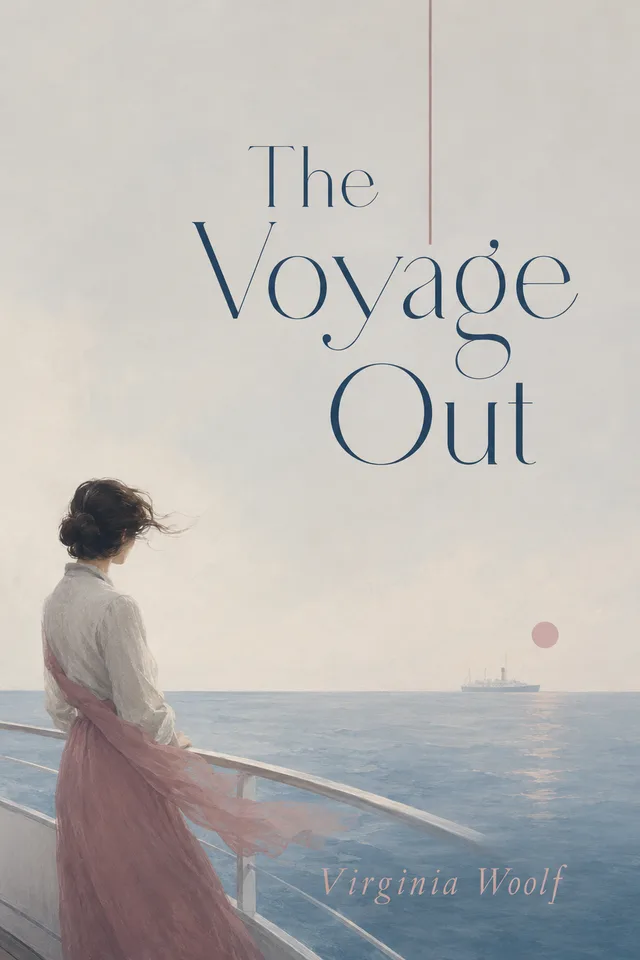
Englisch Ausgabe
Literatur
The Voyage Out
BooksWhale-Ausgabe auf Englisch von Virginia Woolf
Virginia Woolf’s debut novel, a modernist voyage into youth, society, selfhood, and emotional awakening.
- Vorschau
- Auszug aus dem vorbereiteten Text
- Formate
- Online-Reader, EPUB, PDF
- Zugriff
- Bibliotheks-Claim
Bucheinführung
The Voyage Out
The Voyage Out follows Rachel Vinrace from English society into travel, friendship, love, illness, and self-discovery. Virginia Woolf’s first novel is a key English modernist work for readers of women’s writing, psychological fiction, colonial travel, social manners, and literary experimentation.
BooksWhale-Ausgabe
Wie diese Ausgabe vorbereitet wurde
Diese Ausgabe basiert auf einem gemeinfreien Text und wurde von BooksWhale für digitales Lesen vorbereitet.
Public-Domain-Grundlage
Warum diese Ausgabe geteilt werden kann
Virginia Woolf died in 1941, and The Voyage Out was first published in 1915; these dates support the public-domain basis for this original English edition.
Vorschau lesen
Auszug aus dem vorbereiteten Text
Vorschau aus dem vorbereiteten Lesetext.
VorschaukapitelFull textVorschau lesen
The Voyage Out
Virginia Woolf
VorschaukapitelCHAPTER IVorschau
As the streets that lead from the Strand to the Embankment are very narrow, it is better not to walk down them arm-in-arm. If you persist, lawyers’ clerks will have to make flying leaps into the mud; young lady typists will have to fidget behind you. In the streets of London where beauty goes unregarded, eccentricity must pay the penalty, and it is better not to be very tall, to wear a long blue cloak, or to beat the air with your left hand.
One afternoon in the beginning of October when the traffic was becoming brisk a tall man strode along the edge of the pavement with a lady on his arm. Angry glances struck upon their backs. The small, agitated figures—for in comparison with this couple most people looked small—decorated with fountain pens, and burdened with despatch-boxes, had appointments to keep, and drew a weekly salary, so that there was some reason for the unfriendly stare which was bestowed upon Mr. Ambrose’s height and upon Mrs. Ambrose’s cloak. But some enchantment had put both man and woman beyond the reach of malice and unpopularity. In his case one might guess from the moving lips that it was thought; and in hers from the eyes fixed stonily straight in front of her at a level above the eyes of most that it was sorrow. It was only by scorning all she met that she kept herself from tears, and the friction of people brushing past her was evidently painful. After watching the traffic on the Embankment for a minute or two with a stoical gaze she twitched her husband’s sleeve, and they crossed between the swift discharge of motor cars. When they were safe on the further side, she gently withdrew her arm from his, allowing her mouth at the same time to relax, to tremble; then tears rolled down, and leaning her elbows on the balustrade, she shielded her face from the curious. Mr. Ambrose attempted consolation; he patted her shoulder; but she showed no signs of admitting him, and feeling it awkward to stand beside a grief that was greater than his, he crossed his arms behind him, and took a turn along the pavement.
The embankment juts out in angles here and there, like pulpits; instead of preachers, however, small boys occupy them, dangling string, dropping pebbles, or launching wads of paper for a cruise. With their sharp eye for eccentricity, they were inclined to think Mr. Ambrose awful; but the quickest witted cried “Bluebeard!” as he passed. In case they should proceed to tease his wife, Mr. Ambrose flourished his stick at them, upon which they decided that he was grotesque merely, and four instead of one cried “Bluebeard!” in chorus.
Although Mrs. Ambrose stood quite still, much longer than is natural, the little boys let her be. Some one is always looking into the river near Waterloo Bridge; a couple will stand there talking for half an hour on a fine afternoon; most people, walking for pleasure, contemplate for three minutes; when, having compared the occasion with other occasions, or made some sentence, they pass on. Sometimes the flats and churches and hotels of Westminster are like the outlines of Constantinople in a mist; sometimes the river is an opulent purple, sometimes mud-coloured, sometimes sparkling blue like the sea. It is always worth while to look down and see what is happening. But this lady looked neither up nor down; the only thing she had seen, since she stood there, was a circular iridescent patch slowly floating past with a straw in the middle of it. The straw and the patch swam again and again behind the tremulous medium of a great welling tear, and the tear rose and fell and dropped into the river. Then there struck close upon her ears—
Lars Porsena of Clusium By the nine Gods he swore—
VorschaukapitelCHAPTER IIVorschau
Uncomfortable as the night, with its rocking movement, and salt smells, may have been, and in one case undoubtedly was, for Mr. Pepper had insufficient clothes upon his bed, the breakfast next morning wore a kind of beauty. The voyage had begun, and had begun happily with a soft blue sky, and a calm sea. The sense of untapped resources, things to say as yet unsaid, made the hour significant, so that in future years the entire journey perhaps would be represented by this one scene, with the sound of sirens hooting in the river the night before, somehow mixing in.
The table was cheerful with apples and bread and eggs. Helen handed Willoughby the butter, and as she did so cast her eye on him and reflected, “And she married you, and she was happy, I suppose.”
She went off on a familiar train of thought, leading on to all kinds of well-known reflections, from the old wonder, why Theresa had married Willoughby?
“Of course, one sees all that,” she thought, meaning that one sees that he is big and burly, and has a great booming voice, and a fist and a will of his own; “but—” here she slipped into a fine analysis of him which is best represented by one word, “sentimental,” by which she meant that he was never simple and honest about his feelings. For example, he seldom spoke of the dead, but kept anniversaries with singular pomp. She suspected him of nameless atrocities with regard to his daughter, as indeed she had always suspected him of bullying his wife. Naturally she fell to comparing her own fortunes with the fortunes of her friend, for Willoughby’s wife had been perhaps the one woman Helen called friend, and this comparison often made the staple of their talk. Ridley was a scholar, and Willoughby was a man of business. Ridley was bringing out the third volume of Pindar when Willoughby was launching his first ship. They built a new factory the very year the commentary on Aristotle—was it?—appeared at the University Press. “And Rachel,” she looked at her, meaning, no doubt, to decide the argument, which was otherwise too evenly balanced, by declaring that Rachel was not comparable to her own children. “She really might be six years old,” was all she said, however, this judgment referring to the smooth unmarked outline of the girl’s face, and not condemning her otherwise, for if Rachel were ever to think, feel, laugh, or express herself, instead of dropping milk from a height as though to see what kind of drops it made, she might be interesting though never exactly pretty. She was like her mother, as the image in a pool on a still summer’s day is like the vivid flushed face that hangs over it.
Meanwhile Helen herself was under examination, though not from either of her victims. Mr. Pepper considered her; and his meditations, carried on while he cut his toast into bars and neatly buttered them, took him through a considerable stretch of autobiography. One of his penetrating glances assured him that he was right last night in judging that Helen was beautiful. Blandly he passed her the jam. She was talking nonsense, but not worse nonsense than people usually do talk at breakfast, the cerebral circulation, as he knew to his cost, being apt to give trouble at that hour. He went on saying “No” to her, on principle, for he never yielded to a woman on account of her sex. And here, dropping his eyes to his plate, he became autobiographical. He had not married himself for the sufficient reason that he had never met a woman who commanded his respect. Condemned to pass the susceptible years of youth in a railway station in Bombay, he had seen only coloured women, military women, official women; and his ideal was a woman who could read Greek, if not Persian, was irreproachably fair in the face, and able to understand the small things he let fall while undressing. As it was he had contracted habits of which he was not in the least ashamed. Certain odd minutes every day went to learning things by heart; he never took a ticket without noting the number; he devoted January to Petronius, February to Catullus, March to the Etruscan vases perhaps; anyhow he had done good work in India, and there was nothing to regret in his life except the fundamental defects which no wise man regrets, when the present is still his. So concluding he looked up suddenly and smiled. Rachel caught his eye.
Inhaltsverzeichnis
In dieser Ausgabe
- 01Full text
- 02CHAPTER I
- 03CHAPTER II
- 04part, they think of God as a kind of walrus; but now that my back’s
- 05ABC.”
- 06books, at the general mess. In the first place she considered Rachel
- 07CHAPTER III
- 08party. I’m dropping them on the coast.”
- 09actually sick once,” he corrected himself. “That was crossing the
- 10CHAPTER IV
- 11CHAPTER V
- 12CHAPTER VI
- 13partly of course because Rachel showed no disposition to be known. So,
- 14actresses; what clubs they belonged to, where they lived, what games
- 15CHAPTER VII
- 16CHAPTER VIII
- 17CHAPTER IX
- 18partly because she was engaged in writing a short _Primer of English
- 19CHAPTER X
- 20partly as the heroine of the play she had just read. The landscape
- 21TERENCE HEWET
- 22books—I wonder what you find in them. . . .”
- 23CHAPTER XI
- 24parties was dominated by Hughling Elliot and Mrs. Thornbury, who,
- 25CHAPTER XII
- 26party, by the faces of strangers all hostile to her, with hooked noses
- 27part of her body hung considerably in advance of her feet, which could
- 28party.
- 29partly because it was obvious that the girls were secretly hostile to
- 30activity.” He sat in his favourite position with his arms binding his
- 31CHAPTER XIII
- 32books on the floor, and their progress was stopped.
- 33CHAPTER XIV
- 34particularly on the part of women to the fact that they wanted to
- 35CHAPTER XV
- 36CHAPTER XVI
- 37parted. The expression was one of childlike intentness, as if she were
- 38parts of London; but it’s often blue over the park when London’s in a
- 39particularly if they happen to be burning wood in the keeper’s lodge
- 40acts of charity and unselfishness which flowered punctually from a
- 41part of it. Does it seem to you the kind of book you’d like to read?”
- 42CHAPTER XVII
- 43book after another; and now he was seated in his chair again, and she
- 44particular Sunday, various people tended to draw together in the hall,
- 45actually placed them on his nose—“they would not live long in
- 46CHAPTER XVIII
- 47parts. Susan used to pursue Arthur about with a sweater, because he had
- 48CHAPTER XIX
- 49particularly glad of your assistance, because there is a tiresome set
- 50book which they ought to read; and Mr. Thornbury recollected that he
- 51CHAPTER XX
- 52parties which steamed a short way up the river, landed, and looked at
- 53parts of the world one town had risen upon the ruins of another town,
- 54books or pieces of paper or embroidery on their knees, at which they
- 55books again. The morning was peaceful as the night had been, only it
- 56book and shaking it free from the dried blades of grass which had
- 57CHAPTER XXI
- 58CHAPTER XXII
- 59party. She was left, you see, with one foot in the boat, and the other
- 60CHAPTER XXIII
- 61particular. She liked women, but where emotion was concerned they were
- 62CHAPTER XXIV
- 63book, some fusty old thing that no one else would dream of reading. She
- 64CHAPTER XXV
- 65particular, and looking past him. As she appeared to be looking at a
- 66CHAPTER XXVI
- 67CHAPTER XXVII
Sprachverfügbarkeit
Andere Sprachen
Weitere Sprachausgaben sind noch nicht veröffentlicht. Sobald verfügbar, werden sie hier verlinkt.
Andere Sprache anfragen