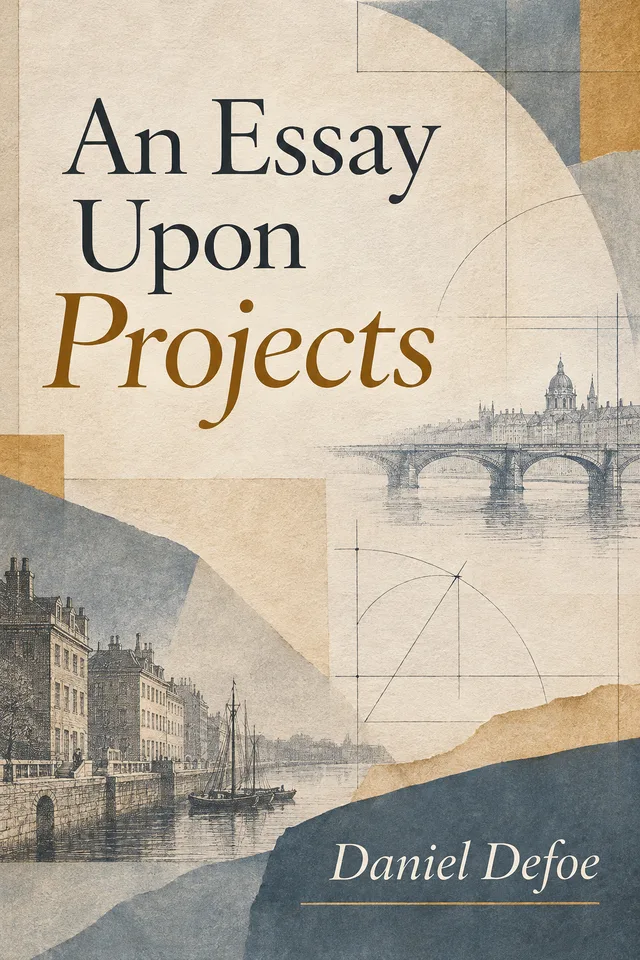
inglese Edizione
Economia
An Essay Upon Projects
Edizione BooksWhale in inglese di Daniel Defoe
Daniel Defoe proposes practical reforms for banking, roads, insurance, bankruptcy, and women’s education in late seventeenth-century England.
- Anteprima
- Estratto dal testo preparato
- Formati
- Lettore online, EPUB, PDF
- Accesso
- Claim Libreria
Introduzione al libro
An Essay Upon Projects
In his first published book, Defoe turns the appetite for schemes in his own age into proposals for public improvement. He considers who should pay for roads, how banking might serve the counties, and how insurance and mutual aid could protect families. A chapter on academies argues that women should have access to serious education.
Edizione BooksWhale
Come è stata preparata
Questa edizione si basa su un testo di pubblico dominio ed è stata preparata da BooksWhale per la lettura digitale.
Base di pubblico dominio
Perché può essere condivisa
Daniel Defoe died in 1731. The original English work dates to 1697; this edition uses the text provided by Project Gutenberg and marked public domain in the United States.
Leggi anteprima
Estratto dal testo preparato
Anteprima selezionata dal testo preparato per la lettura.
Capitolo in anteprimaAUTHOR’S PREFACE.Leggi anteprima
To DALBY THOMAS, Esq.,
One of the Commission’s for Managing His majesty’s Duties on Glass, &c.
Sir,
This preface comes directed to you, not as commissioner, &c., under whom I have the honour to serve his Majesty, nor as a friend, though I have great obligations of that sort also, but as the most proper judge of the subjects treated of, and more capable than the greatest part of mankind to distinguish and understand them.
Books are useful only to such whose genius are suitable to the subject of them; and to dedicate a book of projects to a person who had never concerned himself to think that way would be like music to one that has no ear.
And yet your having a capacity to judge of these things no way brings you under the despicable title of a projector, any more than knowing the practices and subtleties of wicked men makes a man guilty of their crimes.
The several chapters of this book are the results of particular thoughts occasioned by conversing with the public affairs during the present war with France. The losses and casualties which attend all trading nations in the world, when involved in so cruel a war as this, have reached us all, and I am none of the least sufferers; if this has put me, as well as others, on inventions and projects, so much the subject of this book, it is no more than a proof of the reason I give for the general projecting humour of the nation.
One unhappiness I lie under in the following book, viz.: That having kept the greatest part of it by me for near five years, several of the thoughts seem to be hit by other hands, and some by the public, which turns the tables upon me, as if I had borrowed from them.
As particularly that of the seamen, which you know well I had contrived long before the Act for registering seamen was proposed. And that of educating women, which I think myself bound to declare, was formed long before the book called “Advice to the Ladies” was made public; and yet I do not write this to magnify my own invention, but to acquit myself from grafting on other people’s thoughts. If I have trespassed upon any person in the world, it is upon yourself, from whom I had some of the notions about county banks, and factories for goods, in the chapter of banks; and yet I do not think that my proposal for the women or the seamen clashes at all, either with that book, or the public method of registering seamen.
I have been told since this was done that my proposal for a commission of inquiries into bankrupt estates is borrowed from the Dutch; if there is anything like it among the Dutch, it is more than ever I knew, or know yet; but if so, I hope it is no objection against our having the same here, especially if it be true that it would be so publicly beneficial as is expressed.
What is said of friendly societies, I think no man will dispute with me, since one has met with so much success already in the practice of it. I mean the Friendly Society for Widows, of which you have been pleased to be a governor.
Friendly societies are very extensive, and, as I have hinted, might be carried on to many particulars. I have omitted one which was mentioned in discourse with yourself, where a hundred tradesmen, all of several trades, agree together to buy whatever they want of one another, and nowhere else, prices and payments to be settled among themselves; whereby every man is sure to have ninety-nine customers, and can never want a trade; and I could have filled up the book with instances of like nature, but I never designed to fire the reader with particulars.
Capitolo in anteprimaAUTHOR’S INTRODUCTION.Anteprima
Necessity, which is allowed to be the mother of invention, has so violently agitated the wits of men at this time that it seems not at all improper, by way of distinction, to call it the Projecting Age. For though in times of war and public confusions the like humour of invention has seemed to stir, yet, without being partial to the present, it is, I think, no injury to say the past ages have never come up to the degree of projecting and inventing, as it refers to matters of negotiation and methods of civil polity, which we see this age arrived to.
Nor is it a hard matter to assign probable causes of the perfection in this modern art. I am not of their melancholy opinion who ascribe it to the general poverty of the nation, since I believe it is easy to prove the nation itself, taking it as one general stock, is not at all diminished or impoverished by this long, this chargeable war, but, on the contrary, was never richer since it was inhabited.
Nor am I absolutely of the opinion that we are so happy as to be wiser in this age than our forefathers; though at the same time I must own some parts of knowledge in science as well as art have received improvements in this age altogether concealed from the former.
The art of war, which I take to be the highest perfection of human knowledge, is a sufficient proof of what I say, especially in conducting armies and in offensive engines. Witness the now ways of rallies, fougades, entrenchments, attacks, lodgments, and a long et cetera of new inventions which want names, practised in sieges and encampments; witness the new forts of bombs and unheard-of mortars, of seven to ten ton weight, with which our fleets, standing two or three miles off at sea, can imitate God Almighty Himself and rain fire and brimstone out of heaven, as it were, upon towns built on the firm land; witness also our new-invented child of hell, the machine which carries thunder, lightning, and earthquakes in its bowels, and tears up the most impregnable fortification.
But if I would search for a cause from whence it comes to pass that this age swarms with such a multitude of projectors more than usual, who—besides the innumerable conceptions, which die in the bringing forth, and (like abortions of the brain) only come into the air and dissolve—do really every day produce new contrivances, engines, and projects to get money, never before thought of; if, I say, I would examine whence this comes to pass, it must be thus:
The losses and depredations which this war brought with it at first were exceeding many, suffered chiefly by the ill-conduct of merchants themselves, who did not apprehend the danger to be really what it was: for before our Admiralty could possibly settle convoys, cruisers, and stations for men-of-war all over the world, the French covered the sea with their privateers and took an incredible number of our ships. I have heard the loss computed, by those who pretended they were able to guess, at above fifteen millions of pounds sterling, in ships and goods, in the first two or three years of the war—a sum which, if put into French, would make such a rumbling sound of great numbers as would fright a weak accountant out of his belief, being no less than one hundred and ninety millions of livres. The weight of this loss fell chiefly on the trading part of the nation, and, amongst them, on the merchants; and amongst them, again, upon the most refined capacities, as the insurers, &c. And an incredible number of the best merchants in the kingdom sunk under the load, as may appear a little by a Bill which once passed the House of Commons for the relief of merchant-insurers, who had suffered by the war with France. If a great many fell, much greater were the number of those who felt a sensible ebb of their fortunes, and with difficulty bore up under the loss of great part of their estates. These, prompted by necessity, rack their wits for new contrivances, new inventions, new trades, stocks, projects, and anything to retrieve the desperate credit of their fortunes. That this is probable to be the cause will appear further thus. France (though I do not believe all the great outcries we make of their misery and distress—if one-half of which be true, they are certainly the best subjects in the world) yet without question has felt its share of the losses and damages of the war; but the poverty there falling chiefly on the poorer sort of people, they have not been so fruitful in inventions and practices of this nature, their genius being quite of another strain. As for the gentry and more capable sort, the first thing a Frenchman flies to in his distress is the army; and he seldom comes back from thence to get an estate by painful industry, but either has his brains knocked out or makes his fortune there.
Capitolo in anteprimaThe History of Projects.Anteprima
When I speak of writing a History of Projects, I do not mean either of the introduction of, or continuing, necessary inventions, or the improvement of arts and sciences before known, but a short account of projects and projecting, as the word is allowed in the general acceptation at this present time; and I need not go far back for the original of the practice.
Invention of arts, with engines and handicraft instruments for their improvement, requires a chronology as far back as the eldest son of Adam, and has to this day afforded some new discovery in every age.
The building of the Ark by Noah, so far as you will allow it a human work, was the first project I read of; and, no question, seemed so ridiculous to the graver heads of that wise, though wicked, age that poor Noah was sufficiently bantered for it: and, had he not been set on work by a very peculiar direction from heaven, the good old man would certainly have been laughed out of it as a most senseless ridiculous project.
The building of Babel was a right project; for indeed the true definition of a project, according to modern acceptation, is, as is said before, a vast undertaking, too big to be managed, and therefore likely enough to come to nothing. And yet, as great as they are, it is certainly true of them all, even as the projectors propose: that, according to the old tale, if so many eggs are hatched, there will be so many chickens, and those chickens may lay so many eggs more, and those eggs produce so many chickens more, and so on. Thus it was most certainly true that if the people of the Old World could have built a house up to heaven, they should never be drowned again on earth, and they only had forgot to measure the height; that is, as in other projects, it only miscarried, or else it would have succeeded.
And yet, when all is done, that very building, and the incredible height it was carried, is a demonstration of the vast knowledge of that infant age of the world, who had no advantage of the experiments or invention of any before themselves.
“Thus when our fathers, touched with guilt, That huge stupendous staircase built; We mock, indeed, the fruitless enterprise (For fruitless actions seldom pass for wise), But were the mighty ruins left, they’d show To what degree that untaught age did know.”
I believe a very diverting account might be given of this, but I shall not attempt it. Some are apt to say with Solomon, “No new thing happens under the sun; but what is, has been:” yet I make no question but some considerable discovery has been made in these latter ages, and inventions of human origin produced, which the world was ever without before, either in whole or in part; and I refer only to two cardinal points, the use of the loadstone at sea, and the use of gunpowder and guns: both which, as to the inventing part, I believe the world owes as absolutely to those particular ages as it does the working in brass and iron to Tubal Cain, or the inventing of music to Jubal, his brother. As to engines and instruments for handicraftsmen, this age, I daresay, can show such as never were so much as thought of, much less imitated before; for I do not call that a real invention which has something before done like it—I account that more properly an improvement. For handicraft instruments, I know none owes more to true genuine contrivance, without borrowing from any former use, than a mechanic engine contrived in our time called a knitting-frame, which, built with admirable symmetry, works really with a very happy success, and may be observed by the curious to have a more than ordinary composition; for which I refer to the engine itself, to be seen in every stocking-weaver’s garret.
Indice
In questa edizione
- 01AUTHOR’S PREFACE.
- 02AUTHOR’S INTRODUCTION.
- 03The History of Projects.
- 04OF PROJECTORS.
- 05OF BANKS.
- 06Of the Multiplicity of Banks.
- 07OF THE HIGHWAYS.
- 08OF ASSURANCES.
- 09OF FRIENDLY SOCIETIES.
- 10Of Seamen.
- 11I.
- 12II.—FOR WIDOWS.
- 13THE PROPOSAL IS FOR A PENSION OFFICE.
- 14OF WAGERING.
- 15OF FOOLS.
- 16A CHARITY-LOTTERY.
- 17OF BANKRUPTS.
- 18A Court of Inquiries.
- 19OF ACADEMIES.
- 20Royal Academy for Military Exercises.
- 21Academy for Women.
- 22OF A COURT MERCHANT.
- 23OF SEAMEN.
- 24The Consequences of this Method.
- 25THE CONCLUSION.
Disponibilità lingue
Altre lingue
Altre edizioni linguistiche non sono ancora pubblicate. Qui appariranno quando disponibili.
Richiedi un'altra lingua