inglese Edizione
Letteratura
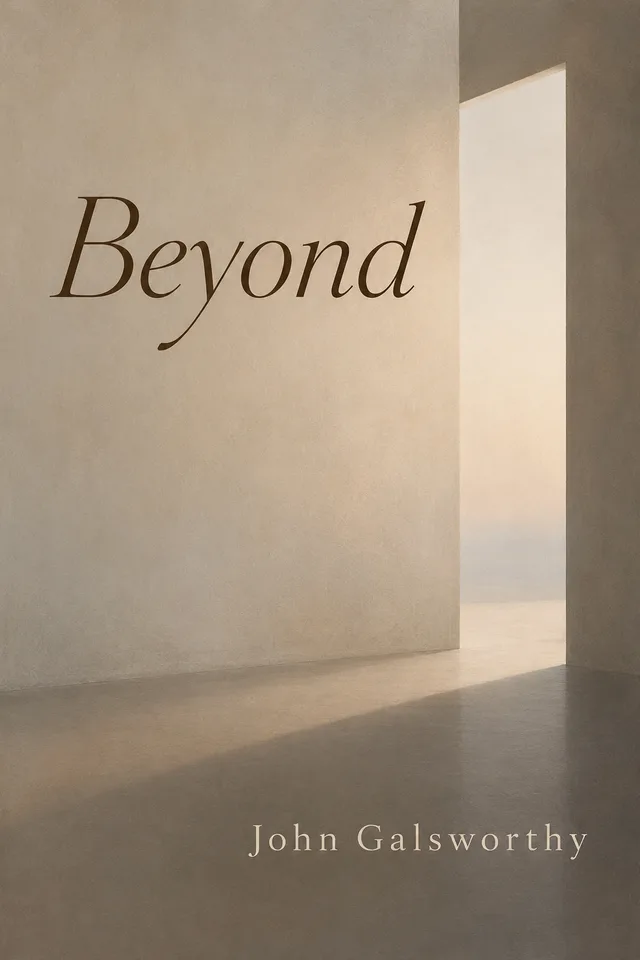
Beyond
Edizione BooksWhale in inglese di John Galsworthy
A woman’s search for affection and independence unfolds through marriage, music, family loyalty, and the constraints of English social life.
- Anteprima
- Estratto dal testo preparato
- Formati
- Lettore online, EPUB, PDF
- Accesso
- Claim Libreria
Introduzione al libro
Beyond
Beyond follows Gyp Winton as love, marriage, and emotional dependence unsettle the protections of her upbringing. John Galsworthy explores the competing claims of desire, respectability, parenthood, and personal freedom. The novel’s four parts trace private choices and their consequences through closely observed domestic relationships and the social expectations surrounding them.
Edizione BooksWhale
Come è stata preparata
Questa edizione si basa su un testo di pubblico dominio ed è stata preparata da BooksWhale per la lettura digitale.
Base di pubblico dominio
Perché può essere condivisa
John Galsworthy died in 1933. This edition uses the original English text of Beyond from Project Gutenberg, which identifies this source as public domain in the United States; later editorial notes and illustrations are excluded.
Leggi anteprima
Estratto dal testo preparato
Anteprima selezionata dal testo preparato per la lettura.
Capitolo in anteprimaFull textLeggi anteprima
Beyond
John Galsworthy
“Che faro senza—!”
To Thomas Hardy
Capitolo in anteprimaPart IAnteprima
Part I
Capitolo in anteprimaIAnteprima
At the door of St. George's registry office, Charles Clare Winton strolled forward in the wake of the taxi-cab that was bearing his daughter away with “the fiddler fellow” she had married. His sense of decorum forbade his walking with Nurse Betty—the only other witness of the wedding. A stout woman in a highly emotional condition would have been an incongruous companion to his slim, upright figure, moving with just that unexaggerated swing and balance becoming to a lancer of the old school, even if he has been on the retired list for sixteen years.
Poor Betty! He thought of her with irritated sympathy—she need not have given way to tears on the door-step. She might well feel lost now Gyp was gone, but not so lost as himself! His pale-gloved hand—the one real hand he had, for his right hand had been amputated at the wrist—twisted vexedly at the small, grizzling moustache lifting itself from the corners of his firm lips. On this grey February day he wore no overcoat; faithful to the absolute, almost shamefaced quietness of that wedding, he had not even donned black coat and silk hat, but wore a blue suit and a hard black felt. The instinct of a soldier and hunting man to exhibit no sign whatever of emotion did not desert him this dark day of his life; but his grey-hazel eyes kept contracting, staring fiercely, contracting again; and, at moments, as if overpowered by some deep feeling, they darkened and seemed to draw back in his head. His face was narrow and weathered and thin-cheeked, with a clean-cut jaw, small ears, hair darker than the moustache, but touched at the side wings with grey—the face of a man of action, self-reliant, resourceful. And his bearing was that of one who has always been a bit of a dandy, and paid attention to “form,” yet been conscious sometimes that there were things beyond. A man, who, preserving all the precision of a type, yet had in him a streak of something that was not typical. Such often have tragedy in their pasts.
Making his way towards the park, he turned into Mount Street. There was the house still, though the street had been very different then—the house he had passed, up and down, up and down in the fog, like a ghost, that November afternoon, like a cast-out dog, in such awful, unutterable agony of mind, twenty-three years ago, when Gyp was born. And then to be told at the door—he, with no right to enter, he, loving as he believed man never loved woman—to be told at the door that SHE was dead—dead in bearing what he and she alone knew was their child! Up and down in the fog, hour after hour, knowing her time was upon her; and at last to be told that! Of all fates that befall man, surely the most awful is to love too much.
Queer that his route should take him past the very house to-day, after this new bereavement! Accursed luck—that gout which had sent him to Wiesbaden, last September! Accursed luck that Gyp had ever set eyes on this fellow Fiorsen, with his fatal fiddle! Certainly not since Gyp had come to live with him, fifteen years ago, had he felt so forlorn and fit for nothing. To-morrow he would get back to Mildenham and see what hard riding would do. Without Gyp—to be without Gyp! A fiddler! A chap who had never been on a horse in his life! And with his crutch-handled cane he switched viciously at the air, as though carving a man in two.
His club, near Hyde Park Corner, had never seemed to him so desolate. From sheer force of habit he went into the card-room. The afternoon had so darkened that electric light already burned, and there were the usual dozen of players seated among the shaded gleams falling decorously on dark-wood tables, on the backs of chairs, on cards and tumblers, the little gilded coffee-cups, the polished nails of fingers holding cigars. A crony challenged him to piquet. He sat down listless. That three-legged whist—bridge—had always offended his fastidiousness—a mangled short cut of a game! Poker had something blatant in it. Piquet, though out of fashion, remained for him the only game worth playing—the only game which still had style. He held good cards and rose the winner of five pounds that he would willingly have paid to escape the boredom of the bout. Where would they be by now? Past Newbury; Gyp sitting opposite that Swedish fellow with his greenish wildcat's eyes. Something furtive, and so foreign, about him! A mess—if he were any judge of horse or man! Thank God he had tied Gyp's money up—every farthing! And an emotion that was almost jealousy swept him at the thought of the fellow's arms round his soft-haired, dark-eyed daughter—that pretty, willowy creature, so like in face and limb to her whom he had loved so desperately.
Indice
In questa edizione
- 01Full text
- 02Part I
- 03I
- 04II
- 05III
- 06IV
- 07V
- 08VI
- 09Part II
- 10I
- 11II
- 12III
- 13IV
- 14V
- 15VI
- 16VII
- 17VIII
- 18IX
- 19X
- 20XI
- 21XII
- 22XIII
- 23XIV
- 24XV
- 25XVI
- 26XVII
- 27XVIII
- 28XIX
- 29XX
- 30XXI
- 31Part III
- 32I
- 33II
- 34III
- 35IV
- 36V
- 37VI
- 38VII
- 39VIII
- 40IX
- 41X
- 42XI
- 43XII
- 44XIII
- 45XIV
- 46Part IV
- 47I
- 48II
- 49III
- 50IV
- 51V
- 52VI
- 53VII
- 54VIII
- 55IX
- 56X
- 57XI
- 58XII
Disponibilità lingue
Altre lingue
Altre edizioni linguistiche non sono ancora pubblicate. Qui appariranno quando disponibili.
Richiedi un'altra lingua