inglese Edizione
Letteratura
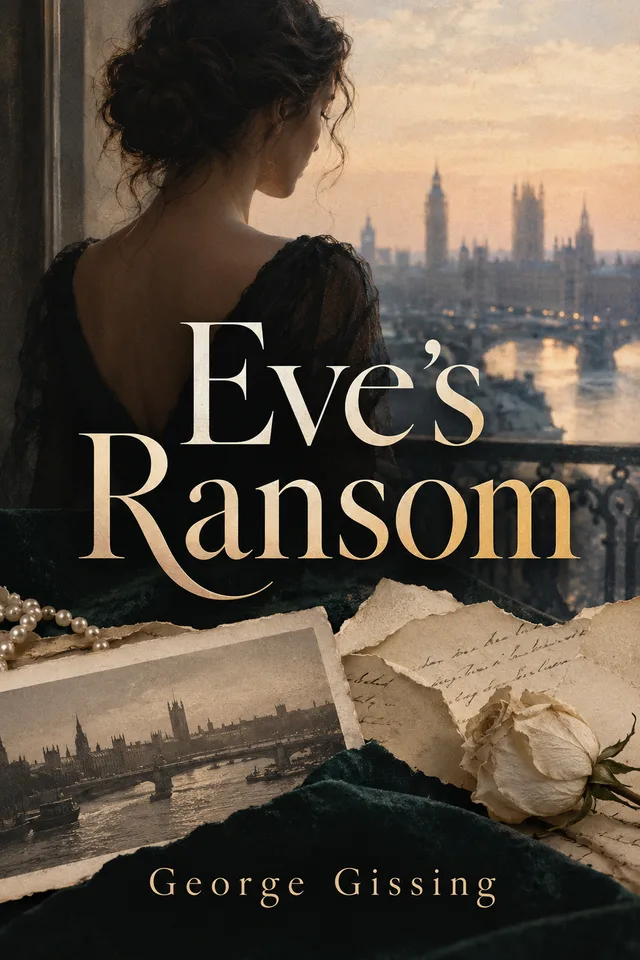
Eve's Ransom
Edizione BooksWhale in inglese di George Gissing
Hilliard’s encounter with a photograph leads to a complicated attachment shaped by money, independence, disappointment, and unequal expectations.
- Anteprima
- Estratto dal testo preparato
- Formati
- Lettore online, EPUB, PDF
- Accesso
- Claim Libreria
Introduzione al libro
Eve's Ransom
An unexpected financial opportunity allows Maurice Hilliard to leave his familiar routine and pursue the woman whose photograph has caught his attention. Eve Madeley’s circumstances and choices resist the romantic story he imagines. George Gissing examines work, class, dependency, and the awkward relation between generosity and possession. This English novel follows Hilliard’s emotional education across twenty-seven original chapters.
Edizione BooksWhale
Come è stata preparata
Questa edizione si basa su un testo di pubblico dominio ed è stata preparata da BooksWhale per la lettura digitale.
Base di pubblico dominio
Perché può essere condivisa
George Gissing died in 1903. This edition uses the original English text preserved by Project Gutenberg, excluding separate notes and later editorial material.
Leggi anteprima
Estratto dal testo preparato
Anteprima selezionata dal testo preparato per la lettura.
Capitolo in anteprimaCHAPTER ILeggi anteprima
On the station platform at Dudley Port, in the dusk of a February afternoon, half-a-dozen people waited for the train to Birmingham. A south-west wind had loaded the air with moisture, which dripped at moments, thinly and sluggishly, from a featureless sky. The lamps, just lighted, cast upon wet wood and metal a pale yellow shimmer; voices sounded with peculiar clearness; so did the rumble of a porter's barrow laden with luggage. From a foundry hard by came the muffled, rhythmic thunder of mighty blows; this and the long note of an engine-whistle wailing far off seemed to intensify the stillness of the air as gloomy day passed into gloomier night.
In clear daylight the high, uncovered platform would have offered an outlook over the surrounding country, but at this hour no horizon was discernible. Buildings near at hand, rude masses of grimy brick, stood out against a grey confused background; among them rose a turret which vomited crimson flame. This fierce, infernal glare seemed to lack the irradiating quality of earthly fires; with hard, though fluctuating outline, it leapt towards the kindred night, and diffused a blotchy darkness. In the opposite direction, over towards Dudley Town, appeared spots of lurid glow. But on the scarred and barren plain which extends to Birmingham there had settled so thick an obscurity, vapours from above blending with earthly reek, that all tile beacons of fiery toil were wrapped and hidden.
Of the waiting travellers, two kept apart from the rest, pacing this way and that, but independently of each other. They were men of dissimilar appearance; the one comfortably and expensively dressed, his age about fifty, his visage bearing the stamp of commerce; the other, younger by more than twenty years, habited in a way which made it; difficult to as certain his social standing, and looking about him with eyes suggestive of anything but prudence or content. Now and then they exchanged a glance: he of the high hat and caped ulster betrayed an interest in the younger man, who, in his turn, took occasion to observe the other from a distance, with show of dubious recognition.
The trill of an electric signal, followed by a clanging bell, brought them both to a pause, and they stood only two or three yards apart. Presently a light flashed through the thickening dusk; there was roaring, grinding, creaking and a final yell of brake-tortured wheels. Making at once for the nearest third-class carriage, the man in the seedy overcoat sprang to a place, and threw himself carelessly back; a moment, and he was followed by the second passenger, who seated himself on the opposite side of the compartment. Once more they looked at each other, but without change of countenance.
Tickets were collected, for there would be no stoppage before Birmingham: then the door slammed, and the two men were alone together.
Two or three minutes after the train had started, the elder man leaned forward, moved slightly, and spoke.
"Excuse me, I think your name must be Hilliard."
"What then?" was the brusque reply.
"You don't remember me?"
"Scoundrels are common enough," returned the other, crossing his legs, "but I remember you for all that."
The insult was thrown out with a peculiarly reckless air; it astounded the hearer, who sat for an instant with staring eyes and lips apart; then the blood rushed to his cheeks.
"If I hadn't just about twice your muscle, my lad," he answered angrily, "I'd make you repent that, and be more careful with your tongue in future. Now, mind what you say! We've a quiet quarter of an hour before us, and I might alter my mind."
The young man laughed contemptuously. He was tall, but slightly built, and had delicate hands.
"So you've turned out a blackguard, have you?" pursued his companion, whose name was Dengate. "I heard something about that."
"From whom?"
"You drink, I am told. I suppose that's your condition now."
Capitolo in anteprimaCHAPTER IIAnteprima
An hour later he was at Old Square, waiting for the tram to Aston. Huge steam-driven vehicles came and went, whirling about the open space with monitory bell-clang. Amid a press of homeward-going workfolk, Hilliard clambered to a place on the top and lit his pipe. He did not look the same man who had waited gloomily at Dudley Port; his eyes gleamed with life; answering a remark addressed to him by a neighbour on the car, he spoke jovially.
No rain was falling, but the streets shone wet and muddy under lurid lamp-lights. Just above the house-tops appeared the full moon, a reddish disk, blurred athwart floating vapour. The car drove northward, speedily passing from the region of main streets and great edifices into a squalid district of factories and workshops and crowded by-ways. At Aston Church the young man alighted, and walked rapidly for five minutes, till he reached a row of small modern houses. Socially they represented a step or two upwards in the gradation which, at Birmingham, begins with the numbered court and culminates in the mansions of Edgbaston.
He knocked at a door, and was answered by a girl, who nodded recognition.
"Mrs. Hilliard in? Just tell her I'm here."
There was a natural abruptness in his voice, but it had a kindly note, and a pleasant smile accompanied it. After a brief delay he received permission to go upstairs, where the door of a sitting-room stood open. Within was a young woman, slight, pale, and pretty, who showed something of embarrassment, though her face made him welcome.
"I expected you sooner."
"Business kept me back. Well, little girl?"
The table was spread for tea, and at one end of it, on a high chair, sat a child of four years old. Hilliard kissed her, and stroked her curly hair, and talked with playful affection. This little girl was his niece, the child of his elder brother, who had died three years ago. The poorly furnished room and her own attire proved that Mrs. Hilliard had but narrow resources in her widowhood. Nor did she appear a woman of much courage; tears had thinned her cheeks, and her delicate hands had suffered noticeably from unwonted household work.
Hilliard remarked something unusual in her behaviour this evening. She was restless, and kept regarding him askance, as if in apprehension. A letter from her, in which she merely said she wished to speak to him, had summoned him hither from Dudley. As a rule, they saw each other but once a month.
"No bad news, I hope!" he remarked aside to her, as he took his place at the table.
"Oh, no. I'll tell you afterwards."
Very soon after the meal Mrs. Hilliard took the child away and put her to bed. During her absence the visitor sat brooding, a peculiar half-smile on his face. She came back, drew a chair up to the fire, but did not sit down.
"Well, what is it?" asked her brother-in-law, much as he might have spoken to the little girl.
"I have something very serious to talk about, Maurice."
"Have you? All right; go ahead."
"I—I am so very much afraid I shall offend you."
The young man laughed.
"Not very likely. I can take a good deal from you."
She stood with her hands on the back of the chair, and as he looked at her, Hilliard saw her pale cheeks grow warm.
"It'll seem very strange to you, Maurice."
"Nothing will seem strange after an adventure I've had this afternoon. You shall hear about it presently."
"Tell me your story first."
"That's like a woman. All right, I'll tell you. I met that scoundrel Dengate, and—he's paid me the money he owed my father."
"He has paid it? Oh! really?"
"See, here's a cheque, and I think it likely I can turn it into cash. The blackguard has been doing well at Liverpool. I'm not quite sure that I understand the reptile, but he seems to have given me this because I abused him. I hurt his vanity, and he couldn't resist the temptation to astonish me. He thinks I shall go about proclaiming him a noble fellow. Four hundred and thirty-six pounds; there it is."
Capitolo in anteprimaCHAPTER IIIAnteprima
Instead of making for the railway station, to take a train back to Dudley, he crossed from the northern to the southern extremity of the town, and by ten o'clock was in one of the streets which lead out of Moseley Road. Here, at a house such as lodges young men in business, he made inquiry for "Mr. Narramore," and was forthwith admitted.
Robert Narramore, a long-stemmed pipe at his lips, sat by the fireside; on the table lay the materials of a satisfactory supper—a cold fowl, a ham, a Stilton cheese, and a bottle of wine.
"Hollo! You?" he exclaimed, without rising. "I was going to write to you; thanks for saving me the trouble. Have something to eat?"
"Yes, and to drink likewise."
"Do you mind ringing the bell? I believe there's a bottle of Burgundy left. If not, plenty of Bass."
He stretched forth a languid hand, smiling amiably. Narramore was the image of luxurious indolence; he had pleasant features, dark hair inclined to curliness, a well-built frame set off by good tailoring. His income from the commercial house in which he held a post of responsibility would have permitted him to occupy better quarters than these; but here he had lived for ten years, and he preferred a few inconveniences to the trouble of moving. Trouble of any kind was Robert's bugbear. His progress up the commercial ladder seemed due rather to the luck which favours amiable and good-looking young fellows than to any special ability or effort of his own. The very sound of his voice had a drowsiness which soothed—if it did not irritate—the listener.
"Tell them to lay out the truckle-bed," said Hilliard, when he had pulled the bell. "I shall stay here to-night."
"Good!"
Their talk was merely interjectional, until the visitor had begun to appease his hunger and had drawn the cork of a second bottle of bitter ale.
"This is a great day," Hilliard then exclaimed. "I left Dudley this afternoon feeling ready to cut my throat. Now I'm a free man, with the world before me."
"How's that?"
"Emily's going to take a second husband—that's one thing."
"Heaven be praised! Better than one could have looked for."
Hilliard related the circumstances. Then he drew from his pocket an oblong slip of paper, and held it out.
"Dengate?" cried his friend. "How the deuce did you get hold of this?"
Explanation followed. They debated Dengate's character and motives.
"I can understand it," said Narramore. "When I was a boy of twelve I once cheated an apple-woman out of three-halfpence. At the age of sixteen I encountered the old woman again, and felt immense satisfaction in giving her a shilling. But then, you see, I had done with petty cheating; I wished to clear my conscience, and look my fellow-woman in the face."
"That's it, no doubt. He seems to have got some sort of position in Liverpool society, and he didn't like the thought that there was a poor devil at Dudley who went about calling him a scoundrel. By-the-bye, someone told him that I had taken to liquor, and was on my way to destruction generally. I don't know who it could be."
"Oh, we all have candid friends that talk about us.
"It's true I have been drunk now and then of late. There's much to be said for getting drunk."
"Much," assented Narramore, philosophically.
Hilliard went on with his supper; his friend puffed tobacco, and idly regarded the cheque he was still holding.
"And what are you going to do?" he asked at length.
There came no reply, and several minutes passed in silence. Then Hilliard rose from the table, paced the floor once or twice, selected a cigar from a box that caught his eye, and, in cutting off the end, observed quietly—
"I'm going to live."
"Wait a minute. We'll have the table cleared, and a kettle on the fire."
Indice
In questa edizione
- 01CHAPTER I
- 02CHAPTER II
- 03CHAPTER III
- 04CHAPTER IV
- 05CHAPTER V
- 06CHAPTER VI
- 07CHAPTER VII
- 08CHAPTER VIII
- 09CHAPTER IX
- 10CHAPTER X
- 11CHAPTER XI
- 12CHAPTER XII
- 13CHAPTER XIII
- 14CHAPTER XIV
- 15CHAPTER XV
- 16CHAPTER XVI
- 17CHAPTER XVII
- 18CHAPTER XVIII
- 19CHAPTER XIX
- 20CHAPTER XX
- 21CHAPTER XXI
- 22CHAPTER XXII
- 23CHAPTER XXIII
- 24CHAPTER XXIV
- 25CHAPTER XXV
- 26CHAPTER XXVI
- 27CHAPTER XXVII
Disponibilità lingue
Altre lingue
Altre edizioni linguistiche non sono ancora pubblicate. Qui appariranno quando disponibili.
Richiedi un'altra lingua