inglese Edizione
Letteratura
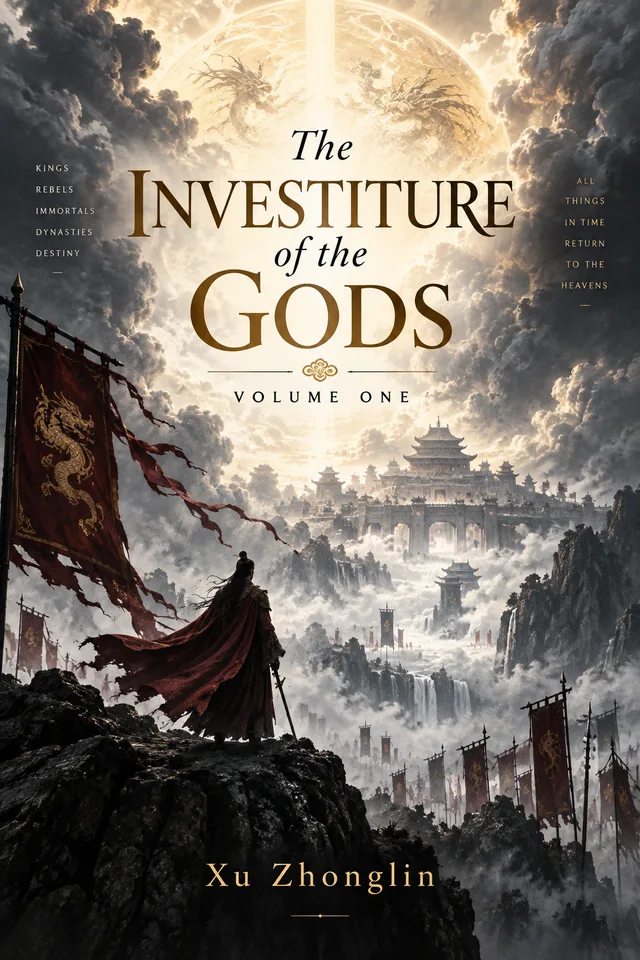
The Investiture of the Gods, Volume One
Edizione BooksWhale in inglese di Xu Zhonglin
Titolo originale: 封神演义
A mythic epic of gods, kings, rebels, immortals, dynastic conflict, and cosmic destiny.
- Anteprima
- Estratto dal testo preparato
- Formati
- Lettore online, EPUB, PDF
- Accesso
- Claim Libreria
Introduzione al libro
The Investiture of the Gods, Volume One
Volume One begins the conflict between the Shang and Zhou worlds, combining court politics, military campaigns, divine interventions, legendary heroes, loyalty, and betrayal.
Edizione BooksWhale
Come è stata preparata
Questa edizione si basa su un testo di pubblico dominio ed è stata preparata da BooksWhale per la lettura digitale.
Base di pubblico dominio
Perché può essere condivisa
The sixteenth-century Chinese source text is public domain. This edition is an authorized AI-assisted translation.
Leggi anteprima
Estratto dal testo preparato
Anteprima selezionata dal testo preparato per la lettura.
Capitolo in anteprimaFull textLeggi anteprima
The Investiture of the Gods, Volume One
Xu Zhonglin
Investiture of the Gods
Fengshen Yanyi, Vol. 1
Capitolo in anteprimaPrefaceAnteprima
Attributed to the Ming dynasty writer Xu Zhonglin, Investiture of the Gods: Fengshen Yanyi stands as one of the most imaginative and influential works of Chinese mythological fiction. Blending history, folklore, religion, and fantasy, the novel offers readers a sweeping narrative of cosmic conflict and moral transformation set against the decline of the Shang dynasty and the rise of the Zhou. Yet to approach this work merely as historical fiction would be to overlook its deeper significance: it is, above all, a grand allegory of the moral order of the universe.
At its surface, Fengshen Yanyi recounts the downfall of the tyrannical King Zhou of Shang, whose descent into cruelty and indulgence brings suffering upon his people and invites divine retribution. Opposing him is King Wu of Zhou, supported not only by loyal generals and wise ministers but also by an entire pantheon of immortals, sages, and spirits. The narrative unfolds as a vast struggle between good and evil, justice and corruption, heaven and chaos. However, beneath this epic confrontation lies a more intricate philosophical framework shaped by Daoist and Buddhist thought.
The title itself—“Investiture of the Gods”—refers to the celestial appointment of deities following the great conflict. Heroes, villains, and even tragic figures who perish in the struggle are ultimately assigned positions within the heavenly bureaucracy. This concept reflects a uniquely Chinese cosmology, in which the divine realm mirrors the structure of the human world, governed by hierarchy, merit, and moral consequence. Death is not an end, but a transformation; suffering is not meaningless, but part of a larger cosmic design.
One of the most striking features of the novel is its rich tapestry of characters. From cunning strategists like Jiang Ziya to powerful immortals such as Nezha and Yang Jian, each figure embodies distinct virtues, flaws, and destinies. Even antagonists are portrayed with a complexity that invites reflection rather than simple condemnation. The result is a narrative world that feels both fantastical and deeply human, where divine intervention coexists with personal ambition, loyalty, and sacrifice.
The stylistic charm of Fengshen Yanyi lies in its seamless integration of the supernatural with the mundane. Battles are fought not only with swords and armies, but with spells, talismans, and mystical artifacts. Mountains split, storms rage, and spirits descend, yet these extraordinary events are woven into a narrative rhythm that remains grounded in human emotion and ethical tension. This fusion of myth and reality has made the novel a lasting source of inspiration in Chinese opera, visual arts, and modern media.
For contemporary readers, especially those encountering the work in translation, Investiture of the Gods offers more than entertainment. It opens a window into the spiritual imagination of traditional China, revealing how ancient writers grappled with questions of justice, fate, and the nature of power. The novel challenges us to consider the consequences of moral failure and the possibility of redemption within a universe governed by unseen forces.
At the same time, the text invites comparison with other great mythological epics of the world. Like Homer’s Iliad or the Indian Mahabharata, it presents a cosmos in which human affairs are inseparable from divine will. Yet its distinctly Chinese sensibility—its emphasis on harmony, balance, and moral order—gives it a unique voice among global classics.
In presenting this translation, it is hoped that readers will not only follow the unfolding drama of kings and immortals, but also appreciate the deeper currents that animate the story. Fengshen Yanyi is not merely a tale of gods being created; it is a meditation on how order emerges from chaos, how virtue is tested in adversity, and how the boundaries between the mortal and the divine are continually reshaped.
To read this work is to enter a world where history becomes legend, and legend becomes a reflection of eternal truths.
Capitolo in anteprimaPrologueAnteprima
When chaos first was cleft, Pangu came before;
The Great Ultimate hung forth Two Forms and Four.
Heaven rose at Zi, earth at Chou was framed,
At Yin mankind appeared, by Youchao tamed
The beasts’ affliction, building nests for men;
Suiren drew fire and ended raw food then.
Fuxi traced trigrams, yin and yang made plain;
Shennong ruled, tasting herbs for people’s gain.
Xuanyuan set rites, music, marriage law;
Shaohao and the Five Emperors made all flourish more.
Yu quelled the floods and drained the surging wave;
Four hundred years of peace the Xia kings gave,
Till wicked Jie overturned earth and sky,
And spent his days with Meixi, wine, and lust run high.
Tang founded Bo, washed foulness from the land,
Exiled Jie to Nanchao with righteous hand;
The people, long as drought awaiting rain,
Revived as clouds and rainbow came again.
Through thirty-one descents to Yin’s King Zhou,
The Shang line thinned like strings about to go.
He wrecked the court, destroyed all human ties,
Killed wife and son, believed slander and lies.
He fouled the palace, doted on Daji,
Made Scorpion Pit and Burning Pillar misery.
At Deer Terrace he amassed the people’s store,
Their grief and rancor darkened Heaven’s door.
He burned and butchered those who dared advise;
Ripped open loyal hearts before his eyes.
He slew the pregnant, killed at morning ford,
Trusted the treacherous, cast away each lord.
He let rites lapse, ancestral temples fall,
And gave strange crafts and wanton skills his all.
Fond of the guilty, fearing not Heaven’s ban,
He drank and raged like hawk or kite on man.
The Western Earl came east and was confined;
Weizi fled with sacred vessels through the wind.
High Heaven shook with wrath and sent down bane;
The world was like a boundless, shoreless main.
All under Heaven groaned in bitter wrong,
When Ziya came, an immortal among men strong.
All day he dropped his line to fish for kings;
A flying bear entered dreams on Qishan’s hunting wings.
Borne back to Zhou, he aided royal rule;
Two-thirds of all the realm inclined to Zhou.
King Wen, before the great work was complete,
Departed; King Wu pressed on with tireless feet.
At Mengjin gathered eight hundred states in line,
To punish guilt and strike the cruel malign.
At dawn on Jiazi, on Muye’s plain,
The vanguard turned their spears and wheeled again.
As cliffs collapse, they bowed with battered brow;
Blood flowed enough to float the pestles now.
King Wu had scarcely donned his battle dress
When all the realm was settled into peace.
He added glory to Tang’s ancient name,
Turned horses loose at Huashan, ending war’s flame,
And opened for the house of Zhou’s long reign
Eight hundred years beneath Heaven’s domain.
When Taibai’s banner hung, the tyrant died;
The ghosts of fallen warriors sank aside.
Heaven raised the worthy man, called Shangfu then,
And on the Investiture Altar ranked the souls of men.
Great spirits, small, received their honored place;
Thus Shang and Zhou’s romance has crossed all time and space.
Indice
In questa edizione
- 01Full text
- 02Preface
- 03Prologue
- 04Chapter 1: King Zhou Goes to Offer Incense at Nüwa’s Palace
- 05Chapter 2: Su Hu, Lord of Jizhou, Rebels Against Shang
- 06Chapter 3: Ji Chang Lifts the Siege and Sends Daji Forward
- 07Chapter 4: At Enzhou Post Station, the Fox Spirit Kills Daji
- 08Chapter 5: Yunzhongzi Presents a Sword to Destroy the Demon
- 09Chapter 6: King Zhou, Tyrannical and Lawless, Devises the Brazen Toaster
- 10Chapter 7: Fei Zhong Plots the Deposition of Queen Jiang
- 11Chapter 8: Fang Bi and Fang Xiang Rebel and Flee Zhaoge
- 12Chapter 9: Shang Rong Dies for Principle in the Hall of Nine Chambers
- 13Chapter 10: Lord Ji of the West Finds Leizhen on Mount Yan
- 14Chapter 11: The Lord of the West Imprisoned at Youli
- 15Chapter 12: Nezha Is Born at Chentang Pass
- 16Chapter 13: Taiyi Zhenren Subdues Lady Shiji
- 17Chapter 14: Nezha Appears in a Lotus-Born Body
- 18Chapter 15: Jiang Ziya Descends from Mount Kunlun
- 19Chapter 16: Jiang Ziya Burns the Pipa Spirit
- 20Chapter 17: King Zhou, in His Tyranny, Creates the Pit of Vipers
- 21Chapter 18: Jiang Ziya Admonishes His Sovereign and Withdraws to Pan Stream
- 22Chapter 19: Bo Yikao Brings Tribute to Redeem His Father's Crime
- 23Chapter 20: Sanyi Sheng Secretly Bribes Fei and You
- 24Chapter 21: The Lord of the West Flaunts His Honors and Flees the Five Passes
- 25Chapter 22: King Wen, Lord of the West, Vomits Up His Son
- 26Chapter 23: King Wen's Night Dream of the Flying Bear
- 27Chapter 24: King Wen at the Wei River Invites Jiang Ziya
- 28Chapter 25: Su Daji Invites the Demons to a Banquet
- 29About the Author