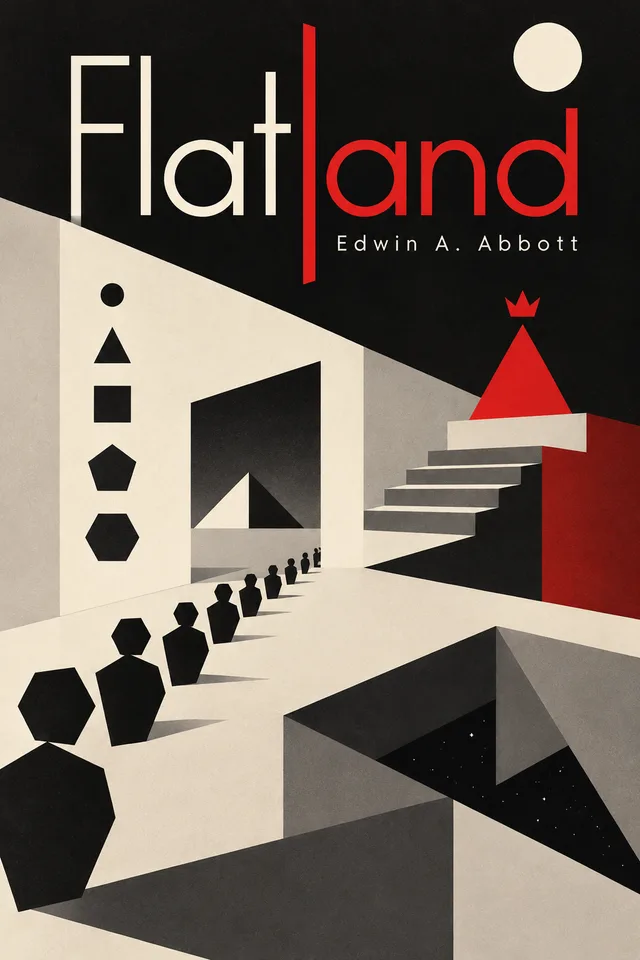
inglese Edizione
Scienza
Flatland
Edizione BooksWhale in inglese di Edwin A. Abbott
mathematical imagination, dimensions, geometry, social hierarchy, and satire.
- Anteprima
- Estratto dal testo preparato
- Formati
- Lettore online, EPUB, PDF
- Accesso
- Claim Libreria
Introduzione al libro
Flatland
Flatland by Edwin A. Abbott is a public-domain science classic centered on mathematical imagination, dimensions, geometry, social hierarchy, and satire. This edition gives readers a clear path into the work’s style, historical setting, and enduring ideas.
Edizione BooksWhale
Come è stata preparata
Questa edizione si basa su un testo di pubblico dominio ed è stata preparata da BooksWhale per la lettura digitale.
Base di pubblico dominio
Perché può essere condivisa
Edwin A. Abbott died in 1926, and Flatland was first published in 1884. These dates support the public-domain basis for this original English edition.
Leggi anteprima
Estratto dal testo preparato
Anteprima selezionata dal testo preparato per la lettura.
Capitolo in anteprimaFull textLeggi anteprima
Flatland
Flatland: A Romance of Many Dimensions
Edwin A. Abbott (1838-1926. English scholar, theologian, and writer.)
----------------------------------------------------------------- | "O day and night, but this is wondrous strange" | | ______ | | / / /| ------ / /| /| / /-. | | /---- / /__| / / /__| / | / / / | | / /___ / | / /___ / | / |/ /__.-' | | | | No Dimensions One Dimension | | . A ROMANCE OF MANY DIMENSIONS ----- | | POINTLAND LINELAND | | | | Two Dimensions Three Dimensions | | ___ __ | | | | /__/| | | |___| |__|/ | | FLATLAND SPACELAND | | "Fie, fie, how franticly I square my talk!" | -----------------------------------------------------------------
With Illustrations by the Author, A SQUARE (Edwin A. Abbott)
To The Inhabitants of SPACE IN GENERAL And H. C. IN PARTICULAR This Work is Dedicated By a Humble Native of Flatland In the Hope that Even as he was Initiated into the Mysteries Of THREE Dimensions Having been previously conversant With ONLY TWO So the Citizens of that Celestial Region May aspire yet higher and higher To the Secrets of FOUR FIVE OR EVEN SIX Dimensions Thereby contributing To the Enlargement of THE IMAGINATION And the possible Development Of that most rare and excellent Gift of MODESTY Among the Superior Races Of SOLID HUMANITY
Preface to the Second and Revised Edition, 1884.
By the Editor
If my poor Flatland friend retained the vigour of mind which he enjoyed when he began to compose these Memoirs, I should not now need to represent him in this preface, in which he desires, firstly, to return his thanks to his readers and critics in Spaceland, whose appreciation has, with unexpected celerity, required a second edition of his work; secondly, to apologize for certain errors and misprints (for which, however, he is not entirely responsible); and, thirdly, to explain one or two misconceptions. But he is not the Square he once was. Years of imprisonment, and the still heavier burden of general incredulity and mockery, have combined with the natural decay of old age to erase from his mind many of the thoughts and notions, and much also of the terminology, which he acquired during his short stay in Spaceland. He has, therefore, requested me to reply in his behalf to two special objections, one of an intellectual, the other of a moral nature.
The first objection is, that a Flatlander, seeing a Line, sees something that must be THICK to the eye as well as LONG to the eye (otherwise it would not be visible, if it had not some thickness); and consequently he ought (it is argued) to acknowledge that his countrymen are not only long and broad, but also (though doubtless in a very slight degree) THICK or HIGH. This objection is plausible, and, to Spacelanders, almost irresistible, so that, I confess, when I first heard it, I knew not what to reply. But my poor old friend's answer appears to me completely to meet it.
"I admit," said he--when I mentioned to him this objection--"I admit the truth of your critic's facts, but I deny his conclusions. It is true that we have really in Flatland a Third unrecognized Dimension called 'height', just as it is also true that you have really in Spaceland a Fourth unrecognized Dimension, called by no name at present, but which I will call 'extra-height'. But we can no more take cognizance of our 'height' than you can of your 'extra-height'. Even I--who have been in Spaceland, and have had the privilege of understanding for twenty-four hours the meaning of 'height'--even I cannot now comprehend it, nor realize it by the sense of sight or by any process of reason; I can but apprehend it by faith.
"The reason is obvious. Dimension implies direction, implies measurement, implies the more and the less. Now, all our lines are EQUALLY and INFINITESIMALLY thick (or high, whichever you like); consequently, there is nothing in them to lead our minds to the conception of that Dimension. No 'delicate micrometer'--as has been suggested by one too hasty Spaceland critic--would in the least avail us; for we should not know WHAT TO MEASURE, NOR IN WHAT DIRECTION. When we see a Line, we see something that is long and BRIGHT; BRIGHTNESS, as well as length, is necessary to the existence of a Line; if the brightness vanishes, the Line is extinguished. Hence, all my Flatland friends--when I talk to them about the unrecognized Dimension which is somehow visible in a Line--say, 'Ah, you mean BRIGHTNESS': and when I reply, 'No, I mean a real Dimension', they at once retort, 'Then measure it, or tell us in what direction it extends'; and this silences me, for I can do neither. Only yesterday, when the Chief Circle (in other words our High Priest) came to inspect the State Prison and paid me his seventh annual visit, and when for the seventh time he put me the question, 'Was I any better?' I tried to prove to him that he was 'high', as well as long and broad, although he did not know it. But what was his reply? 'You say I am "high"; measure my "high-ness" and I will believe you.' What could I do? How could I meet his challenge? I was crushed; and he left the room triumphant.
Capitolo in anteprimaPART I: THIS WORLDAnteprima
"Be patient, for the world is broad and wide."
Capitolo in anteprimaSection 1. Of the Nature of FlatlandAnteprima
I call our world Flatland, not because we call it so, but to make its nature clearer to you, my happy readers, who are privileged to live in Space.
Imagine a vast sheet of paper on which straight Lines, Triangles, Squares, Pentagons, Hexagons, and other figures, instead of remaining fixed in their places, move freely about, on or in the surface, but without the power of rising above or sinking below it, very much like shadows--only hard and with luminous edges--and you will then have a pretty correct notion of my country and countrymen. Alas, a few years ago, I should have said "my universe": but now my mind has been opened to higher views of things.
In such a country, you will perceive at once that it is impossible that there should be anything of what you call a "solid" kind; but I dare say you will suppose that we could at least distinguish by sight the Triangles, Squares, and other figures, moving about as I have described them. On the contrary, we could see nothing of the kind, not at least so as to distinguish one figure from another. Nothing was visible, nor could be visible, to us, except Straight Lines; and the necessity of this I will speedily demonstrate.
Place a penny on the middle of one of your tables in Space; and leaning over it, look down upon it. It will appear a circle.
But now, drawing back to the edge of the table, gradually lower your eye (thus bringing yourself more and more into the condition of the inhabitants of Flatland), and you will find the penny becoming more and more oval to your view, and at last when you have placed your eye exactly on the edge of the table (so that you are, as it were, actually a Flatlander) the penny will then have ceased to appear oval at all, and will have become, so far as you can see, a straight line.
The same thing would happen if you were to treat in the same way a Triangle, or Square, or any other figure cut out of pasteboard. As soon as you look at it with your eye on the edge on the table, you will find that it ceases to appear to you a figure, and that it becomes in appearance a straight line. Take for example an equilateral Triangle--who represents with us a Tradesman of the respectable class. Fig. 1 represents the Tradesman as you would see him while you were bending over him from above; figs. 2 and 3 represent the Tradesman, as you would see him if your eye were close to the level, or all but on the level of the table; and if your eye were quite on the level of the table (and that is how we see him in Flatland) you would see nothing but a straight line.
When I was in Spaceland I heard that your sailors have very similar experiences while they traverse your seas and discern some distant island or coast lying on the horizon. The far-off land may have bays, forelands, angles in and out to any number and extent; yet at a distance you see none of these (unless indeed your sun shines bright upon them revealing the projections and retirements by means of light and shade), nothing but a grey unbroken line upon the water.
Well, that is just what we see when one of our triangular or other acquaintances comes toward us in Flatland. As there is neither sun with us, nor any light of such a kind as to make shadows, we have none of the helps to the sight that you have in Spaceland. If our friend comes closer to us we see his line becomes larger; if he leaves us it becomes smaller: but still he looks like a straight line; be he a Triangle, Square, Pentagon, Hexagon, Circle, what you will--a straight Line he looks and nothing else.
Indice
In questa edizione
- 01Full text
- 02PART I: THIS WORLD
- 03Section 1. Of the Nature of Flatland
- 04Section 2. Of the Climate and Houses in Flatland
- 05Section 3. Concerning the Inhabitants of Flatland
- 06Section 4. Concerning the Women
- 07Section 5. Of our Methods of Recognizing one another
- 08Section 6. Of Recognition by Sight
- 09Section 7. Concerning Irregular Figures
- 10Section 8. Of the Ancient Practice of Painting
- 11Section 9. Of the Universal Colour Bill
- 12Section 10. Of the Suppression of the Chromatic Sedition
- 13Section 11. Concerning our Priests
- 14Section 12. Of the Doctrine of our Priests
- 15PART II: OTHER WORLDS
- 16Section 13. How I had a Vision of Lineland
- 17Section 14. How I vainly tried to explain the nature of Flatland
- 18Section 15. Concerning a Stranger from Spaceland
- 19Section 16. How the Stranger vainly endeavoured to reveal to me in words the mysteries of Spaceland
- 20Section 17. How the Sphere, having in vain tried words, resorted to deeds
- 21Section 18. How I came to Spaceland, and what I saw there
- 22Section 19. How, though the Sphere shewed me other mysteries of Spaceland, I still desired more; and what came of it
- 23Section 20. How the Sphere encouraged me in a Vision
- 24Section 21. How I tried to teach the Theory of Three Dimensions to my Grandson, and with what success
- 25Section 22. How I then tried to diffuse the Theory of Three Dimensions by other means, and of the result
Disponibilità lingue
Altre lingue
Altre edizioni linguistiche non sono ancora pubblicate. Qui appariranno quando disponibili.
Richiedi un'altra lingua