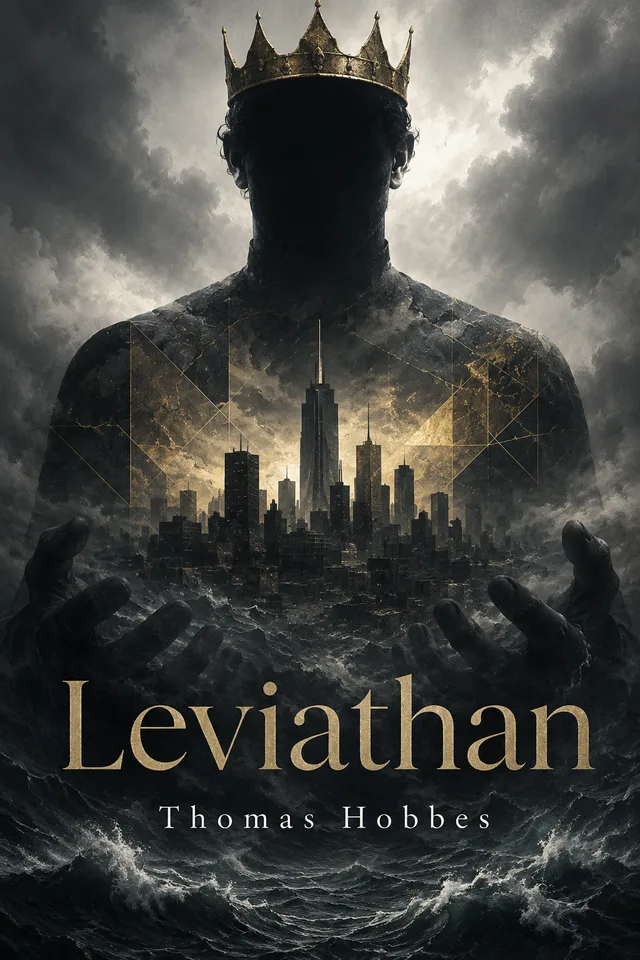
inglese Edizione
Politica
Leviathan
Edizione BooksWhale in inglese di Thomas Hobbes
A foundational work of political philosophy on authority, fear, covenant, and sovereignty.
- Anteprima
- Estratto dal testo preparato
- Formati
- Lettore online, EPUB, PDF
- Accesso
- Claim Libreria
Introduzione al libro
Leviathan
Leviathan develops Thomas Hobbes’s powerful account of human nature, social contract, political authority, and sovereign power. This English original remains a central text in political thought.
Edizione BooksWhale
Come è stata preparata
Questa edizione si basa su un testo di pubblico dominio ed è stata preparata da BooksWhale per la lettura digitale.
Base di pubblico dominio
Perché può essere condivisa
Thomas Hobbes died in 1679, and Leviathan was first published in 1651. These dates support the public-domain basis for this English original-language edition.
Leggi anteprima
Estratto dal testo preparato
Anteprima selezionata dal testo preparato per la lettura.
Capitolo in anteprimaFull textLeggi anteprima
Leviathan
By Thomas Hobbes
LEVIATHAN OR THE MATTER, FORME, & POWER OF A COMMON-WEALTH ECCLESIASTICAL AND CIVILL
Thomas Hobbes of Malmesbury
Printed for Andrew Crooke, at the Green Dragon in St. Paul’s Churchyard, 1651.
TO MY MOST HONOR’D FRIEND Mr. FRANCIS GODOLPHIN of GODOLPHIN
HONOR’D SIR.
Your most worthy Brother Mr SIDNEY GODOLPHIN, when he lived, was pleas’d to think my studies something, and otherwise to oblige me, as you know, with reall testimonies of his good opinion, great in themselves, and the greater for the worthinesse of his person. For there is not any vertue that disposeth a man, either to the service of God, or to the service of his Country, to Civill Society, or private Friendship, that did not manifestly appear in his conversation, not as acquired by necessity, or affected upon occasion, but inhaerent, and shining in a generous constitution of his nature. Therefore in honour and gratitude to him, and with devotion to your selfe, I humbly Dedicate unto you this my discourse of Common-wealth. I know not how the world will receive it, nor how it may reflect on those that shall seem to favour it. For in a way beset with those that contend on one side for too great Liberty, and on the other side for too much Authority, ’tis hard to passe between the points of both unwounded. But yet, me thinks, the endeavour to advance the Civill Power, should not be by the Civill Power condemned; nor private men, by reprehending it, declare they think that Power too great. Besides, I speak not of the men, but (in the Abstract) of the Seat of Power, (like to those simple and unpartiall creatures in the Roman Capitol, that with their noyse defended those within it, not because they were they, but there) offending none, I think, but those without, or such within (if there be any such) as favour them. That which perhaps may most offend, are certain Texts of Holy Scripture, alledged by me to other purpose than ordinarily they use to be by others. But I have done it with due submission, and also (in order to my Subject) necessarily; for they are the Outworks of the Enemy, from whence they impugne the Civill Power. If notwithstanding this, you find my labour generally decryed, you may be pleased to excuse your selfe, and say that I am a man that love my own opinions, and think all true I say, that I honoured your Brother, and honour you, and have presum’d on that, to assume the Title (without your knowledge) of being, as I am,
Sir,
Your most humble, and most obedient servant, Thomas Hobbes.
Paris APRILL 15/25 1651.
Capitolo in anteprimaTHE INTRODUCTIONAnteprima
Nature (the art whereby God hath made and governes the world) is by the art of man, as in many other things, so in this also imitated, that it can make an Artificial Animal. For seeing life is but a motion of Limbs, the begining whereof is in some principall part within; why may we not say, that all Automata (Engines that move themselves by springs and wheeles as doth a watch) have an artificiall life? For what is the Heart, but a Spring; and the Nerves, but so many Strings; and the Joynts, but so many Wheeles, giving motion to the whole Body, such as was intended by the Artificer? Art goes yet further, imitating that Rationall and most excellent worke of Nature, Man. For by Art is created that great LEVIATHAN called a COMMON-WEALTH, or STATE, (in latine CIVITAS) which is but an Artificiall Man; though of greater stature and strength than the Naturall, for whose protection and defence it was intended; and in which, the Soveraignty is an Artificiall Soul, as giving life and motion to the whole body; The Magistrates, and other Officers of Judicature and Execution, artificiall Joynts; Reward and Punishment (by which fastned to the seat of the Soveraignty, every joynt and member is moved to performe his duty) are the Nerves, that do the same in the Body Naturall; The Wealth and Riches of all the particular members, are the Strength; Salus Populi (the Peoples Safety) its Businesse; Counsellors, by whom all things needfull for it to know, are suggested unto it, are the Memory; Equity and Lawes, an artificiall Reason and Will; Concord, Health; Sedition, Sicknesse; and Civill War, Death. Lastly, the Pacts and Covenants, by which the parts of this Body Politique were at first made, set together, and united, resemble that Fiat, or the Let Us Make Man, pronounced by God in the Creation.
To describe the Nature of this Artificiall man, I will consider
First the Matter thereof, and the Artificer; both which is Man.
Secondly, How, and by what Covenants it is made; what are the Rights and just Power or Authority of a Soveraigne; and what it is that Preserveth and Dissolveth it.
Thirdly, what is a Christian Common-Wealth.
Lastly, what is the Kingdome of Darkness.
Concerning the first, there is a saying much usurped of late, That Wisedome is acquired, not by reading of Books, but of Men. Consequently whereunto, those persons, that for the most part can give no other proof of being wise, take great delight to shew what they think they have read in men, by uncharitable censures of one another behind their backs. But there is another saying not of late understood, by which they might learn truly to read one another, if they would take the pains; and that is, Nosce Teipsum, Read Thy Self: which was not meant, as it is now used, to countenance, either the barbarous state of men in power, towards their inferiors; or to encourage men of low degree, to a sawcie behaviour towards their betters; But to teach us, that for the similitude of the thoughts, and Passions of one man, to the thoughts, and Passions of another, whosoever looketh into himselfe, and considereth what he doth, when he does Think, Opine, Reason, Hope, Feare, &c, and upon what grounds; he shall thereby read and know, what are the thoughts, and Passions of all other men, upon the like occasions. I say the similitude of Passions, which are the same in all men, Desire, Feare, Hope, &c; not the similitude or The Objects of the Passions, which are the things Desired, Feared, Hoped, &c: for these the constitution individuall, and particular education do so vary, and they are so easie to be kept from our knowledge, that the characters of mans heart, blotted and confounded as they are, with dissembling, lying, counterfeiting, and erroneous doctrines, are legible onely to him that searcheth hearts. And though by mens actions wee do discover their designee sometimes; yet to do it without comparing them with our own, and distinguishing all circumstances, by which the case may come to be altered, is to decypher without a key, and be for the most part deceived, by too much trust, or by too much diffidence; as he that reads, is himselfe a good or evill man.
Capitolo in anteprimaPART I.Anteprima
OF MAN
Indice
In questa edizione
- 01Full text
- 02THE INTRODUCTION
- 03PART I.
- 04CHAPTER I. OF SENSE
- 05CHAPTER II. OF IMAGINATION
- 06CHAPTER III. OF THE CONSEQUENCE OR TRAYNE OF IMAGINATIONS
- 07CHAPTER IV. OF SPEECH
- 08CHAPTER V. OF REASON, AND SCIENCE.
- 09CHAPTER VI. OF THE INTERIOUR BEGINNINGS OF VOLUNTARY MOTIONS
- 10CHAPTER VII. OF THE ENDS OR RESOLUTIONS OF DISCOURSE
- 11CHAPTER VIII. OF THE VERTUES COMMONLY CALLED INTELLECTUAL; AND THEIR
- 12CHAPTER IX. OF THE SEVERALL SUBJECTS OF KNOWLEDGE
- 13CHAPTER X. OF POWER, WORTH, DIGNITY, HONOUR AND WORTHINESS
- 14CHAPTER XI. OF THE DIFFERENCE OF MANNERS
- 15CHAPTER XII. OF RELIGION
- 16CHAPTER XIII. OF THE NATURALL CONDITION OF MANKIND,
- 17CHAPTER XIV. OF THE FIRST AND SECOND NATURALL LAWES, AND OF CONTRACTS
- 18CHAPTER XV. OF OTHER LAWES OF NATURE
- 19CHAPTER XVI. OF PERSONS, AUTHORS, AND THINGS PERSONATED
- 20PART II.
- 21CHAPTER XVII. OF THE CAUSES, GENERATION, AND DEFINITION OF A
- 22CHAPTER XVIII. OF THE RIGHTS OF SOVERAIGNES BY INSTITUTION
- 23CHAPTER XIX. OF THE SEVERALL KINDS OF COMMON-WEALTH BY INSTITUTION,
- 24CHAPTER XX. OF DOMINION PATERNALL AND DESPOTICALL
- 25CHAPTER XXI. OF THE LIBERTY OF SUBJECTS
- 26CHAPTER XXII. OF SYSTEMES SUBJECT, POLITICALL, AND PRIVATE
- 27CHAPTER XXIII. OF THE PUBLIQUE MINISTERS OF SOVERAIGN POWER
- 28CHAPTER XXIV. OF THE NUTRITION, AND PROCREATION OF A COMMON-WEALTH
- 29CHAPTER XXV. OF COUNSELL
- 30CHAPTER XXVI. OF CIVILL LAWES
- 31CHAPTER XXVII. OF CRIMES, EXCUSES, AND EXTENUATIONS
- 32CHAPTER XXVIII. OF PUNISHMENTS, AND REWARDS
- 33CHAPTER XXIX. OF THOSE THINGS THAT WEAKEN, OR TEND TO THE DISSOLUTION OF
- 34CHAPTER XXX. OF THE OFFICE OF THE SOVERAIGN REPRESENTATIVE
- 35CHAPTER XXXI. OF THE KINGDOME OF GOD BY NATURE
- 36PART III.
- 37CHAPTER XXXII. OF THE PRINCIPLES OF CHRISTIAN POLITIQUES
- 38CHAPTER XXXIII. OF THE NUMBER, ANTIQUITY, SCOPE, AUTHORITY, AND
- 39CHAPTER XXXIV. OF THE SIGNIFICATION OF SPIRIT, ANGEL, AND INSPIRATION IN
- 40CHAPTER XXXV. OF THE SIGNIFICATION IN SCRIPTURE OF KINGDOME OF GOD, OF
- 41CHAPTER XXXVI. OF THE WORD OF GOD, AND OF PROPHETS
- 42CHAPTER XXXVII. OF MIRACLES, AND THEIR USE
- 43CHAPTER XXXVIII. OF THE SIGNIFICATION IN SCRIPTURE OF ETERNALL LIFE,
- 44CHAPTER XXXIX. OF THE SIGNIFICATION IN SCRIPTURE OF THE WORD CHURCH
- 45CHAPTER XL OF THE RIGHTS OF THE KINGDOME OF GOD, IN ABRAHAM, MOSES,
- 46CHAPTER XLI. OF THE OFFICE OF OUR BLESSED SAVIOUR
- 47CHAPTER XLII. OF POWER ECCLESIASTICALL
- 48CHAPTER XLIII. OF WHAT IS NECESSARY FOR A MANS RECEPTION INTO THE
- 49PART IV.
- 50CHAPTER XLIV. OF SPIRITUALL DARKNESSE FROM MISINTERPRETATION OF
- 51CHAPTER XLV. OF DAEMONOLOGY, AND OTHER RELIQUES OF THE RELIGION OF THE
- 52CHAPTER XLVI. OF DARKNESSE FROM VAIN PHILOSOPHY, AND FABULOUS TRADITIONS
- 53CHAPTER XLVII. OF THE BENEFIT THAT PROCEEDETH FROM SUCH DARKNESSE, AND
Disponibilità lingue
Altre lingue
Altre edizioni linguistiche non sono ancora pubblicate. Qui appariranno quando disponibili.
Richiedi un'altra lingua