inglese Edizione
Letteratura
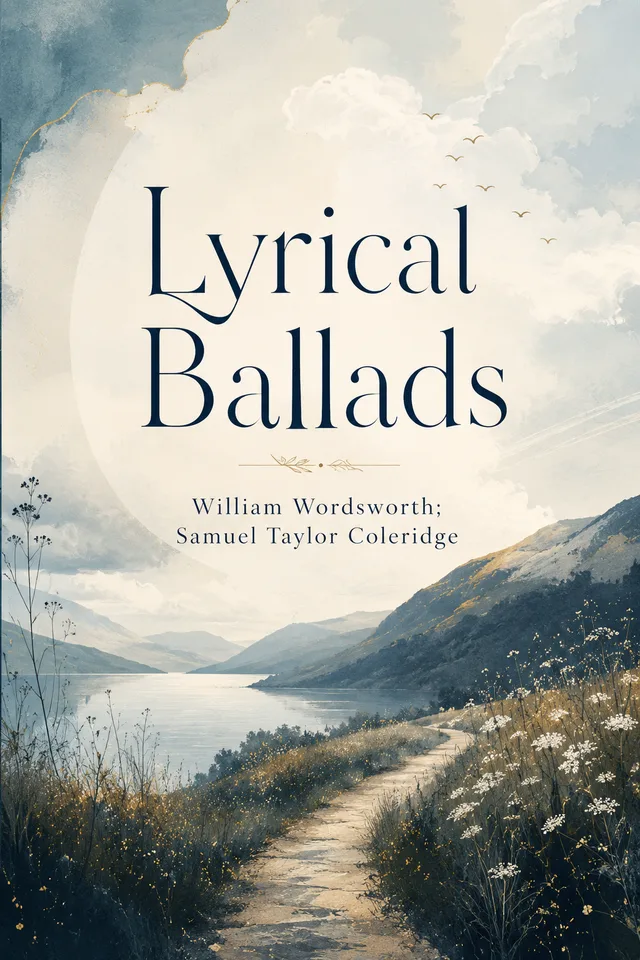
Lyrical Ballads
Edizione BooksWhale in inglese di William Wordsworth
A founding Romantic poetry collection about nature, common life, imagination, memory, and feeling.
- Anteprima
- Estratto dal testo preparato
- Formati
- Lettore online, EPUB, PDF
- Accesso
- Claim Libreria
Introduzione al libro
Lyrical Ballads
Lyrical Ballads changed English poetry by making ordinary speech, rural life, inward feeling, and supernatural imagination central poetic subjects. With Wordsworth and Coleridge together, the collection remains essential for readers of Romanticism, nature poetry, and modern lyric form.
Edizione BooksWhale
Come è stata preparata
Questa edizione si basa su un testo di pubblico dominio ed è stata preparata da BooksWhale per la lettura digitale.
Base di pubblico dominio
Perché può essere condivisa
Lyrical Ballads is a public-domain work: the author died in 1850, and the text was first published in 1798. This edition uses the original English text.
Leggi anteprima
Estratto dal testo preparato
Anteprima selezionata dal testo preparato per la lettura.
Capitolo in anteprimaLyrical BalladsLeggi anteprima
LYRICAL BALLADS,
WITH A FEW OTHER POEMS.
LONDON
PRINTED FOR J. & A. ARCH, GRACECHURCH-STREET.
1798
ADVERTISEMENT.
It is the honourable characteristic of Poetry that its materials are to
be found in every subject which can interest the human mind. The
evidence of this fact is to be sought, not in the writings of Critics,
but in those of Poets themselves.
The majority of the following poems are to be considered as experiments.
They were written chiefly with a view to ascertain how far the language
of conversation in the middle and lower classes of society is adapted to
the purposes of poetic pleasure. Readers accustomed to the gaudiness and
inane phraseology of many modern writers, if they persist in reading
this book to its conclusion, will perhaps frequently have to struggle
with feelings of strangeness and aukwardness: they will look round for
poetry, and will be induced to enquire by what species of courtesy these
attempts can be permitted to assume that title. It is desirable that
such readers, for their own sakes, should not suffer the solitary word
Poetry, a word of very disputed meaning, to stand in the way of their
gratification; but that, while they are perusing this book, they should
ask themselves if it contains a natural delineation of human passions,
human characters, and human incidents; and if the answer be favourable
to the author’s wishes, that they should consent to be pleased in spite
of that most dreadful enemy to our pleasures, our own pre-established
codes of decision.
Readers of superior judgment may disapprove of the style in which many
of these pieces are executed it must be expected that many lines and
phrases will not exactly suit their taste. It will perhaps appear to
them, that wishing to avoid the prevalent fault of the day, the author
has sometimes descended too low, and that many of his expressions are
too familiar, and not of sufficient dignity. It is apprehended, that the
more conversant the reader is with our elder writers, and with those in
modern times who have been the most successful in painting manners and
passions, the fewer complaints of this kind will he have to make.
An accurate taste in poetry, and in all the other arts, Sir Joshua
Reynolds has observed, is an acquired talent, which can only be produced
by severe thought, and a long continued intercourse with the best models
of composition. This is mentioned not with so ridiculous a purpose as to
prevent the most inexperienced reader from judging for himself; but
merely to temper the rashness of decision, and to suggest that if poetry
be a subject on which much time has not been bestowed, the judgment may
be erroneous, and that in many cases it necessarily will be so.
The tale of Goody Blake and Harry Gill is founded on a
well-authenticated fact which happened in Warwickshire. Of the other
poems in the collection, it may be proper to say that they are either
absolute inventions of the author, or facts which took place within his
personal observation or that of his friends. The poem of the Thorn, as
the reader will soon discover, is not supposed to be spoken in the
author’s own person: the character of the loquacious narrator will
sufficiently shew itself in the course of the story. The Rime of the
Ancyent Marinere was professedly written in imitation of the _style_, as
well as of the spirit of the elder poets; but with a few exceptions, the
Author believes that the language adopted in it has been equally
intelligible for these three last centuries. The lines entitled
Expostulation and Reply, and those which follow, arose out of
conversation with a friend who was somewhat unreasonably attached to
modern books of moral philosophy.
CONTENTS.
The Rime of the Ancyent Marinere
The Foster-Mother’s Tale
Lines left upon a Seat in a Yew-tree which stands near the Lake
Capitolo in anteprimaI.Anteprima
It is an ancyent Marinere,
And he stoppeth one of three:
“By thy long grey beard and thy glittering eye
“Now wherefore stoppest me?
“The Bridegroom’s doors are open’d wide
“And I am next of kin;
“The Guests are met, the Feast is set,--
“May’st hear the merry din.--
But still he holds the wedding-guest--
There was a Ship, quoth he--
“Nay, if thou’st got a laughsome tale,
“Marinere! come with me.”
He holds him with his skinny hand,
Quoth he, there was a Ship--
“Now get thee hence, thou grey-beard Loon!
“Or my Staff shall make thee skip.”
He holds him with his glittering eye--
The wedding guest stood still
And listens like a three year’s child;
The Marinere hath his will.
The wedding-guest sate on a stone,
He cannot chuse but hear:
And thus spake on that ancyent man,
The bright-eyed Marinere.
The Ship was cheer’d, the Harbour clear’d--
Merrily did we drop
Below the Kirk, below the Hill,
Below the Light-house top.
The Sun came up upon the left,
Out of the Sea came he:
And he shone bright, and on the right
Went down into the Sea.
Higher and higher every day,
Till over the mast at noon--
The wedding-guest here beat his breast,
For he heard the loud bassoon.
The Bride hath pac’d into the Hall,
Red as a rose is she;
Nodding their heads before her goes
The merry Minstralsy.
The wedding-guest he beat his breast,
Yet he cannot chuse but hear:
And thus spake on that ancyent Man,
The bright-eyed Marinere.
Listen, Stranger! Storm and Wind,
A Wind and Tempest strong!
For days and weeks it play’d us freaks--
Like Chaff we drove along.
Listen, Stranger! Mist and Snow,
And it grew wond’rous cauld:
And Ice mast-high came floating by
As green as Emerauld.
And thro’ the drifts the snowy clifts
Did send a dismal sheen;
Ne shapes of men ne beasts we ken--
The Ice was all between.
The Ice was here, the Ice was there,
The Ice was all around:
It crack’d and growl’d, and roar’d and howl’d--
Like noises of a swound.
At length did cross an Albatross,
Thorough the Fog it came;
And an it were a Christian Soul,
We hail’d it in God’s name.
The Marineres gave it biscuit-worms,
And round and round it flew:
The Ice did split with a Thunder-fit;
The Helmsman steer’d us thro’.
And a good south wind sprung up behind,
The Albatross did follow;
And every day for food or play
Came to the Marinere’s hollo!
In mist or cloud on mast or shroud
It perch’d for vespers nine,
Whiles all the night thro’ fog-smoke white
Glimmer’d the white moon-shine.
“God save thee, ancyent Marinere!
“From the fiends that plague thee thus--
“Why look’st thou so?”--with my cross bow
I shot the Albatross.
Capitolo in anteprimaII.Anteprima
The Sun came up upon the right,
Out of the Sea came he;
And broad as a weft upon the left
Went down into the Sea.
And the good south wind still blew behind,
But no sweet Bird did follow
Ne any day for food or play
Came to the Marinere’s hollo!
And I had done an hellish thing
And it would work ’em woe:
For all averr’d, I had kill’d the Bird
That made the Breeze to blow.
Ne dim ne red, like God’s own head,
The glorious Sun uprist:
Then all averr’d, I had kill’d the Bird
That brought the fog and mist.
’Twas right, said they, such birds to slay
That bring the fog and mist.
The breezes blew, the white foam flew,
The furrow follow’d free:
We were the first that ever burst
Into that silent Sea.
Down dropt the breeze, the Sails dropt down,
’Twas sad as sad could be
And we did speak only to break
The silence of the Sea.
All in a hot and copper sky
The bloody sun at noon,
Right up above the mast did stand,
No bigger than the moon.
Day after day, day after day,
We stuck, ne breath ne motion,
As idle as a painted Ship
Upon a painted Ocean.
Water, water, every where
And all the boards did shrink;
Water, water, every where,
Ne any drop to drink.
The very deeps did rot: O Christ!
That ever this should be!
Yea, slimy things did crawl with legs
Upon the slimy Sea.
About, about, in reel and rout
The Death-fires danc’d at night;
The water, like a witch’s oils,
Burnt green and blue and white.
And some in dreams assured were
Of the Spirit that plagued us so:
Nine fathom deep he had follow’d us
From the Land of Mist and Snow.
And every tongue thro’ utter drouth
Was wither’d at the root;
We could not speak no more than if
We had been choked with soot.
Ah wel-a-day! what evil looks
Had I from old and young;
Instead of the Cross the Albatross
About my neck was hung.
Indice
In questa edizione
- 01Lyrical Ballads
- 02I.
- 03II.
- 04III.
- 05IV.
- 06V.
- 07VI.
- 08VII.
- 09I.
- 10II.
- 11III.
- 12IV.
- 13V.
- 14VI.
- 15VII.
- 16VIII.
- 17IX.
- 18X.
- 19XI.
- 20XII.
- 21XIII.
- 22XIV.
- 23XV.
- 24XVI.
- 25XVII.
- 26XVIII.
- 27XIX.
- 28XX.
- 29XXI.
- 30XXII.
- 31XXIII.
Disponibilità lingue
Altre lingue
Altre edizioni linguistiche non sono ancora pubblicate. Qui appariranno quando disponibili.
Richiedi un'altra lingua