inglese Edizione
Letteratura
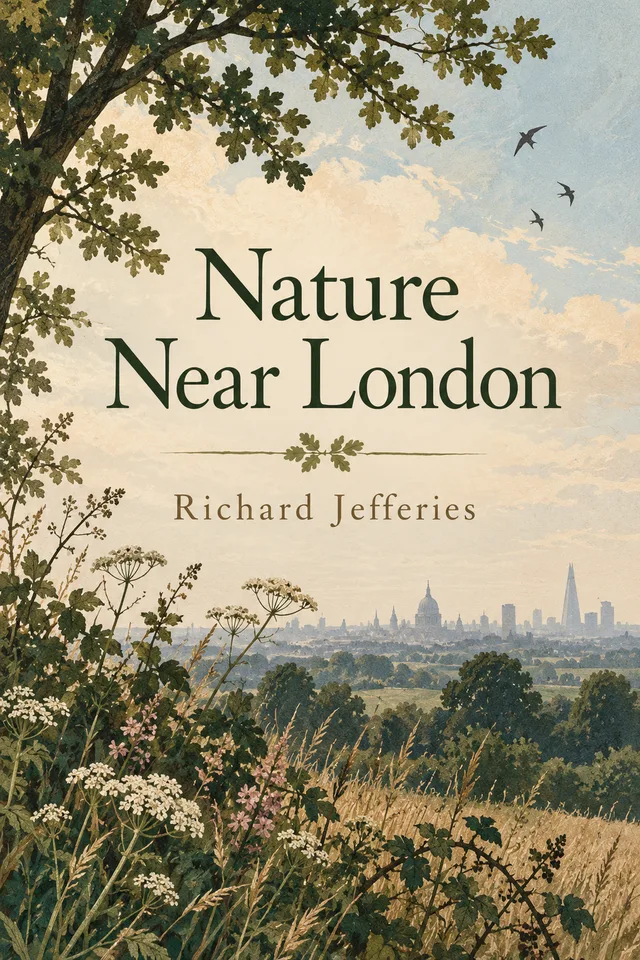
Nature Near London
Edizione BooksWhale in inglese di Richard Jefferies
Jefferies discovers woods, fields, wildlife, and changing weather close to London, revealing natural life within reach of the growing city.
- Anteprima
- Estratto dal testo preparato
- Formati
- Lettore online, EPUB, PDF
- Accesso
- Claim Libreria
Introduzione al libro
Nature Near London
Richard Jefferies explores the countryside around London with attention to birds, trees, streams, cultivated fields, and the changing seasons. The proximity of the city gives his observations a particular tension: wild life persists beside work, transport, and expanding settlement. Nineteen essays connect patient looking with reflections on everyday perception. This English collection includes the author’s preface and the original sequence of essays.
Edizione BooksWhale
Come è stata preparata
Questa edizione si basa su un testo di pubblico dominio ed è stata preparata da BooksWhale per la lettura digitale.
Base di pubblico dominio
Perché può essere condivisa
Richard Jefferies died in 1887. This edition uses the original English text preserved by Project Gutenberg, excluding separate notes and later editorial material.
Leggi anteprima
Estratto dal testo preparato
Anteprima selezionata dal testo preparato per la lettura.
Capitolo in anteprimaPREFACELeggi anteprima
It is usually supposed to be necessary to go far into the country to find wild birds and animals in sufficient numbers to be pleasantly studied. Such was certainly my own impression till circumstances led me, for the convenience of access to London, to reside for awhile about twelve miles from town. There my preconceived views on the subject were quite overthrown by the presence of as much bird-life as I had been accustomed to in distant fields and woods.
First, as the spring began, came crowds of chiffchaffs and willow-wrens, filling the furze with ceaseless flutterings. Presently a nightingale sang in a hawthorn bush only just on the other side of the road. One morning, on looking out of window, there was a hen pheasant in the furze almost underneath. Rabbits often came out into the spaces of sward between the bushes.
The furze itself became a broad surface of gold, beautiful to look down upon, with islands of tenderest birch green interspersed, and willows in which the sedge-reedling chattered. They used to say in the country that cuckoos were getting scarce, but here the notes of the cuckoo echoed all day long, and the birds often flew over the house. Doves cooed, blackbirds whistled, thrushes sang, jays called, wood-pigeons uttered the old familiar notes in the little copse hard by. Even a heron went over now and then, and in the evening from the window I could hear partridges calling each other to roost.
Along the roads and lanes the quantity and variety of life in the hedges was really astonishing. Magpies, jays, woodpeckers—both green and pied—kestrels hovering overhead, sparrow-hawks darting over gateways, hares by the clover, weasels on the mounds, stoats at the edge of the corn. I missed but two birds, the corncrake and the grasshopper lark, and found these another season. Two squirrels one day ran along the palings and up into a guelder-rose tree in the garden. As for the finches and sparrows their number was past calculation. There was material for many years' observation, and finding myself so unexpectedly in the midst of these things, I was led to make the following sketches, which were published in The Standard, and are now reprinted by permission.
The question may be asked: Why have you not indicated in every case the precise locality where you were so pleased? Why not mention the exact hedge, the particular meadow? Because no two persons look at the same thing with the same eyes. To me this spot may be attractive, to you another; a third thinks yonder gnarled oak the most artistic. Nor could I guarantee that every one should see the same things under the same conditions of season, time, or weather. How could I arrange for you next autumn to see the sprays of the horse-chestnut, scarlet from frost, reflected in the dark water of the brook? There might not be any frost till all the leaves had dropped. How could I contrive that the cuckoos should circle round the copse, the sunlight glint upon the stream, the warm sweet wind come breathing over the young corn just when I should wish you to feel it? Every one must find their own locality. I find a favourite wild-flower here, and the spot is dear to me; you find yours yonder. Neither painter nor writer can show the spectator their originals. It would be very easy, too, to pass any of these places and see nothing, or but little. Birds are wayward, wild creatures uncertain. The tree crowded with wood-pigeons one minute is empty the next. To traverse the paths day by day, and week by week; to keep an eye ever on the fields from year's end to year's end, is the one only method of knowing what really is in or comes to them. That the sitting gambler sweeps the board is true of these matters. The richest locality may be apparently devoid of interest just at the juncture of a chance visit.
Capitolo in anteprimaWOODLANDSAnteprima
The tiny white petals of the barren strawberry open under the April sunshine which, as yet unchecked by crowded foliage above, can reach the moist banks under the trees. It is then that the first stroll of the year should be taken in Claygate Lane. The slender runners of the strawberries trail over the mounds among the moss, some of the flowers but just above the black and brown leaves of last year which fill the shallow ditch. These will presently be hidden under the grass which is pushing up long blades, and bending over like a plume.
Crimson stalks and leaves of herb Robert stretch across the little cavities of the mound; lower, and rising almost from the water of the ditch, the wild parsnip spreads its broad fan. Slanting among the underwood, against which it leans, the dry white "gix" (cow-parsnip) of last year has rotted from its root, and is only upheld by branches.
Yellowish green cup-like leaves are forming upon the brown and drooping heads of the spurge, which, sheltered by the bushes, has endured the winter's frosts. The lads pull them off, and break the stems, to watch the white "milk" well up, the whole plant being full of acrid juice. Whorls of woodruff and grass-like leaves of stitchwort are rising; the latter holds but feebly to the earth, and even in snatching the flower the roots sometimes give way and the plant is lifted with it.
Upon either hand the mounds are so broad that they in places resemble covers rather than hedges, thickly grown with bramble and briar, hazel and hawthorn, above which the straight trunks of young oaks and Spanish chestnuts stand in crowded but careless ranks. The leaves which dropped in the preceding autumn from these trees still lie on the ground under the bushes, dry and brittle, and the blackbirds searching about among them cause as much rustling as if some animal were routing about.
As the month progresses these wide mounds become completely green, hawthorn and bramble, briar and hazel put forth their leaves, and the eye can no longer see into the recesses. But above, the oaks and edible chestnuts are still dark and leafless, almost black by contrast with the vivid green beneath them. Upon their bare boughs the birds are easily seen, but the moment they descend among the bushes are difficult to find. Chaffinches call and challenge continually—these trees are their favourite resort—and yellowhammers flit along the underwood.
Behind the broad hedge are the ploughed fields they love, alternating with meadows down whose hedges again a stream of birds is always flowing to the lane. Bright as are the colours of the yellowhammer, when he alights among the brown clods of the ploughed field he is barely visible, for brown conceals like vapour. A white butterfly comes fluttering along the lane, and as it passes under a tree a chaffinch swoops down and snaps at it, but rises again without doing apparent injury, for the butterfly continues its flight.
From an oak overhead comes the sweet slender voice of a linnet, the sunshine falling on his rosy breast. The gateways show the thickness of the hedge, as an embrasure shows the thickness of a wall. One gives entrance to an arable field which has been recently rolled, and along the gentle rise of a "land" a cock-pheasant walks, so near that the ring about his neck is visible. Presently, becoming conscious that he is observed, he goes down into a furrow, and is then hidden.
The next gateway, equally deep-set between the bushes, opens on a pasture, where the docks of last year still cumber the ground, and bunches of rough grass and rushes are scattered here and there. A partridge separated from his mate is calling across the field, and comes running over the short sward as his companion answers. With his neck held high and upright, stretched to see around, he looks larger than would be supposed, as he runs swiftly, threading his way through the tufts, the docks, and the rushes. But suddenly noticing that the gateway is not clear, he crouches, and is concealed by the grass.
Capitolo in anteprimaFOOTPATHSAnteprima
"Always get over a stile," is the one rule that should ever be borne in mind by those who wish to see the land as it really is—that is to say, never omit to explore a footpath, for never was there a footpath yet which did not pass something of interest.
In the meadows, everything comes pressing lovingly up to the path. The small-leaved clover can scarce be driven back by frequent footsteps from endeavouring to cover the bare earth of the centre. Tall buttercups, round whose stalks the cattle have carefully grazed, stand in ranks; strong ox-eye daisies, with broad white disks and torn leaves, form with the grass the tricolour of the pasture—white, green, and gold.
When the path enters the mowing grass, ripe for the scythe, the simplicity of these cardinal hues is lost in the multitude of shades and the addition of other colours. The surface of mowing grass is indeed made up of so many tints that at the first glance it is confusing; and hence, perhaps, it is that hardly ever has an artist succeeded in getting the effect upon canvas. Of the million blades of grass no two are of the same shade.
Pluck a handful and spread them out side by side and this is at once evident. Nor is any single blade the same shade all the way up. There may be a faint yellow towards the root, a full green about the middle, at the tip perhaps the hot sun has scorched it, and there is a trace of brown. The older grass, which comes up earliest, is distinctly different in tint from that which has but just reached its greatest height, and in which the sap has not yet stood still.
Under all there is the new grass, short, sweet, and verdant, springing up fresh between the old, and giving a tone to the rest as you look down into the bunches. Some blades are nearly grey, some the palest green, and among them others, torn from the roots perhaps by rooks searching for grubs, are quite white. The very track of a rook through the grass leaves a different shade each side, as the blades are bent or trampled down.
The stalks of the bennets vary, some green, some yellowish, some brown, some approaching whiteness, according to age and the condition of the sap. Their tops, too, are never the same, whether the pollen clings to the surface or whether it has gone. Here the green is almost lost in red, or quite; here the grass has a soft, velvety look; yonder it is hard and wiry, and again graceful and drooping. Here there are bunches so rankly verdant that no flower is visible and no other tint but dark green; here it is thin and short, and the flowers, and almost the turf itself, can be seen; then there is an array of bennets (stalks which bear the grass-seed) with scarcely any grass proper.
Every variety of grass—and they are many—has its own colour, and every blade of every variety has its individual variations of that colour. The rain falls, and there is a darker tint at large upon the field, fresh but darker; the sun shines and at first the hue is lighter, but presently if the heat last a brown comes. The wind blows, and immediately as the waves of grass roll across the meadow a paler tint follows it.
A clouded sky dulls the herbage, a cloudless heaven brightens it, so that the grass almost reflects the firmament like water. At sunset the rosy rays bring out every tint of red or purple. At noonday, watch as alternate shadow and sunshine come one after the other as the clouds are wafted over. By moonlight perhaps the white ox-eyed daisies show the most. But never will you find the mowing grass in the same field looking twice alike.
Indice
In questa edizione
- 01PREFACE
- 02WOODLANDS
- 03FOOTPATHS
- 04FLOCKS OF BIRDS
- 05NIGHTINGALE ROAD
- 06A BROOK
- 07A LONDON TROUT
- 08A BARN
- 09WHEATFIELDS
- 10THE CROWS
- 11HEATHLANDS
- 12THE RIVER
- 13NUTTY AUTUMN
- 14ROUND A LONDON COPSE
- 15MAGPIE FIELDS
- 16HERBS
- 17TREES ABOUT TOWN
- 18TO BRIGHTON
- 19THE SOUTHDOWN SHEPHERD
- 20THE BREEZE ON BEACHY HEAD
Disponibilità lingue
Altre lingue
Altre edizioni linguistiche non sono ancora pubblicate. Qui appariranno quando disponibili.
Richiedi un'altra lingua