inglese Edizione
Teologia
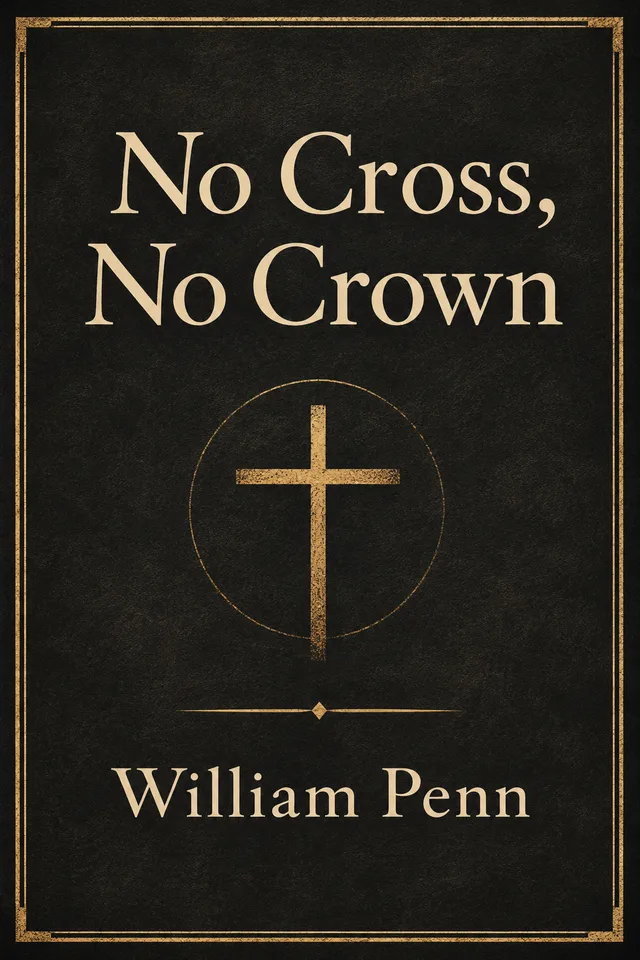
No Cross, No Crown
Edizione BooksWhale in inglese di William Penn
William Penn examines self-denial, conscience, pride, luxury, and Christian conduct through religious argument and examples from earlier lives.
- Anteprima
- Estratto dal testo preparato
- Formati
- Lettore online, EPUB, PDF
- Accesso
- Claim Libreria
Introduzione al libro
No Cross, No Crown
No Cross, No Crown develops William Penn’s argument that spiritual freedom requires discipline rather than conformity to worldly ambition. Its first part addresses pride, luxury, and the practice of self-denial; the second turns to the words and lives of historical figures. The work combines Quaker conviction, ethical criticism, and reflection on public and private conduct.
Edizione BooksWhale
Come è stata preparata
Questa edizione si basa su un testo di pubblico dominio ed è stata preparata da BooksWhale per la lettura digitale.
Base di pubblico dominio
Perché può essere condivisa
William Penn died in 1718. This edition uses the original English text of No Cross, No Crown from Project Gutenberg, which identifies this source as public domain in the United States; later editorial notes and illustrations are excluded.
Leggi anteprima
Estratto dal testo preparato
Anteprima selezionata dal testo preparato per la lettura.
Capitolo in anteprimaFull textLeggi anteprima
No Cross, No Crown
William Penn
"And Jesus said unto them all; If any man will come after me, let him deny himself, and take up his cross daily, and follow me."—Luke, ix. 23.
"I have fought a good fight, I have finished my course, I have kept the faith; henceforth there is laid up for me a crown of righteousness," &c.—2 Tim. iv. 7, 8.
Capitolo in anteprimaPREFACE.Anteprima
Reader,
The great business of man's life, is to answer the end for which he lives; and that is to glorify God and save his own soul: this is the decree of Heaven, as old as the world. But so it is, that man mindeth nothing less than what he should most mind; and despiseth to inquire into his own being, its original duty and end; choosing rather to dedicate his days (the steps he should make to blessedness) to gratify the pride, avarice, and luxury of his heart: as if he had been born for himself, or rather given himself being, and so not subject to the reckoning and judgment of a superior power. To this wild and lamentable pass hath poor man brought himself by his disobedience to the law of God in his heart, by doing that which he knows he should not do, and leaving undone what he knows he should do. And as long as this disease continueth upon man he will make his God his enemy, and himself incapable of the love and salvation that He hath manifested, by his Son Jesus Christ, to the world.
If, Reader, thou art such an one, my counsel to thee is, to retire into thyself, and take a view of the condition of thy soul; for Christ hath given thee light with which to do it; search carefully and thoroughly; thy life is in it; thy soul is at stake. It is but once to be done; if thou abuse thyself in it, the loss is irreparable; the world is not price enough to ransom thee: wilt thou then, for such a world, belate thyself, overstay the time of thy salvation, and lose thy soul? Thou hast to do, I grant thee, with great patience; but that also must have an end: therefore provoke not that God that made thee, to reject thee. Dost thou know what it is? It is Tophet; it is hell, the eternal anguish of the damned. Oh! Reader, as one knowing the terrors of the Lord, I persuade thee to be serious, diligent, and fervent about thy own salvation. Aye, and as one knowing the comfort, peace, joy, and pleasure of the ways of righteousness too, I exhort and invite thee to embrace the reproofs and convictions of Christ's light and spirit in thine own conscience, and bear the judgment, who hast wrought the sin. The fire burns but the stubble: the wind blows but the chaff: yield up the body, soul, and spirit to Him that maketh all things new: new heavens, and new earth, new love, new joy, new peace, new works, a new life and conversation. Men are grown corrupt and drossy by sin, and they must be saved through fire, which purgeth it away: therefore the word of God is compared to a fire, and the day of salvation to an oven; and Christ himself to a refiner and purifier of silver.
Come, Reader, hearken to me awhile; I seek thy salvation; that is my plot; thou wilt forgive me. A refiner is come near thee, his grace hath appeared unto thee: it shows thee the world's lusts, and teaches thee to deny them. Receive his leaven, and it will change thee: his medicine, and it will cure thee: he is as infallible as free; without money, and with certainty. A touch of his garment did it of old: it will do it still: his virtue is the same, it cannot be exhausted: for in him the fulness dwells; blessed be God for his sufficiency. He laid help upon him, that he might be mighty to save all that come to God through him: do thou so, and he will change thee: aye, thy vile body like unto his glorious body. He is the great philosopher indeed; the wisdom of God, that turns lead into gold, vile things into things precious: for he maketh saints out of sinners, and almost gods of men. What rests to us, then, that we must do, to be thus witnesses of his power and love? This is the Crown: but where is the Cross? Where is the bitter cup and bloody baptism? Come, Reader, be like him; for this transcendant joy lift up thy head above the world; then thy salvation will draw nigh indeed.
Capitolo in anteprimaPART I.Anteprima
PART I.
Indice
In questa edizione
- 01Full text
- 02PREFACE.
- 03PART I.
- 04CHAPTER I.
- 05CHAPTER II.
- 06CHAPTER III.
- 07CHAPTER IV.
- 08CHAPTER V.
- 09CHAPTER VI.
- 10CHAPTER VII.
- 11CHAPTER VIII.
- 12CHAPTER IX.
- 13CHAPTER X.
- 14CHAPTER XI.
- 15CHAPTER XII.
- 16CHAPTER XIII.
- 17CHAPTER XIV.
- 18CHAPTER XV.
- 19CHAPTER XVI.
- 20CHAPTER XVII.
- 21CHAPTER XVIII.
- 22PART II
- 23PREFACE.
- 24CHAPTER XIX.
- 25I. AMONG THE GREEKS, &c. viz.
- 26II. The Romans also yielded us instances to our point in hand, viz.
- 27III. I will now proceed to report the virtuous doctrines and sayings of men of more retirement; such as philosophers and writers, both Greeks and Romans, who in their respective times were masters in the civility, knowledge, and virtue that were among the Gentiles, being most of them many ages before the coming of Christ, viz.
- 28IV. Nor is this reputation, wisdom, and virtue, only to be attributed to men: there were women also in the Greek and Roman ages, that honoured their sex, by great examples of meekness, prudence, and chastity; and which I do the rather mention, that the honour, story yields to their virtuous conduct, may raise an allowable emulation in those of their own sex, at least, to equal the noble character given them by antiquity, viz.
- 29CHAPTER XX.
- 30CHAPTER XXI.
- 31CHAPTER XXII.
- 32THE CONCLUSION.
Disponibilità lingue
Altre lingue
Altre edizioni linguistiche non sono ancora pubblicate. Qui appariranno quando disponibili.
Richiedi un'altra lingua