inglese Edizione
Scienza
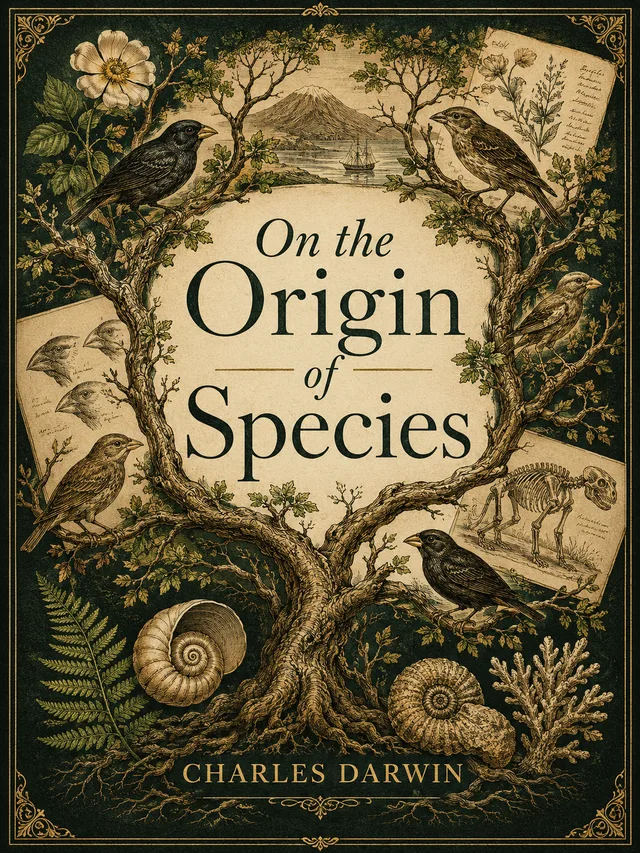
On the Origin of Species
Edizione BooksWhale in inglese di Charles Darwin
Darwin’s revolutionary argument for evolution by natural selection, grounded in observation and comparison.
- Anteprima
- Estratto dal testo preparato
- Formati
- Lettore online, EPUB, PDF
- Accesso
- Claim Libreria
Introduzione al libro
On the Origin of Species
On the Origin of Species presents Darwin’s case that species change through variation, inheritance, struggle, and natural selection. Its patient accumulation of evidence from breeding, geology, biogeography, and classification transformed modern biology.
Edizione BooksWhale
Come è stata preparata
Questa edizione si basa su un testo di pubblico dominio ed è stata preparata da BooksWhale per la lettura digitale.
Base di pubblico dominio
Perché può essere condivisa
Charles Darwin died in 1882, and On the Origin of Species was first published in 1859. These dates support the public-domain basis for this English original edition.
Leggi anteprima
Estratto dal testo preparato
Anteprima selezionata dal testo preparato per la lettura.
Capitolo in anteprimaFull textLeggi anteprima
On the Origin of Species
Charles Darwin
Capitolo in anteprimaINTRODUCTION.Anteprima
When on board H.M.S. ‘Beagle,’ as naturalist, I was much struck with certain facts in the distribution of the inhabitants of South America, and in the geological relations of the present to the past inhabitants of that continent. These facts seemed to me to throw some light on the origin of species—that mystery of mysteries, as it has been called by one of our greatest philosophers. On my return home, it occurred to me, in 1837, that something might perhaps be made out on this question by patiently accumulating and reflecting on all sorts of facts which could possibly have any bearing on it. After five years’ work I allowed myself to speculate on the subject, and drew up some short notes; these I enlarged in 1844 into a sketch of the conclusions, which then seemed to me probable: from that period to the present day I have steadily pursued the same object. I hope that I may be excused for entering on these personal details, as I give them to show that I have not been hasty in coming to a decision.
My work is now nearly finished; but as it will take me two or three more years to complete it, and as my health is far from strong, I have been urged to publish this Abstract. I have more especially been induced to do this, as Mr. Wallace, who is now studying the natural history of the Malay archipelago, has arrived at almost exactly the same general conclusions that I have on the origin of species. Last year he sent to me a memoir on this subject, with a request that I would forward it to Sir Charles Lyell, who sent it to the Linnean Society, and it is published in the third volume of the Journal of that Society. Sir C. Lyell and Dr. Hooker, who both knew of my work—the latter having read my sketch of 1844—honoured me by thinking it advisable to publish, with Mr. Wallace’s excellent memoir, some brief extracts from my manuscripts.
This Abstract, which I now publish, must necessarily be imperfect. I cannot here give references and authorities for my several statements; and I must trust to the reader reposing some confidence in my accuracy. No doubt errors will have crept in, though I hope I have always been cautious in trusting to good authorities alone. I can here give only the general conclusions at which I have arrived, with a few facts in
feel more sensible than I do of the necessity of hereafter publishing in detail all the facts, with references, on which my conclusions have been grounded; and I hope in a future work to do this. For I am well aware that scarcely a single point is discussed in this volume on which facts cannot be adduced, often apparently leading to conclusions directly opposite to those at which I have arrived. A fair result can be obtained only by fully stating and balancing the facts and arguments on both sides of each question; and this cannot possibly be here done.
I much regret that want of space prevents my having the satisfaction of acknowledging the generous assistance which I have received from very many naturalists, some of them personally unknown to me. I cannot, however, let this opportunity pass without expressing my deep obligations to Dr. Hooker, who for the last fifteen years has aided me in every possible way by his large stores of knowledge and his excellent judgment.
In considering the Origin of Species, it is quite conceivable that a naturalist, reflecting on the mutual affinities of organic beings, on their embryological relations, their geographical distribution, geological succession, and other such facts, might come to the conclusion that each species had not been independently created, but had descended, like varieties, from other species. Nevertheless, such a conclusion, even if well founded, would be unsatisfactory, until it could be shown how the innumerable species inhabiting this world have been modified, so as to acquire that perfection of structure and coadaptation which most justly excites our admiration. Naturalists continually refer to external conditions, such as climate, food, etc., as the only possible cause of variation. In one very limited sense, as we shall hereafter see, this may be true; but it is preposterous to attribute to mere external conditions, the structure, for instance, of the woodpecker, with its feet, tail, beak, and tongue, so admirably adapted to catch insects under the bark of trees. In the case of the misseltoe, which draws its nourishment from certain trees, which has seeds that must be transported by certain birds, and which has flowers with separate sexes absolutely requiring the agency of certain insects to bring pollen from one flower to the other, it is equally preposterous to account for the structure of this parasite, with its relations to several distinct organic beings, by the effects of external conditions, or of habit, or of the volition of the plant itself.
Capitolo in anteprimaCHAPTER I.Anteprima
VARIATION UNDER DOMESTICATION.
Causes of Variability. Effects of Habit. Correlation of Growth. Inheritance. Character of Domestic Varieties. Difficulty of distinguishing between Varieties and Species. Origin of Domestic Varieties from one or more Species. Domestic Pigeons, their Differences and Origin. Principle of Selection anciently followed, its Effects. Methodical and Unconscious Selection. Unknown Origin of our Domestic Productions. Circumstances favourable to Man’s power of Selection.
When we look to the individuals of the same variety or sub-variety of our older cultivated plants and animals, one of the first points which strikes us, is, that they generally differ much more from each other, than do the individuals of any one species or variety in a state of nature. When we reflect on the vast diversity of the plants and animals which have been cultivated, and which have varied during all ages under the most different climates and treatment, I think we are driven to conclude that this greater variability is simply due to our domestic productions having been raised under conditions of life not so uniform as, and somewhat different from, those to which the parent-species have been exposed under nature. There is, also, I think, some probability in the view propounded by Andrew Knight, that this variability may be partly connected with excess of food. It seems pretty clear that organic beings must be exposed during several generations to the new conditions of life to cause any appreciable amount of variation; and that when the organisation has once begun to vary, it generally continues to vary for many generations. No case is on record of a variable being ceasing to be variable under cultivation. Our oldest cultivated plants, such as wheat, still often yield new varieties: our oldest domesticated animals are still capable of rapid improvement or modification.
It has been disputed at what period of life the causes of variability, whatever they may be, generally act; whether during the early or late period of development of the embryo, or at the instant of conception. Geoffroy St. Hilaire’s experiments show that unnatural treatment of the embryo causes monstrosities; and monstrosities cannot be separated by any clear line of distinction from mere variations. But I am strongly inclined to suspect that the most frequent cause of variability may be attributed to the male and female reproductive elements having been affected prior to the act of conception. Several reasons make me believe in this; but the chief one is the remarkable effect which confinement or cultivation has on the functions of the reproductive system; this system appearing to be far more susceptible than any other part of the organisation, to the action of any change in the conditions of life. Nothing is more easy than to tame an animal, and few things more difficult than to get it to breed freely under confinement, even in the many cases when the male and female unite. How many animals there are which will not breed, though living long under not very close confinement in their native country! This is generally attributed to vitiated instincts; but how many cultivated plants display the utmost vigour, and yet rarely or never seed! In some few such cases it has been found out that very trifling changes, such as a little more or less water at some particular period of growth, will determine whether or not the plant sets a seed. I cannot here enter on the copious details which I have collected on this curious subject; but to show how singular the laws are which determine the reproduction of animals under confinement, I may just mention that carnivorous animals, even from the tropics, breed in this country pretty freely under confinement, with the exception of the plantigrades or bear family; whereas, carnivorous birds, with the rarest exceptions, hardly ever lay fertile eggs. Many exotic plants have pollen utterly worthless, in the same exact condition as in the most sterile hybrids. When, on the one hand, we see domesticated animals and plants, though often weak and sickly, yet breeding quite freely under confinement; and when, on the other hand, we see individuals, though taken young from a state of nature, perfectly tamed, long-lived, and healthy (of which I could give numerous instances), yet having their reproductive system so seriously affected by unperceived causes as to fail in acting, we need not be surprised at this system, when it does act under confinement, acting not quite regularly, and producing offspring not perfectly like their parents or variable.
Indice
In questa edizione
- 01Full text
- 02INTRODUCTION.
- 03CHAPTER I.
- 04CHAPTER II.
- 05CHAPTER III.
- 06CHAPTER IV.
- 07CHAPTER V.
- 08CHAPTER VI.
- 09CHAPTER VII.
- 10CHAPTER VIII.
- 11CHAPTER IX.
- 12CHAPTER X.
- 13CHAPTER XI.
- 14CHAPTER XII.
- 15CHAPTER XIII.
- 16CHAPTER XIV.
- 17INDEX.
Disponibilità lingue
Altre lingue
Altre edizioni linguistiche non sono ancora pubblicate. Qui appariranno quando disponibili.
Richiedi un'altra lingua