inglese Edizione
Storia
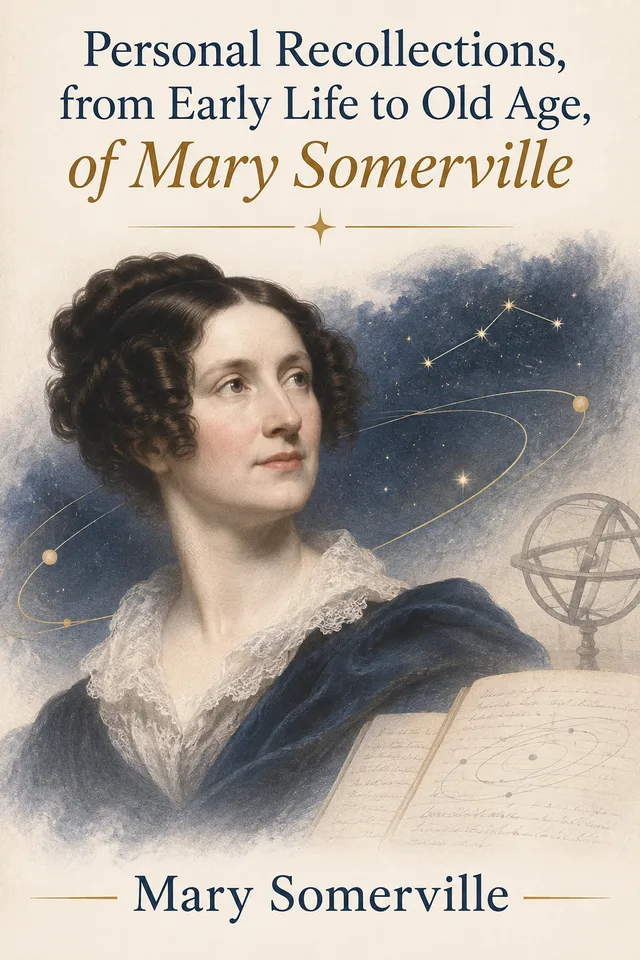
Personal Recollections, from Early Life to Old Age, of Mary Somerville
Edizione BooksWhale in inglese di Mary Somerville
Mary Somerville recalls her education, scientific work, travels, and friendships in a volume assembled by her daughter Martha.
- Anteprima
- Estratto dal testo preparato
- Formati
- Lettore online, EPUB, PDF
- Accesso
- Claim Libreria
Introduzione al libro
Personal Recollections, from Early Life to Old Age, of Mary Somerville
Somerville describes learning mathematics through private study, entering British and European scientific circles, and writing books on astronomy and natural science. Her recollections also follow family life in Scotland, London, and Italy. The volume, assembled by Martha Somerville, includes correspondence and an account of Mary Somerville’s final years.
Edizione BooksWhale
Come è stata preparata
Questa edizione si basa su un testo di pubblico dominio ed è stata preparata da BooksWhale per la lettura digitale.
Base di pubblico dominio
Perché può essere condivisa
Mary Somerville died in 1872. This English text follows the nineteenth-century volume prepared by her daughter Martha Somerville and sourced from Project Gutenberg, which marks it as public domain in the United States.
Leggi anteprima
Estratto dal testo preparato
Anteprima selezionata dal testo preparato per la lettura.
Capitolo in anteprimaCHAPTER I.Leggi anteprima
INTRODUCTION—PARENTAGE—LIFE IN SCOTLAND IN THE LAST CENTURY—EARLY EDUCATION—SCHOOL.
The life of a woman entirely devoted to her family duties and to scientific pursuits affords little scope for a biography. There are in it neither stirring events nor brilliant deeds to record; and as my Mother was strongly averse to gossip, and to revelations of private life or of intimate correspondence, nothing of the kind will be found in the following pages. It has been only after very great hesitation, and on the recommendation of valued friends, who think that some account of so remarkable and beautiful a character cannot fail to interest the public, that I have resolved to publish some detached Recollections of past times, noted down by my mother during the last years of her life, together with a few letters from eminent men and women, referring almost exclusively to her scientific works. A still smaller number of her own letters have been added, either as illustrating her opinions on events she witnessed, or else as affording some slight idea of her simple and loving disposition.
Few thoughtful minds will read without emotion my mother's own account of the wonderful energy and indomitable perseverance by which, in her ardent thirst for knowledge, she overcame obstacles apparently insurmountable, at a time when women were well-nigh totally debarred from education; and the almost intuitive way in which she entered upon studies of which she had scarcely heard the names, living, as she did, among persons to whom they were utterly unknown, and who disapproved of her devotion to pursuits so different from those of ordinary young girls at the end of the last century, especially in Scotland, which was far more old-fashioned and primitive than England.
Nor is her simple account of her early days without interest, when, as a lonely child, she wandered by the seashore, and on the links of Burntisland, collecting shells and flowers; or spent the clear, cold nights at her window, watching the starlit heavens, whose mysteries she was destined one day to penetrate in all their profound and sublime laws, making clear to others that knowledge which she herself had acquired, at the cost of so hard a struggle.
It was not only in her childhood and youth that my mother's studies encountered disapproval. Not till she became a widow, had she perfect freedom to pursue them. The first person—indeed the only one in her early days—who encouraged her passion for learning was her uncle by marriage, afterwards her father-in-law, the Rev. Dr. Somerville, minister of Jedburgh, a man very much in advance of his century in liberality of thought on all subjects. He was one of the first to discern her rare qualities, and valued her as she deserved; while through life she retained the most grateful affection for him, and confided to him many doubts and difficulties on subjects of the highest importance. Nothing can be more erroneous than the statement, repeated in several obituary notices of my mother, that Mr. Greig (her first husband) aided her in her mathematical and other pursuits. Nearly the contrary was the case. Mr. Greig took no interest in science or literature, and possessed in full the prejudice against learned women which was common at that time. Only on her marriage with my father, my mother at last met with one who entirely sympathised with her, and warmly entered into all her ideas, encouraging her zeal for study to the utmost, and affording her every facility for it in his power. His love and admiration for her were unbounded; he frankly and willingly acknowledged her superiority to himself, and many of our friends can bear witness to the honest pride and gratification which he always testified in the fame and honours she attained.
No one can escape sorrow, and my mother, in the course of her long life, had her full share, but she bore it with that deep feeling of trust in the great goodness of God which formed so marked a feature in her character. She had a buoyant and hopeful spirit, and though her affections were very strong, and she felt keenly, it was ever her nature to turn from the shadows to all that is bright and beautiful in mortal life. She had much to make life pleasant in the great honours universally bestowed upon her; but she found far more in the devoted affection of friends, to say nothing of those whose happy lot it has been to live in close and loving intercourse with so noble and gentle a spirit.
Capitolo in anteprimaCHAPTER II.Anteprima
FREEDOM—RELIGIOUS EDUCATION—JEDBURGH.
My mother remained at school at Musselburgh for a twelvemonth, till she was eleven years old. After this prolonged and elaborate education, she was recalled to Burntisland, and the results of the process she had undergone are detailed in her "Recollections" with much drollery.
Soon after my return home I received a note from a lady in the neighbourhood, inquiring for my mother, who had been ill. This note greatly distressed me, for my half-text writing was as bad as possible, and I could neither compose an answer nor spell the words. My eldest cousin, Miss Somerville, a grown-up young lady, then with us, got me out of this scrape, but I soon got myself into another, by writing to my brother in Edinburgh that I had sent him a bank-knot (note) to buy something for me. The school at Musselburgh was expensive, and I was reproached with having cost so much money in vain. My mother said she would have been contented if I had only learnt to write well and keep accounts, which was all that a woman was expected to know.
This passed over, and I was like a wild animal escaped out of a cage. I was no longer amused in the gardens, but wandered about the country. When the tide was out I spent hours on the sands, looking at the star-fish and sea-urchins, or watching the children digging for sand-eels, cockles, and the spouting razor-fish. I made a collection of shells, such as were cast ashore, some so small that they appeared like white specks in patches of black sand. There was a small pier on the sands for shipping limestone brought from the coal mines inland. I was astonished to see the surface of these blocks of stone covered with beautiful impressions of what seemed to be leaves; how they got there I could not imagine, but I picked up the broken bits, and even large pieces, and brought them to my repository. I knew the eggs of many birds, and made a collection of them. I never robbed a nest, but bought strings of eggs, which were sold by boys, besides getting sea-fowl eggs from sailors who had been in whalers or on other northern voyages. It was believed by these sailors that there was a gigantic flat fish in the North Sea, called a kraken. It was so enormous that when it came to the surface, covered with tangles and sand, it was supposed to be an island, till, on one occasion, part of a ship's crew landed on it and found out their mistake. However, much as they believed in it, none of the sailors at Burntisland had ever seen it. The sea serpent was also an article of our faith.
In the rocks at the end of our garden there was a shingly opening, in which we used to bathe, and where at low tide I frequently waded among masses of rock covered with sea-weeds. With the exception of dulse and tangle I knew the names of none, though I was well acquainted with and admired many of these beautiful plants. I also watched the crabs, live shells, jelly-fish, and various marine animals, all of which were objects of curiosity and amusement to me in my lonely life.
The flora on the links and hills around was very beautiful, and I soon learnt the trivial names of all the plants. There was not a tree nor bush higher than furze in this part of the country, but the coast to the north-west of Burntisland was bordered by a tree and brushwood-covered bank belonging to the Earl of Morton, which extended to Aberdour. I could not go so far alone, but had frequent opportunities of walking there and gathering ferns, foxgloves, and primroses, which grew on the mossy banks of a little stream that ran into the sea. The bed of this stream or burn was thickly covered with the freshwater mussel, which I knew often contained pearls, but I did not like to kill the creatures to get the pearls.
Capitolo in anteprimaCHAPTER III.Anteprima
EDINBURGH—YOUTHFUL STUDIES AND AMUSEMENTS—POLITICS—THE THEATRES OF THE TIME.
My mother's next visit was to the house of her uncle, William Charters, in Edinburgh. From thence she was enabled to partake of the advantages of a dancing-school of the period.
They sent me to Strange's dancing school. Strange himself was exactly like a figure on the stage; tall and thin, he wore a powdered wig, with cannons at the ears, and a pigtail. Ruffles at the breast and wrists, white waistcoat, black silk or velvet shorts, white silk stockings, large silver buckles, and a pale blue coat completed his costume. He had a little fiddle on which he played, called a kit. My first lesson was how to walk and make a curtsey. "Young lady, if you visit the queen you must make three curtsies, lower and lower and lower as you approach her. So—o—o," leading me on and making me curtsey. "Now, if the queen were to ask you to eat a bit of mutton with her, what would you say?" Every Saturday afternoon all the scholars, both boys and girls, met to practise in the public assembly rooms in George's Street. It was a handsome large hall with benches rising like an amphitheatre. Some of the elder girls were very pretty, and danced well, so these practisings became a lounge for officers from the Castle, and other young men. We used always to go in full evening dress. We learnt the minuet de la cour, reels and country dances. Our partners used to give us gingerbread and oranges. Dancing before so many people was quite an exhibition, and I was greatly mortified one day when ready to begin a minuet, by the dancing-master shaking me roughly and making me hold out my frock properly.
Though kind in the main, my uncle and his wife were rather sarcastic and severe, and kept me down a good deal, which I felt keenly, but said nothing. I was not a favourite with my family at that period of my life, because I was reserved and unexpansive, in consequence of the silence I was obliged to observe on the subjects which interested me. Three Miss Melvilles, friends, or perhaps relatives, of Mrs. Charters, were always held up to me as models of perfection, to be imitated in everything, and I wearied of hearing them constantly praised at my expense.
In a small society like that of Edinburgh there was a good deal of scandal and gossip; every one's character and conduct were freely criticised, and by none more than by my aunt and her friends. She used to sit at a window embroidering, where she not only could see every one that passed, but with a small telescope could look into the dressing-room of a lady of her acquaintance, and watch all she did. A spinster lady of good family, a cousin of ours, carried her gossip so far, that she was tried for defamation, and condemned to a month's imprisonment, which she actually underwent in the Tolbooth. She was let out just before the king's birthday, to celebrate which, besides the guns fired at the Castle, the boys let off squibs and crackers in all the streets. As the lady in question was walking up the High Street, some lads in a wynd, or narrow street, fired a small cannon, and one of the slugs with which it was loaded hit her mouth and wounded her tongue. This raised a universal laugh; and no one enjoyed it more than my uncle William, who disliked this somewhat masculine woman.
Whilst at my uncle's house, I attended a school for writing and arithmetic, and made considerable progress in the latter, for I liked it, but I soon forgot it from want of practice.
My uncle and aunt generally paid a visit to the Lyells of Kinnordy, the father and mother of my friend Sir Charles Lyell, the celebrated geologist; but this time they accepted an invitation from Captain Wedderburn, and took me with them. Captain Wedderburn was an old bachelor, who had left the army and devoted himself to agriculture. Mounted on a very tall but quiet horse, I accompanied my host every morning when he went over his farm, which was chiefly a grass farm. The house was infested with rats, and a masculine old maid, who was of the party, lived in such terror of them, that she had a light in her bedroom, and after she was in bed, made her maid tuck in the white dimity curtains all round. One night we were awakened by violent screams, and on going to see what was the matter, we found Miss Cowe in the middle of the room, bare-footed, in her night-dress, screaming at the top of her voice. Instead of tucking the rats out of the bed, the maid had tucked one in, and Miss Cowe on waking beheld it sitting on her pillow.
Indice
In questa edizione
- 01CHAPTER I.
- 02CHAPTER II.
- 03CHAPTER III.
- 04CHAPTER IV.
- 05CHAPTER V.
- 06CHAPTER VI.
- 07CHAPTER VII.
- 08CHAPTER VIII.
- 09CHAPTER IX.
- 10CHAPTER X.
- 11CHAPTER XI.
- 12CHAPTER XII.
- 13CHAPTER XIII.
- 14CHAPTER XIV.
- 15CHAPTER XV.
- 16CHAPTER XVI.
- 17CHAPTER XVII.
- 18CHAPTER XVIII.
Disponibilità lingue
Altre lingue
Altre edizioni linguistiche non sono ancora pubblicate. Qui appariranno quando disponibili.
Richiedi un'altra lingua