inglese Edizione
Letteratura
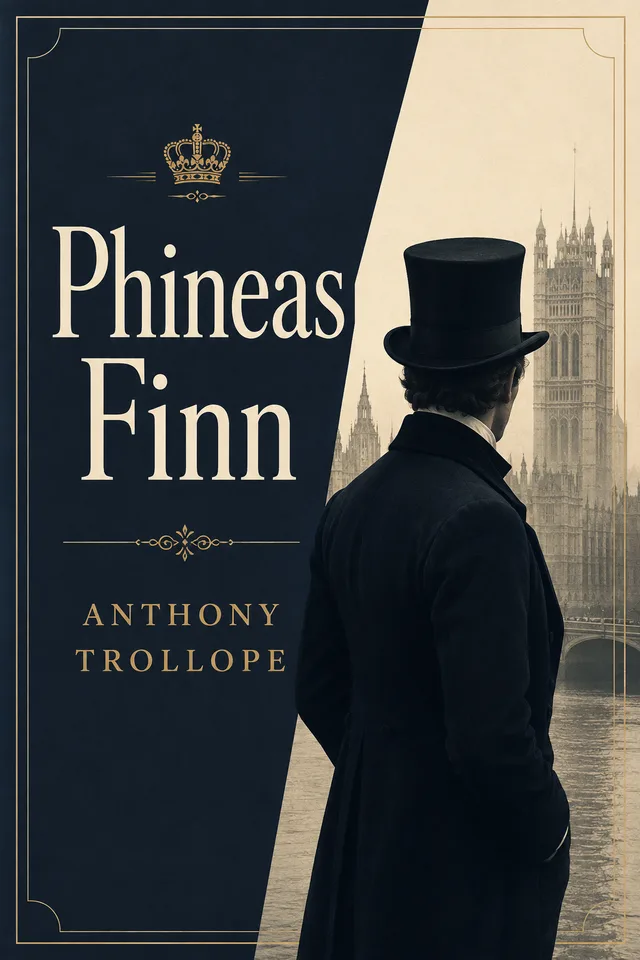
Phineas Finn
Edizione BooksWhale in inglese di Anthony Trollope
Trollope’s parliamentary novel follows Phineas Finn through ambition, reform politics, society, love, and moral compromise.
- Anteprima
- Estratto dal testo preparato
- Formati
- Lettore online, EPUB, PDF
- Accesso
- Claim Libreria
Introduzione al libro
Phineas Finn
Phineas Finn, the second Palliser novel, follows an Irish barrister as he enters Parliament and London society. Anthony Trollope turns elections, party discipline, reform debates, courtship, friendship, and personal ambition into a detailed portrait of Victorian political life and the private cost of public advancement.
Edizione BooksWhale
Come è stata preparata
Questa edizione si basa su un testo di pubblico dominio ed è stata preparata da BooksWhale per la lettura digitale.
Base di pubblico dominio
Perché può essere condivisa
Author died in 1882; original English text is in the public domain.
Leggi anteprima
Estratto dal testo preparato
Anteprima selezionata dal testo preparato per la lettura.
Capitolo in anteprimaPhineas FinnLeggi anteprima
Phineas Finn Proposes to Stand for Loughshane
Dr. Finn, of Killaloe, in county Clare, was as well known in those
parts,--the confines, that is, of the counties Clare, Limerick,
Tipperary, and Galway,--as was the bishop himself who lived in the
same town, and was as much respected. Many said that the doctor was
the richer man of the two, and the practice of his profession was
extended over almost as wide a district. Indeed the bishop whom he
was privileged to attend, although a Roman Catholic, always spoke of
their dioceses being conterminate. It will therefore be understood
that Dr. Finn,--Malachi Finn was his full name,--had obtained a wide
reputation as a country practitioner in the west of Ireland. And he
was a man sufficiently well to do, though that boast made by his
friends, that he was as warm a man as the bishop, had but little
truth to support it. Bishops in Ireland, if they live at home, even
in these days, are very warm men; and Dr. Finn had not a penny in the
world for which he had not worked hard. He had, moreover, a costly
family, five daughters and one son, and, at the time of which we
are speaking, no provision in the way of marriage or profession had
been made for any of them. Of the one son, Phineas, the hero of the
following pages, the mother and five sisters were very proud. The
doctor was accustomed to say that his goose was as good as any other
man’s goose, as far as he could see as yet; but that he should like
some very strong evidence before he allowed himself to express an
opinion that the young bird partook, in any degree, of the qualities
of a swan. From which it may be gathered that Dr. Finn was a man of
common-sense.
Phineas had come to be a swan in the estimation of his mother and
sisters by reason of certain early successes at college. His father,
whose religion was not of that bitter kind in which we in England
are apt to suppose that all the Irish Roman Catholics indulge, had
sent his son to Trinity; and there were some in the neighbourhood of
Killaloe,--patients, probably, of Dr. Duggin, of Castle Connell, a
learned physician who had spent a fruitless life in endeavouring to
make head against Dr. Finn,--who declared that old Finn would not be
sorry if his son were to turn Protestant and go in for a fellowship.
Mrs. Finn was a Protestant, and the five Miss Finns were Protestants,
and the doctor himself was very much given to dining out among his
Protestant friends on a Friday. Our Phineas, however, did not turn
Protestant up in Dublin, whatever his father’s secret wishes on that
subject may have been. He did join a debating society, to success
in which his religion was no bar; and he there achieved a sort of
distinction which was both easy and pleasant, and which, making
its way down to Killaloe, assisted in engendering those ideas as
to swanhood of which maternal and sisterly minds are so sweetly
susceptible. “I know half a dozen old windbags at the present
moment,” said the doctor, “who were great fellows at debating clubs
when they were boys.” “Phineas is not a boy any longer,” said Mrs.
Finn. “And windbags don’t get college scholarships,” said Matilda
Finn, the second daughter. “But papa always snubs Phinny,” said
Barbara, the youngest. “I’ll snub you, if you don’t take care,” said
the doctor, taking Barbara tenderly by the ear;--for his youngest
daughter was the doctor’s pet.
The doctor certainly did not snub his son, for he allowed him to go
over to London when he was twenty-two years of age, in order that he
might read with an English barrister. It was the doctor’s wish that
Capitolo in anteprima“About Loughshane.”Anteprima
“All right, old fellow; we shall be sure to carry you through. The
Irish writs will be out on the third of March, and the sooner you’re
there the better.”
Capitolo in anteprimaCHAPTER IIAnteprima
Phineas Finn Is Elected for Loughshane
One great difficulty about the borough vanished in a very wonderful
way at the first touch. Dr. Finn, who was a man stout at heart,
and by no means afraid of his great friends, drove himself over to
Castlemorris to tell his news to the Earl, as soon as he got a second
letter from his son declaring his intention of proceeding with the
business, let the results be what they might. Lord Tulla was a
passionate old man, and the doctor expected that there would be a
quarrel;--but he was prepared to face that. He was under no special
debt of gratitude to the lord, having given as much as he had taken
in the long intercourse which had existed between them;--and he
agreed with his son in thinking that if there was to be a Liberal
candidate at Loughshane, no consideration of old pill-boxes and
gallipots should deter his son Phineas from standing. Other
considerations might very probably deter him, but not that. The Earl
probably would be of a different opinion, and the doctor felt it to
be incumbent on him to break the news to Lord Tulla.
“The devil he is!” said the Earl, when the doctor had told his story.
“Then I’ll tell you what, Finn, I’ll support him.”
“You support him, Lord Tulla!”
“Yes;--why shouldn’t I support him? I suppose it’s not so bad with me
in the country that my support will rob him of his chance! I’ll tell
you one thing for certain, I won’t support George Morris.”
“But, my lord--”
“Well; go on.”
“I’ve never taken much part in politics myself, as you know; but my
boy Phineas is on the other side.”
“I don’t care a ---- for sides. What has my party done for me?
Look at my cousin, Dick Morris. There’s not a clergyman in Ireland
stauncher to them than he has been, and now they’ve given the deanery
of Kilfenora to a man that never had a father, though I condescended
to ask for it for my cousin. Let them wait till I ask for anything
again.” Dr. Finn, who knew all about Dick Morris’s debts, and who had
heard of his modes of preaching, was not surprised at the decision
of the Conservative bestower of Irish Church patronage; but on this
subject he said nothing. “And as for George,” continued the Earl, “I
will never lift my hand again for him. His standing for Loughshane
would be quite out of the question. My own tenants wouldn’t vote for
him if I were to ask them myself. Peter Blake”--Mr. Peter Blake was
the lord’s agent--“told me only a week ago that it would be useless.
The whole thing is gone, and for my part I wish they’d disenfranchise
the borough. I wish they’d disenfranchise the whole country, and send
us a military governor. What’s the use of such members as we send?
There isn’t one gentleman among ten of them. Your son is welcome for
me. What support I can give him he shall have, but it isn’t much. I
suppose he had better come and see me.”
The doctor promised that his son should ride over to Castlemorris,
and then took his leave,--not specially flattered, as he felt that
were his son to be returned, the Earl would not regard him as the
one gentleman among ten whom the county might send to leaven the
remainder of its members,--but aware that the greatest impediment
in his son’s way was already removed. He certainly had not gone to
Castlemorris with any idea of canvassing for his son, and yet he had
canvassed for him most satisfactorily. When he got home he did not
know how to speak of the matter otherwise than triumphantly to his
Indice
In questa edizione
- 01Phineas Finn
- 02“About Loughshane.”
- 03CHAPTER II
- 04“Lady Laura Fiddlestick!”
- 05“Lady Laura Standish!”
- 06part.”
- 07CHAPTER III
- 08Phineas Finn Takes His Seat
- 09CHAPTER IV
- 10Lady Laura Standish
- 11CHAPTER V
- 12Monday.”
- 13CHAPTER VI
- 14Cabinet.”
- 15Loughshane.”
- 16Kennedy?”
- 17Parliament.”
- 18CHAPTER VII
- 19CHAPTER VIII
- 20Laura.”
- 21Parliament, Mr. Finn.”
- 22CHAPTER IX
- 23The New Government
- 24CHAPTER X
- 25Violet Effingham
- 26“Well.”
- 27Lord Chiltern--”
- 28“Well.”
- 29CHAPTER XI
- 30Lord Chiltern
- 31CHAPTER XII
- 32Autumnal Prospects
- 33CHAPTER XIII
- 34Saulsby Wood
- 35“Poor Mr. Palliser!”
- 36CHAPTER XIV
- 37Loughlinter
- 38“Undoubtedly.”
- 39CHAPTER XV
- 40Loughlinter.”
- 41part of Ireland. It certainly did not become him to fear Lady Laura
- 42“Oh, Lady Laura!”
- 43CHAPTER XVI
- 44Parliament.”
- 45CHAPTER XVII
- 46CHAPTER XVIII
- 47Mr. Turnbull
- 48CHAPTER XIX
- 49Lord Chiltern Rides His Horse Bonebreaker
- 50Effingham--”
- 51“Never?”
- 52“Never.”
- 53CHAPTER XX
- 54British Constitution.”
- 55CHAPTER XXI
- 56“Arrangements!”
- 57Parliament.”
- 58“What;--Clarkson?”
- 59CHAPTER XXII
- 60Laurence?”
- 61“No!”
- 62“From Lady Laura?”
- 63CHAPTER XXIII
- 64CHAPTER XXIV
- 65The Willingford Bull
- 66Square.”
- 67Grosvenor Place?”
- 68Finn.”
- 69CHAPTER XXV
- 70CHAPTER XXVI
- 71“The First Speech”
- 72part with him against the magistrates,--having a hope also, in which
- 73CHAPTER XXVII
- 74Phineas Discussed
- 75“No!”
- 76CHAPTER XXVIII
- 77The Second Reading Is Carried
- 78CHAPTER XXIX
- 79A Cabinet Meeting
- 80CHAPTER XXX
- 81“What?”
- 82CHAPTER XXXI
- 83“Lady Laura!”
- 84CHAPTER XXXII
- 85Governor.”
- 86CHAPTER XXXIII
- 87Loughlinter.”
- 88“Nonsense?”
- 89CHAPTER XXXIV
- 90Lord Chiltern.”
- 91“None.”
- 92CHAPTER XXXV
- 93chapter. He felt very keenly that his position was unsatisfactory,
- 94CHAPTER XXXVI
- 95Phineas Finn Makes Progress
- 96CHAPTER XXXVII
- 97A Rough Encounter
- 98VOLUME II
- 99CHAPTER XXXVIII
- 100The Duel
- 101CHAPTER XXXIX
- 102Lady Laura Is Told
- 103“Lady Laura!”
- 104CHAPTER XL
- 105Madame Max Goesler
- 106“To Blankenberg!”
- 107CHAPTER XLI
- 108Lord Fawn
- 109CHAPTER XLII
- 110“Well!”
- 111CHAPTER XLIII
- 112Promotion
- 113Brussels.”
- 114CHAPTER XLIV
- 115Attorney-General.”
- 116“Nonsense!”
- 117“Psha!”
- 118CHAPTER XLV
- 119“Like Lady Baldock?”
- 120“Well?”
- 121CHAPTER XLVI
- 122The Mousetrap
- 123CHAPTER XLVII
- 124CHAPTER XLVIII
- 125“The Duke”
- 126CHAPTER XLIX
- 127The Duellists Meet
- 128“Oh, Lord Chiltern!”
- 129part they do not in the least know their own motives for what they
- 130CHAPTER L
- 131Again Successful
- 132London University?”
- 133“What! Fitzgibbon?”
- 134“Sometimes.”
- 135State.”
- 136CHAPTER LI
- 137“Assignations!”
- 138“Robert!”
- 139“Never.”
- 140Loughlinter.”
- 141CHAPTER LII
- 142The First Blow
- 143CHAPTER LIII
- 144“Phineas Finn.”
- 145CHAPTER LIV
- 146Consolation
- 147Effingham.”
- 148CHAPTER LV
- 149Lady Fawn.”
- 150“And Mr. Appledom!”
- 151“No.”
- 152“Yes.”
- 153Parliament.”
- 154CHAPTER LVI
- 155“Madame Goesler!”
- 156“Psha!”
- 157CHAPTER LVII
- 158CHAPTER LVIII
- 159CHAPTER LIX
- 160“Nor Mr. Kennedy?”
- 161CHAPTER LX
- 162CHAPTER LXI
- 163Another Duel
- 164Glencora.”
- 165CHAPTER LXII
- 166CHAPTER LXIII
- 167Treasury Bench.”
- 168CHAPTER LXIV
- 169The Horns
- 170“Mr. Finn!”
- 171Farewell.”
- 172“Oh, Lady Laura!”
- 173CHAPTER LXV
- 174Blood.”
- 175CHAPTER LXVI
- 176Victrix
- 177Mary.”
- 178CHAPTER LXVII
- 179CHAPTER LXVIII
- 180The Joint Attack
- 181CHAPTER LXIX
- 182The Temptress
- 183Mary:--
- 184Violet Effingham.”
- 185CHAPTER LXX
- 186Mouser.”
- 187CHAPTER LXXI
- 188Comparing Notes
- 189part. Though it nearly broke her heart to see him leave her, she bid
- 190Scotland.”
- 191“Violet!”
- 192CHAPTER LXXII
- 193“Exactly.”
- 194“No;--Madame Goesler.”
- 195CHAPTER LXXIII
- 196Amantium Iræ
- 197CHAPTER LXXIV
- 198part of a barrister’s work. He had gone altogether into a different
- 199Parliament.”
- 200CHAPTER LXXV
- 201“Next Sunday.”
- 202part from her with some special expression of affection, but he did
- 203CHAPTER LXXVI
- 204Conclusion
Disponibilità lingue
Altre lingue
Altre edizioni linguistiche non sono ancora pubblicate. Qui appariranno quando disponibili.
Richiedi un'altra lingua