inglese Edizione
Letteratura
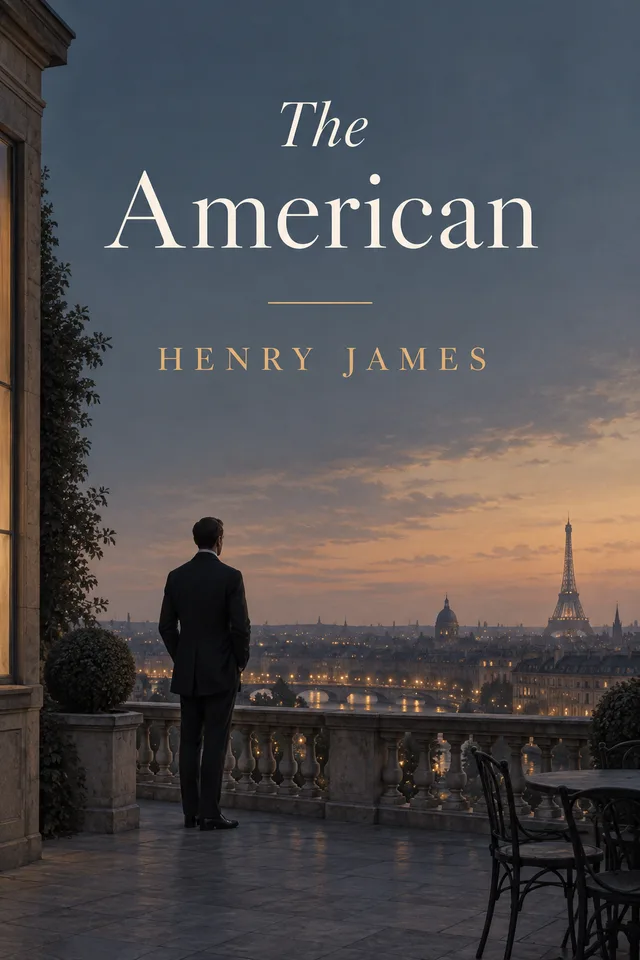
The American
Edizione BooksWhale in inglese di Henry James
A classic English-language work about American innocence, European convention, class, courtship and family pride.
- Anteprima
- Estratto dal testo preparato
- Formati
- Lettore online, EPUB, PDF
- Accesso
- Claim Libreria
Introduzione al libro
The American
The American explores American innocence, European convention, class, courtship and family pride. The work combines memorable characters, social observation and a sustained conflict between private desire, public expectation and moral choice.
Edizione BooksWhale
Come è stata preparata
Questa edizione si basa su un testo di pubblico dominio ed è stata preparata da BooksWhale per la lettura digitale.
Base di pubblico dominio
Perché può essere condivisa
Henry James died in 1916, and The American was first published or composed in 1877. These dates support the public-domain basis for this original-language edition.
Leggi anteprima
Estratto dal testo preparato
Anteprima selezionata dal testo preparato per la lettura.
Capitolo in anteprimaFull textLeggi anteprima
The American
Henry James
Capitolo in anteprimaCHAPTER IAnteprima
On a brilliant day in May, in the year 1868, a gentleman was reclining at his ease on the great circular divan which at that period occupied the centre of the Salon Carré, in the Museum of the Louvre. This commodious ottoman has since been removed, to the extreme regret of all weak-kneed lovers of the fine arts, but the gentleman in question had taken serene possession of its softest spot, and, with his head thrown back and his legs outstretched, was staring at Murillo’s beautiful moon-borne Madonna in profound enjoyment of his posture. He had removed his hat, and flung down beside him a little red guide-book and an opera-glass. The day was warm; he was heated with walking, and he repeatedly passed his handkerchief over his forehead, with a somewhat wearied gesture. And yet he was evidently not a man to whom fatigue was familiar; long, lean, and muscular, he suggested the sort of vigor that is commonly known as “toughness.” But his exertions on this particular day had been of an unwonted sort, and he had performed great physical feats which left him less jaded than his tranquil stroll through the Louvre. He had looked out all the pictures to which an asterisk was affixed in those formidable pages of fine print in his Bädeker; his attention had been strained and his eyes dazzled, and he had sat down with an æsthetic headache. He had looked, moreover, not only at all the pictures, but at all the copies that were going forward around them, in the hands of those innumerable young women in irreproachable toilets who devote themselves, in France, to the propagation of masterpieces, and if the truth must be told, he had often admired the copy much more than the original. His physiognomy would have sufficiently indicated that he was a shrewd and capable fellow, and in truth he had often sat up all night over a bristling bundle of accounts, and heard the cock crow without a yawn. But Raphael and Titian and Rubens were a new kind of arithmetic, and they inspired our friend, for the first time in his life, with a vague self-mistrust.
An observer with anything of an eye for national types would have had no difficulty in determining the local origin of this undeveloped connoisseur, and indeed such an observer might have felt a certain humorous relish of the almost ideal completeness with which he filled out the national mould. The gentleman on the divan was a powerful specimen of an American. But he was not only a fine American; he was in the first place, physically, a fine man. He appeared to possess that kind of health and strength which, when found in perfection, are the most impressive—the physical capital which the owner does nothing to “keep up.” If he was a muscular Christian, it was quite without knowing it. If it was necessary to walk to a remote spot, he walked, but he had never known himself to “exercise.” He had no theory with regard to cold bathing or the use of Indian clubs; he was neither an oarsman, a rifleman, nor a fencer—he had never had time for these amusements—and he was quite unaware that the saddle is recommended for certain forms of indigestion. He was by inclination a temperate man; but he had supped the night before his visit to the Louvre at the Café Anglais—someone had told him it was an experience not to be omitted—and he had slept none the less the sleep of the just. His usual attitude and carriage were of a rather relaxed and lounging kind, but when under a special inspiration, he straightened himself, he looked like a grenadier on parade. He never smoked. He had been assured—such things are said—that cigars were excellent for the health, and he was quite capable of believing it; but he knew as little about tobacco as about homœopathy. He had a very well-formed head, with a shapely, symmetrical balance of the frontal and the occipital development, and a good deal of straight, rather dry brown hair. His complexion was brown, and his nose had a bold well-marked arch. His eye was of a clear, cold gray, and save for a rather abundant moustache he was clean-shaved. He had the flat jaw and sinewy neck which are frequent in the American type; but the traces of national origin are a matter of expression even more than of feature, and it was in this respect that our friend’s countenance was supremely eloquent. The discriminating observer we have been supposing might, however, perfectly have measured its expressiveness, and yet have been at a loss to describe it. It had that typical vagueness which is not vacuity, that blankness which is not simplicity, that look of being committed to nothing in particular, of standing in an attitude of general hospitality to the chances of life, of being very much at one’s own disposal so characteristic of many American faces. It was our friend’s eye that chiefly told his story; an eye in which innocence and experience were singularly blended. It was full of contradictory suggestions, and though it was by no means the glowing orb of a hero of romance, you could find in it almost anything you looked for. Frigid and yet friendly, frank yet cautious, shrewd yet credulous, positive yet sceptical, confident yet shy, extremely intelligent and extremely good-humored, there was something vaguely defiant in its concessions, and something profoundly reassuring in its reserve. The cut of this gentleman’s moustache, with the two premature wrinkles in the cheek above it, and the fashion of his garments, in which an exposed shirt-front and a cerulean cravat played perhaps an obtrusive part, completed the conditions of his identity. We have approached him, perhaps, at a not especially favorable moment; he is by no means sitting for his portrait. But listless as he lounges there, rather baffled on the æsthetic question, and guilty of the damning fault (as we have lately discovered it to be) of confounding the merit of the artist with that of his work (for he admires the squinting Madonna of the young lady with the boyish coiffure, because he thinks the young lady herself uncommonly taking), he is a sufficiently promising acquaintance. Decision, salubrity, jocosity, prosperity, seem to hover within his call; he is evidently a practical man, but the idea in his case, has undefined and mysterious boundaries, which invite the imagination to bestir itself on his behalf.
Capitolo in anteprimaCHAPTER IIAnteprima
He wandered back to the divan and seated himself on the other side, in view of the great canvas on which Paul Veronese had depicted the marriage-feast of Cana. Wearied as he was he found the picture entertaining; it had an illusion for him; it satisfied his conception, which was ambitious, of what a splendid banquet should be. In the left-hand corner of the picture is a young woman with yellow tresses confined in a golden head-dress; she is bending forward and listening, with the smile of a charming woman at a dinner-party, to her neighbor. Newman detected her in the crowd, admired her, and perceived that she too had her votive copyist—a young man with his hair standing on end. Suddenly he became conscious of the germ of the mania of the “collector;” he had taken the first step; why should he not go on? It was only twenty minutes before that he had bought the first picture of his life, and now he was already thinking of art-patronage as a fascinating pursuit. His reflections quickened his good-humor, and he was on the point of approaching the young man with another “_Combien?_” Two or three facts in this relation are noticeable, although the logical chain which connects them may seem imperfect. He knew Mademoiselle Nioche had asked too much; he bore her no grudge for doing so, and he was determined to pay the young man exactly the proper sum. At this moment, however, his attention was attracted by a gentleman who had come from another part of the room and whose manner was that of a stranger to the gallery, although he was equipped with neither guide-book nor opera-glass. He carried a white sun-umbrella, lined with blue silk, and he strolled in front of the Paul Veronese, vaguely looking at it, but much too near to see anything but the grain of the canvas. Opposite to Christopher Newman he paused and turned, and then our friend, who had been observing him, had a chance to verify a suspicion aroused by an imperfect view of his face. The result of this larger scrutiny was that he presently sprang to his feet, strode across the room, and, with an outstretched hand, arrested the gentleman with the blue-lined umbrella. The latter stared, but put out his hand at a venture. He was corpulent and rosy, and though his countenance, which was ornamented with a beautiful flaxen beard, carefully divided in the middle and brushed outward at the sides, was not remarkable for intensity of expression, he looked like a person who would willingly shake hands with anyone. I know not what Newman thought of his face, but he found a want of response in his grasp.
“Oh, come, come,” he said, laughing; “don’t say, now, you don’t know me—if I have _not_ got a white parasol!”
The sound of his voice quickened the other’s memory, his face expanded to its fullest capacity, and he also broke into a laugh. “Why, Newman—I’ll be blowed! Where in the world—I declare—who would have thought? You know you have changed.”
“You haven’t!” said Newman.
“Not for the better, no doubt. When did you get here?”
“Three days ago.”
“Why didn’t you let me know?”
“I had no idea _you_ were here.”
“I have been here these six years.”
“It must be eight or nine since we met.”
“Something of that sort. We were very young.”
“It was in St. Louis, during the war. You were in the army.”
“Oh no, not I! But you were.”
“I believe I was.”
“You came out all right?”
“I came out with my legs and arms—and with satisfaction. All that seems very far away.”
“And how long have you been in Europe?”
“Seventeen days.”
“First time?”
“Yes, very much so.”
“Made your everlasting fortune?”
Christopher Newman was silent a moment, and then with a tranquil smile he answered, “Yes.”
Indice
In questa edizione
- 01Full text
- 02CHAPTER I
- 03CHAPTER II
- 04CHAPTER III
- 05CHAPTER IV
- 06CHAPTER V
- 07BENJAMIN BABCOCK
- 08CHAPTER VI
- 09CHAPTER VII
- 10CHAPTER VIII
- 11CHAPTER IX
- 12CHAPTER X
- 13CHAPTER XI
- 14CHAPTER XII
- 15CHAPTER XIII
- 16CHAPTER XIV
- 17CHAPTER XV
- 18CHAPTER XVI
- 19CHAPTER XVII
- 20CHAPTER XVIII
- 21CHAPTER XIX
- 22CHAPTER XX
- 23CHAPTER XXI
- 24CHAPTER XXII
- 25CHAPTER XXIII
- 26CHAPTER XXIV
- 27CHAPTER XXV
- 28CHAPTER XXVI
- 29THE END
Disponibilità lingue
Altre lingue
Altre edizioni linguistiche non sono ancora pubblicate. Qui appariranno quando disponibili.
Richiedi un'altra lingua