inglese Edizione
Educazione
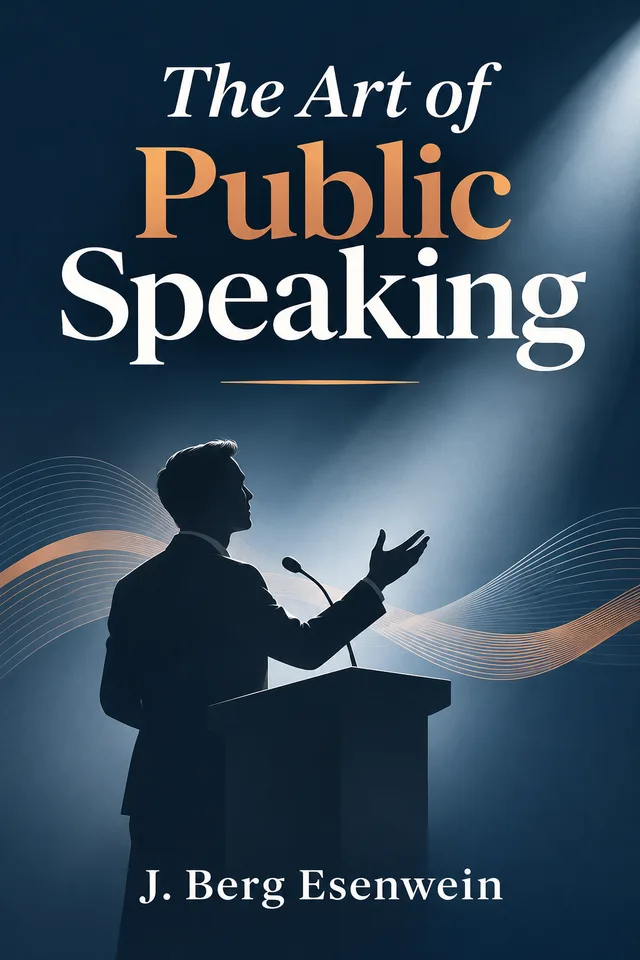
The Art of Public Speaking
Edizione BooksWhale in inglese di J. Berg Esenwein & Dale Carnegie
A practical manual of public speaking covering preparation, delivery, persuasion, audience response, and the disciplined use of voice.
- Anteprima
- Estratto dal testo preparato
- Formati
- Lettore online, EPUB, PDF
- Accesso
- Claim Libreria
Introduzione al libro
The Art of Public Speaking
J. Berg Esenwein and Dale Carnegie examine public speaking through explanation, exercises, and examples drawn from speeches and literature. Topics include confidence, concentration, vocal variety, argument, imagination, and the relationship between speaker and audience. The complete thirty-one chapters and four practice appendices preserve an early twentieth-century approach to learning effective oral expression through repeated, purposeful practice.
Edizione BooksWhale
Come è stata preparata
Questa edizione si basa su un testo di pubblico dominio ed è stata preparata da BooksWhale per la lettura digitale.
Base di pubblico dominio
Perché può essere condivisa
First published in 1915, this English text is from Project Gutenberg. J. Berg Esenwein died in 1946 and Dale Carnegie in 1955; later copyrighted editorial additions are not included.
Leggi anteprima
Estratto dal testo preparato
Anteprima selezionata dal testo preparato per la lettura.
Capitolo in anteprimaFull textLeggi anteprima
The Art of Public Speaking
J. Berg Esenwein · Dale Carnegie
Capitolo in anteprimaTHINGS TO THINK OF FIRSTAnteprima
THINGS TO THINK OF FIRST
Capitolo in anteprimaA FOREWORDAnteprima
The efficiency of a book is like that of a man, in one important respect: its attitude toward its subject is the first source of its power. A book may be full of good ideas well expressed, but if its writer views his subject from the wrong angle even his excellent advice may prove to be ineffective.
This book stands or falls by its authors' attitude toward its subject. If the best way to teach oneself or others to speak effectively in public is to fill the mind with rules, and to set up fixed standards for the interpretation of thought, the utterance of language, the making of gestures, and all the rest, then this book will be limited in value to such stray ideas throughout its pages as may prove helpful to the reader—as an effort to enforce a group of principles it must be reckoned a failure, because it is then untrue.
It is of some importance, therefore, to those who take up this volume with open mind that they should see clearly at the out-start what is the thought that at once underlies and is builded through this structure. In plain words it is this:
Training in public speaking is not a matter of externals—primarily; it is not a matter of imitation—fundamentally; it is not a matter of conformity to standards—at all. Public speaking is public utterance, public issuance, of the man himself; therefore the first thing both in time and in importance is that the man should be and think and feel things that are worthy of being given forth. Unless there be something of value within, no tricks of training can ever make of the talker anything more than a machine—albeit a highly perfected machine—for the delivery of other men's goods. So self-development is fundamental in our plan.
The second principle lies close to the first: The man must enthrone his will to rule over his thought, his feelings, and all his physical powers, so that the outer self may give perfect, unhampered expression to the inner. It is futile, we assert, to lay down systems of rules for voice culture, intonation, gesture, and what not, unless these two principles of having something to say and making the will sovereign have at least begun to make themselves felt in the life.
The third principle will, we surmise, arouse no dispute: No one can learn how to speak who does not first speak as best he can. That may seem like a vicious circle in statement, but it will bear examination.
Many teachers have begun with the how. Vain effort! It is an ancient truism that we learn to do by doing. The first thing for the beginner in public speaking is to speak—not to study voice and gesture and the rest. Once he has spoken he can improve himself by self-observation or according to the criticisms of those who hear.
But how shall he be able to criticise himself? Simply by finding out three things: What are the qualities which by common consent go to make up an effective speaker; by what means at least some of these qualities may be acquired; and what wrong habits of speech in himself work against his acquiring and using the qualities which he finds to be good.
Experience, then, is not only the best teacher, but the first and the last. But experience must be a dual thing—the experience of others must be used to supplement, correct and justify our own experience; in this way we shall become our own best critics only after we have trained ourselves in self-knowledge, the knowledge of what other minds think, and in the ability to judge ourselves by the standards we have come to believe are right. "If I ought," said Kant, "I can."
An examination of the contents of this volume will show how consistently these articles of faith have been declared, expounded, and illustrated. The student is urged to begin to speak at once of what he knows. Then he is given simple suggestions for self-control, with gradually increasing emphasis upon the power of the inner man over the outer. Next, the way to the rich storehouses of material is pointed out. And finally, all the while he is urged to speak, speak, SPEAK as he is applying to his own methods, in his own personal way, the principles he has gathered from his own experience and observation and the recorded experiences of others.
Indice
In questa edizione
- 01Full text
- 02THINGS TO THINK OF FIRST
- 03A FOREWORD
- 04CHAPTER I — ACQUIRING CONFIDENCE BEFORE AN AUDIENCE
- 05QUESTIONS AND EXERCISES.
- 06CHAPTER II — THE SIN OF MONOTONY
- 07QUESTIONS AND EXERCISES.
- 08CHAPTER III — EFFICIENCY THROUGH EMPHASIS AND SUBORDINATION
- 09QUESTIONS AND EXERCISES
- 10CHAPTER IV — EFFICIENCY THROUGH CHANGE OF PITCH
- 11QUESTIONS AND EXERCISES
- 12CHAPTER V — EFFICIENCY THROUGH CHANGE OF PACE
- 13QUESTIONS AND EXERCISES
- 14FOOL'S GOLD
- 15EXERCISES
- 16THE MOB
- 17QUESTIONS AND EXERCISES
- 18A PLEA FOR CUBA
- 19CHAPTER VI — PAUSE AND POWER
- 20QUESTIONS AND EXERCISES
- 21CHAPTER VII — EFFICIENCY THROUGH INFLECTION
- 22QUESTIONS AND EXERCISES
- 23SELECTIONS FOR PRACTISE
- 24THE HISTORY OF LIBERTY
- 25CHAPTER VIII — CONCENTRATION IN DELIVERY
- 26QUESTIONS AND EXERCISES
- 27CHAPTER IX — FORCE
- 28QUESTIONS AND EXERCISES
- 29CHAPTER X — FEELING AND ENTHUSIASM
- 30QUESTIONS AND EXERCISES
- 31PATRICK HENRY'S SPEECH — BEFORE THE VIRGINIA CONVENTION OF DELEGATES
- 32CHAPTER XI — FLUENCY THROUGH PREPARATION
- 33QUESTIONS AND EXERCISES
- 34GENERAL THEMES
- 35CHAPTER XII — THE VOICE
- 36QUESTIONS AND EXERCISES
- 37CHAPTER XIII — VOICE CHARM
- 38SELECTIONS FOR PRACTISE
- 39FROM MILTON'S "L'ALLEGRO"
- 40THE SEA
- 41THE LARK
- 42THE BROOK
- 43QUESTIONS AND EXERCISES
- 44CHAPTER XIV — DISTINCTNESS AND PRECISION OF UTTERANCE
- 45QUESTIONS AND EXERCISES
- 46CHAPTER XV — THE TRUTH ABOUT GESTURE
- 47QUESTIONS AND EXERCISES
- 48CHAPTER XVI — METHODS OF DELIVERY
- 49QUESTIONS AND EXERCISES
- 50CHAPTER XVII — THOUGHT AND RESERVE POWER
- 51QUESTIONS AND EXERCISES
- 52CHAPTER XVIII — SUBJECT AND PREPARATION
- 53QUESTIONS AND EXERCISES
- 54CHAPTER XIX — INFLUENCING BY EXPOSITION
- 55QUESTIONS AND EXERCISES
- 56CHAPTER XX — INFLUENCING BY DESCRIPTION
- 57CHAPTER XXI — INFLUENCING BY NARRATION
- 58QUESTIONS AND EXERCISES
- 59CHAPTER XXII — INFLUENCING BY SUGGESTION
- 60INVICTUS
- 61QUESTIONS AND EXERCISES
- 62CHAPTER XXIII — INFLUENCING BY ARGUMENT
- 63QUESTIONS AND EXERCISES
- 64CHAPTER XXIV — INFLUENCING BY PERSUASION
- 65QUESTIONS AND EXERCISES
- 66CHAPTER XXV — INFLUENCING THE CROWD
- 67CHAPTER XXVI — RIDING THE WINGED HORSE
- 68I. WHAT IS IMAGINATION?
- 69II. THE USES OF IMAGING IN PUBLIC SPEAKING
- 70III. HOW TO ACQUIRE THE IMAGING HABIT
- 71QUESTIONS AND EXERCISES
- 72CHAPTER XXVII — GROWING A VOCABULARY
- 73QUESTIONS AND EXERCISES
- 74CHAPTER XXVIII — MEMORY TRAINING
- 75QUESTIONS AND EXERCISES
- 76CHAPTER XXIX — RIGHT THINKING AND PERSONALITY
- 77QUESTIONS AND EXERCISES
- 78CHAPTER XXX — AFTER-DINNER AND OTHER OCCASIONAL SPEAKING
- 79QUESTIONS AND EXERCISES
- 80CHAPTER XXXI — MAKING CONVERSATION EFFECTIVE
- 81QUESTIONS AND EXERCISES
- 82APPENDIX A — FIFTY QUESTIONS FOR DEBATE
- 83APPENDIX B — THIRTY THEMES FOR SPEECHES
- 84APPENDIX C — SUGGESTIVE SUBJECTS FOR SPEECHES
- 85APPENDIX D — SPEECHES FOR STUDY AND PRACTISE
- 86BRAVE LITTLE BELGIUM — NEWELL DWIGHT HILLIS
- 87THE NEW AMERICANISM — HENRY WATTERSON
- 88FOUNDER'S DAY ADDRESS — JOHN MORLEY
- 89ON RESIGNING FROM THE SENATE, 1861 — ROBERT TOOMBS
- 90INAUGURAL ADDRESS — THEODORE ROOSEVELT
- 91ON AMERICAN MOTHERHOOD
- 92THE CALL TO DEMOCRATS — ALTON B. PARKER
- 93NOMINATING WOODROW WILSON — JOHN W. WESCOTT
- 94THE RACE PROBLEM — HENRY W. GRADY
- 95LAST SPEECH — WILLIAM McKINLEY
- 96TRIBUTE TO MCKINLEY — JOHN HAY
- 97THE PRINCE OF PEACE — WILLIAM JENNINGS BRYAN
- 98EULOGY OF WEBSTER — RUFUS CHOATE
- 99PASS PROSPERITY AROUND — ALBERT J. BEVERIDGE
- 100ACRES OF DIAMONDS — RUSSELL CONWELL
- 101HONORE DE BALZAC — VICTOR HUGO
Disponibilità lingue
Altre lingue
Altre edizioni linguistiche non sono ancora pubblicate. Qui appariranno quando disponibili.
Richiedi un'altra lingua