inglese Edizione
Letteratura
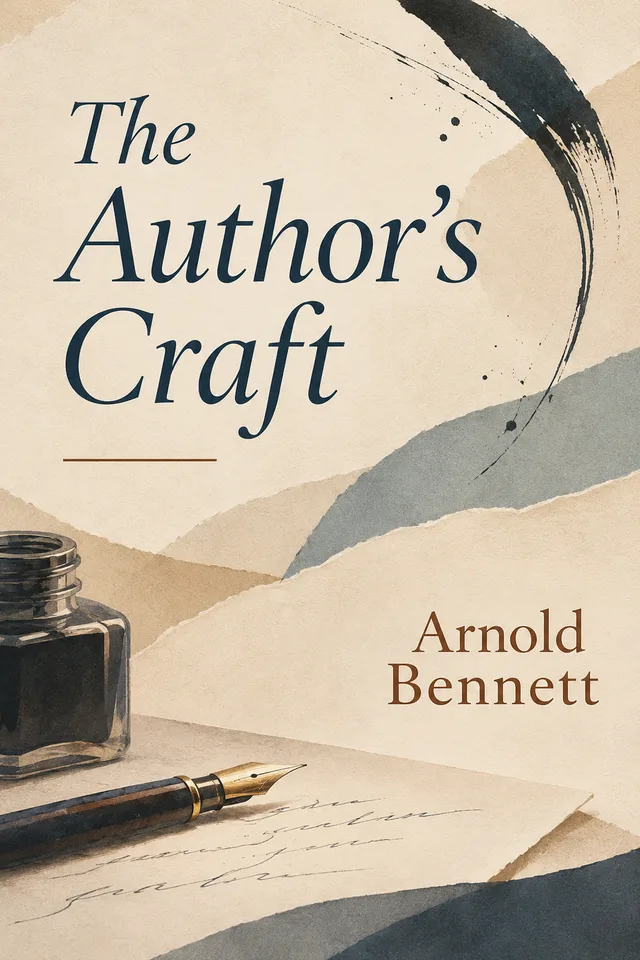
The Author’s Craft
Edizione BooksWhale in inglese di Arnold Bennett
Arnold Bennett examines how writers observe everyday life, build novels and plays, and respond to their readers.
- Anteprima
- Estratto dal testo preparato
- Formati
- Lettore online, EPUB, PDF
- Accesso
- Claim Libreria
Introduzione al libro
The Author’s Craft
Bennett starts with the habits of attention that let a writer notice character and action in ordinary life. He then turns to the distinct demands of novels and plays, including how to choose what belongs in a scene. The final part considers what happens when an artist’s ambitions meet public taste.
Edizione BooksWhale
Come è stata preparata
Questa edizione si basa su un testo di pubblico dominio ed è stata preparata da BooksWhale per la lettura digitale.
Base di pubblico dominio
Perché può essere condivisa
The original text by Arnold Bennett is in the public domain in the United States. This edition uses the historical English text.
Leggi anteprima
Estratto dal testo preparato
Anteprima selezionata dal testo preparato per la lettura.
Capitolo in anteprimaPART ILeggi anteprima
PART I
Capitolo in anteprimaSEEING LIFEAnteprima
SEEING LIFE
Capitolo in anteprimaIAnteprima
A young dog, inexperienced, sadly lacking in even primary education, ambles and frisks along the footpath of Fulham Road, near the mysterious gates of a Marist convent. He is a large puppy, on the way to be a dog of much dignity, but at present he has little to recommend him but that gawky elegance, and that bounding gratitude for the gift of life, which distinguish the normal puppy. He is an ignorant fool. He might have entered the convent of nuns and had a fine time, but instead he steps off the pavement into the road, the road being a vast and interesting continent imperfectly explored. His confidence in his nose, in his agility, and in the goodness of God is touching, absolutely painful to witness. He glances casually at a huge, towering vermilion construction that is whizzing towards him on four wheels, preceded by a glint of brass and a wisp of steam; and then with disdain he ignores it as less important than a mere speck of odorous matter in the mud. The next instant he is lying inert in the mud. His confidence in the goodness of God had been misplaced. Since the beginning of time God had ordained him a victim.
An impressive thing happens. The motor-bus reluctantly slackens and stops. Not the differential brake, nor the foot-brake, has arrested the motor-bus, but the invisible brake of public opinion, acting by administrative transmission. There is not a policeman in sight. Theoretically, the motor-'bus is free to whiz onward in its flight to the paradise of Shoreditch, but in practice it is paralysed by dread. A man in brass buttons and a stylish cap leaps down from it, and the blackened demon who sits on its neck also leaps down from it, and they move gingerly towards the puppy. A little while ago the motor-bus might have overturned a human cyclist or so, and proceeded nonchalant on its way. But now even a puppy requires a post-mortem: such is the force of public opinion aroused. Two policemen appear in the distance.
"A street accident" is now in being, and a crowd gathers with calm joy and stares, passive and determined. The puppy offers no sign whatever; just lies in the road. Then a boy, destined probably to a great future by reason of his singular faculty of initiative, goes to the puppy and carries him by the scruff of the neck, to the shelter of the gutter. Relinquished by the boy, the lithe puppy falls into an easy horizontal attitude, and seems bent upon repose. The boy lifts the puppy's head to examine it, and the head drops back wearily. The puppy is dead. No cry, no blood, no disfigurement! Even no perceptible jolt of the wheel as it climbed over the obstacle of the puppy's body! A wonderfully clean and perfect accident!
The increasing crowd stares with beatific placidity. People emerge impatiently from the bowels of the throbbing motor-bus and slip down from its back, and either join the crowd or vanish. The two policemen and the crew of the motor-bus have now met in parley. The conductor and the driver have an air at once nervous and resigned; their gestures are quick and vivacious. The policemen, on the other hand, indicate by their slow and huge movements that eternity is theirs. And they could not be more sure of the conductor and the driver if they had them manacled and leashed. The conductor and the driver admit the absolute dominion of the elephantine policemen; they admit that before the simple will of the policemen inconvenience, lost minutes, shortened leisure, docked wages, count as less than naught. And the policemen are carelessly sublime, well knowing that magistrates, jails, and the very Home Secretary on his throne—yes, and a whole system of conspiracy and perjury and brutality—are at their beck in case of need. And yet occasionally in the demeanour of the policemen towards the conductor and the driver there is a silent message that says: "After all, we, too, are working men like you, over-worked and under-paid and bursting with grievances in the service of the pitiless and dishonest public. We, too, have wives and children and privations and frightful apprehensions. We, too, have to struggle desperately. Only the awful magic of these garments and of the garter which we wear on our wrists sets an abyss between us and you." And the conductor writes and one of the policemen writes, and they keep on writing, while the traffic makes beautiful curves to avoid them.
Indice
In questa edizione
- 01PART I
- 02SEEING LIFE
- 03I
- 04II
- 05III
- 06IV
- 07V
- 08VI
- 09VII
- 10PART II
- 11WRITING NOVELS
- 12I
- 13II
- 14III
- 15IV
- 16V
- 17PART III
- 18WRITING PLAYS
- 19I
- 20II
- 21III
- 22IV
- 23V
- 24VI
- 25PART IV
- 26THE ARTIST AND THE PUBLIC
- 27I
- 28II
- 29III
- 30IV
Disponibilità lingue
Altre lingue
Altre edizioni linguistiche non sono ancora pubblicate. Qui appariranno quando disponibili.
Richiedi un'altra lingua