inglese Edizione
Letteratura
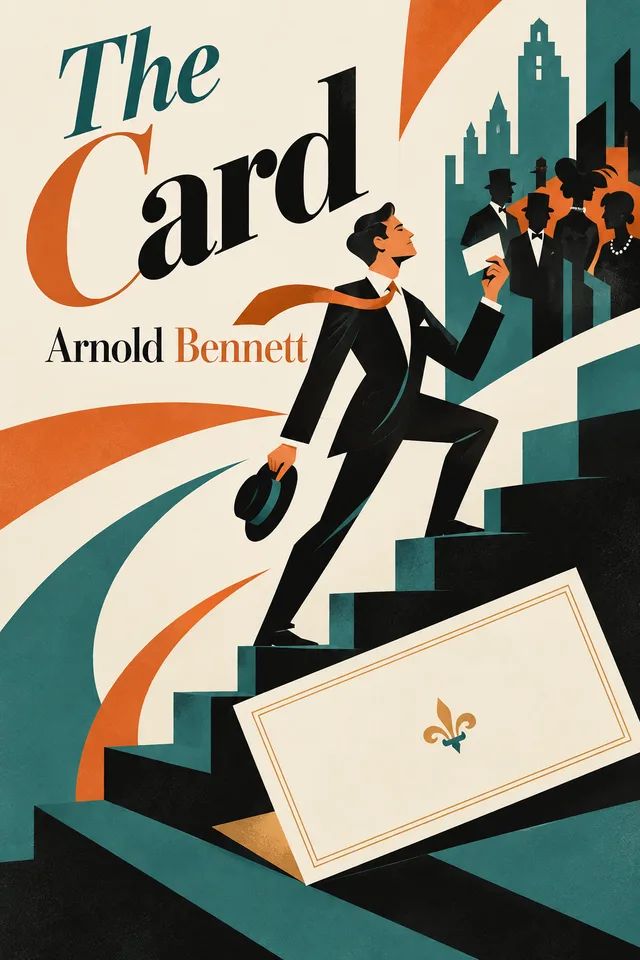
The Card
Edizione BooksWhale in inglese di Arnold Bennett
A humorous rise-to-success story about luck, publicity, business, and self-invention.
- Anteprima
- Estratto dal testo preparato
- Formati
- Lettore online, EPUB, PDF
- Accesso
- Claim Libreria
Introduzione al libro
The Card
Denry Machin learns how bold improvisation and publicity can create a public man, while Bennett satirizes modern commercial life.
Edizione BooksWhale
Come è stata preparata
Questa edizione si basa su un testo di pubblico dominio ed è stata preparata da BooksWhale per la lettura digitale.
Base di pubblico dominio
Perché può essere condivisa
The source text is public domain; Arnold Bennett died in 1931 and the work dates from 1911.
Leggi anteprima
Estratto dal testo preparato
Anteprima selezionata dal testo preparato per la lettura.
Capitolo in anteprimaFull textLeggi anteprima
The Card
Arnold Bennett
Capitolo in anteprimaCHAPTER IAnteprima
THE DANCE I Edward Henry Machin first saw the smoke on the 27th May 1867, in Brougham Street, Bursley, the most ancient of the Five Towns. Brougham Street runs down from St Luke's Square straight into the Shropshire Union Canal, and consists partly of buildings known as "potbanks" (until they come to be sold by auction, when auctioneers describe them as "extensive earthenware manufactories") and partly of cottages whose highest rent is four-and-six a week. In such surroundings was an extraordinary man born. He was the only anxiety of a widowed mother, who gained her livelihood and his by making up "ladies' own materials" in ladies' own houses. Mrs Machin, however, had a speciality apart from her vocation: she could wash flannel with less shrinking than any other woman in the district, and she could wash fine lace without ruining it; thus often she came to sew and remained to wash. A somewhat gloomy woman; thin, with a tongue! But I liked her. She saved a certain amount of time every day by addressing her son as Denry, instead of Edward Henry.
Not intellectual, not industrious, Denry would have maintained the average dignity of labour on a potbank had he not at the age of twelve won a scholarship from the Board School to the Endowed School. He owed his triumph to audacity rather than learning, and to chance rather than design. On the second day of the examination he happened to arrive in the examination-room ten minutes too soon for the afternoon sitting. He wandered about the place exercising his curiosity, and reached the master's desk. On the desk was a tabulated form with names of candidates and the number of marks achieved by each in each subject of the previous day. He had done badly in geography, and saw seven marks against his name, in the geographical column, out of a possible thirty. The figures had been written in pencil. The pencil lay on the desk. He picked it up, glanced at the door and at the rows of empty desks, and wrote a neat "_2_" in front of the _7_; then he strolled innocently forth and came back late. His trick ought to have been found out--the odds were against him--but it was not found out. Of course it was dishonest.
Yes, but I will not agree that Denry was uncommonly vicious. Every schoolboy is dishonest, by the adult standard. If I knew an honest schoolboy I would begin to count my silver spoons as he grew up. All is fair between schoolboys and schoolmasters.
This dazzling feat seemed to influence not only Denry's career but also his character. He gradually came to believe that he had won the scholarship by genuine merit, and that he was a remarkable boy and destined to great ends. His new companions, whose mothers employed Denry's mother, also believed that he was a remarkable boy; but they did not forget, in their gentlemanly way, to call him "washer-woman." Happily Denry did not mind.
He had a thick skin, and fair hair and bright eyes and broad shoulders, and the jolly gaiety of his disposition developed daily. He did not shine at the school; he failed to fulfil the rosy promise of the scholarship; but he was not stupider than the majority; and his opinion of himself, having once risen, remained at "set fair." It was inconceivable that he should work in clay with his hands.
II When he was sixteen his mother, by operations on a yard and a half of Brussels point lace, put Mrs Emery under an obligation. Mrs Emery was the sister of Mr Duncalf. Mr Duncalf was Town Clerk of Bursley, and a solicitor. It is well known that all bureaucracies are honey-combed with intrigue. Denry Machin left school to be clerk to Mr Duncalf, on the condition that within a year he should be able to write shorthand at the rate of a hundred and fifty words a minute. In those days mediocre and incorrect shorthand was not a drug on the market. He complied (more or less, and decidedly less than more) with the condition. And for several years he really thought that he had nothing further to hope for. Then he met the Countess.
Capitolo in anteprimaCHAPTER IIAnteprima
THE WIDOW HULLINS'S HOUSE I The simple fact that he first, of all the citizens of Bursley, had asked a countess for a dance (and not been refused) made a new man of Denry Machin. He was not only regarded by the whole town as a fellow wonderful and dazzling, but he so regarded himself. He could not get over it. He had always been cheerful, even to optimism. He was now in a permanent state of calm, assured jollity. He would get up in the morning with song and dance. Bursley and the general world were no longer Bursley and the general world; they had been mysteriously transformed into an oyster; and Denry felt strangely that the oyster-knife was lying about somewhere handy, but just out of sight, and that presently he should spy it and seize it. He waited for something to happen. And not in vain.
A few days after the historic revelry, Mrs Codleyn called to see Denry's employer. Mr Duncalf was her solicitor. A stout, breathless, and yet muscular woman of near sixty, the widow of a chemist and druggist who had made money before limited companies had taken the liberty of being pharmaceutical. The money had been largely invested in mortgage on cottage property; the interest on it had not been paid, and latterly Mrs Codleyn had been obliged to foreclose, thus becoming the owner of some seventy cottages. Mrs Codleyn, though they brought her in about twelve pounds a week gross, esteemed these cottages an infliction, a bugbear, an affront, and a positive source of loss. Invariably she talked as though she would willingly present them to anybody who cared to accept-- "and glad to be rid of 'em!" Most owners of property talk thus. She particularly hated paying the rates on them.
Now there had recently occurred, under the direction of the Borough Surveyor, a revaluation of the whole town. This may not sound exciting; yet a revaluation is the most exciting event (save a municipal ball given by a titled mayor) that can happen in any town. If your house is rated at forty pounds a year, and rates are seven shillings in the pound, and the revaluation lifts you up to forty-five pounds, it means thirty-five shillings a year right out of your pocket, which is the interest on thirty-five pounds. And if the revaluation drops you to thirty-five pounds, it means thirty-five shillings _in_ your pocket, which is a box of Havanas or a fancy waistcoat. Is not this exciting? And there are seven thousand houses in Bursley. Mrs Codleyn hoped that her rateable value would be reduced. She based the hope chiefly on the fact that she was a client of Mr Duncalf, the Town Clerk.
The Town Clerk was not the Borough Surveyor and had nothing to do with the revaluation. Moreover, Mrs Codleyn presumably entrusted him with her affairs because she considered him an honest man, and an honest man could not honestly have sought to tickle the Borough Surveyor out of the narrow path of rectitude in order to oblige a client. Nevertheless, Mrs Codleyn thought that because she patronised the Town Clerk her rates ought to be reduced! Such is human nature in the provinces! So different from human nature in London, where nobody ever dreams of offering even a match to a municipal official, lest the act might be construed into an insult.
It was on a Saturday morning that Mrs Codleyn called to impart to Mr Duncalf the dissatisfaction with which she had learned the news (printed on a bit of bluish paper) that her rateable value, far from being reduced, had been slightly augmented.
The interview, as judged by the clerks through a lath-and-plaster wall and by means of a speaking tube, atoned by its vivacity for its lack of ceremony. When the stairs had finished creaking under the descent of Mrs Codleyn's righteous fury, Mr Duncalf whistled sharply twice. Two whistles meant Denry. Denry picked up his shorthand note-book and obeyed the summons.
Indice
In questa edizione
- 01Full text
- 02CHAPTER I
- 03CHAPTER II
- 04CHAPTER III
- 05CHAPTER IV
- 06CHAPTER V
- 07CHAPTER VI
- 08CHAPTER VII
- 09CHAPTER VIII
- 10CHAPTER IX
- 11CHAPTER X
- 12CHAPTER XI
- 13CHAPTER XII
Disponibilità lingue
Altre lingue
Altre edizioni linguistiche non sono ancora pubblicate. Qui appariranno quando disponibili.
Richiedi un'altra lingua