inglese Edizione
Letteratura
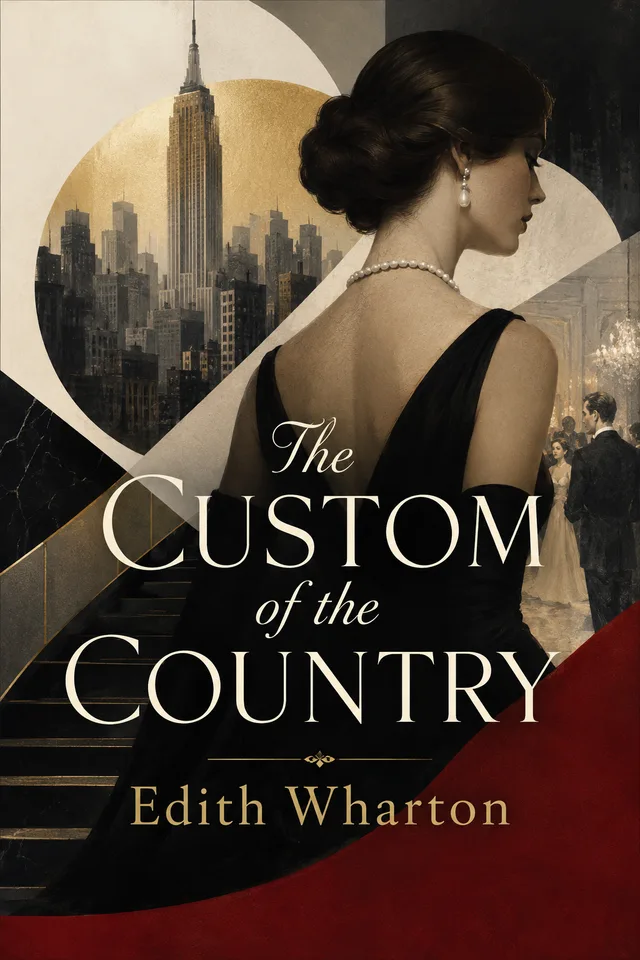
The Custom of the Country
Edizione BooksWhale in inglese di Edith Wharton
A brilliant satire of ambition, marriage, money, status, and American social mobility.
- Anteprima
- Estratto dal testo preparato
- Formati
- Lettore online, EPUB, PDF
- Accesso
- Claim Libreria
Introduzione al libro
The Custom of the Country
The Custom of the Country follows Undine Spragg through marriage markets, social climbing, and transatlantic ambition. Edith Wharton’s novel is one of her sharpest studies of appetite and status.
Edizione BooksWhale
Come è stata preparata
Questa edizione si basa su un testo di pubblico dominio ed è stata preparata da BooksWhale per la lettura digitale.
Base di pubblico dominio
Perché può essere condivisa
Edith Wharton died in 1937, and The Custom of the Country was first published in 1913. These dates support the public-domain basis for this English original-language edition.
Leggi anteprima
Estratto dal testo preparato
Anteprima selezionata dal testo preparato per la lettura.
Capitolo in anteprimaPart 1Leggi anteprima
The Custom of the Country
by EDITH WHARTON
THE CUSTOM OF THE COUNTRY
I
"Undine Spragg--how can you?" her mother wailed, raising a prematurely-wrinkled hand heavy with rings to defend the note which a languid "bell-boy" had just brought in.
But her defence was as feeble as her protest, and she continued to smile on her visitor while Miss Spragg, with a turn of her quick young fingers, possessed herself of the missive and withdrew to the window to read it.
"I guess it's meant for me," she merely threw over her shoulder at her mother.
"Did you EVER, Mrs. Heeny?" Mrs. Spragg murmured with deprecating pride.
Mrs. Heeny, a stout professional-looking person in a waterproof, her rusty veil thrown back, and a shabby alligator bag at her feet, followed the mother's glance with good-humoured approval.
"I never met with a lovelier form," she agreed, answering the spirit rather than the letter of her hostess's enquiry.
Mrs. Spragg and her visitor were enthroned in two heavy gilt armchairs in one of the private drawing-rooms of the Hotel Stentorian. The Spragg rooms were known as one of the Looey suites, and the drawing-room walls, above their wainscoting of highly-varnished mahogany, were hung with salmon-pink damask and adorned with oval portraits of Marie Antoinette and the Princess de Lamballe. In the centre of the florid carpet a gilt table with a top of Mexican onyx sustained a palm in a gilt basket tied with a pink bow. But for this ornament, and a copy of "The Hound of the Baskervilles" which lay beside it, the room showed no traces of human use, and Mrs. Spragg herself wore as complete an air of detachment as if she had been a wax figure in a show-window. Her attire was fashionable enough to justify such a post, and her pale soft-cheeked face, with puffy eye-lids and drooping mouth, suggested a partially-melted wax figure which had run to double-chin.
Mrs. Heeny, in comparison, had a reassuring look of solidity and reality. The planting of her firm black bulk in its chair, and the grasp of her broad red hands on the gilt arms, bespoke an organized and self-reliant activity, accounted for by the fact that Mrs. Heeny was a "society" manicure and masseuse. Toward Mrs. Spragg and her daughter she filled the double role of manipulator and friend; and it was in the latter capacity that, her day's task ended, she had dropped in for a moment to "cheer up" the lonely ladies of the Stentorian.
The young girl whose "form" had won Mrs. Heeny's professional commendation suddenly shifted its lovely lines as she turned back from the window.
"Here--you can have it after all," she said, crumpling the note and tossing it with a contemptuous gesture into her mother's lap.
"Why--isn't it from Mr. Popple?" Mrs. Spragg exclaimed unguardedly.
"No--it isn't. What made you think I thought it was?" snapped her daughter; but the next instant she added, with an outbreak of childish disappointment: "It's only from Mr. Marvell's sister--at least she says she's his sister."
Mrs. Spragg, with a puzzled frown, groped for her eye-glass among the jet fringes of her tightly-girded front.
Mrs. Heeny's small blue eyes shot out sparks of curiosity. "Marvell--what Marvell is that?"
The girl explained languidly: "A little fellow--I think Mr. Popple said his name was Ralph"; while her mother continued: "Undine met them both last night at that party downstairs. And from something Mr. Popple said to her about going to one of the new plays, she thought--"
"How on earth do you know what I thought?" Undine flashed back, her grey eyes darting warnings at her mother under their straight black brows.
"Why, you SAID you thought--" Mrs. Spragg began reproachfully; but Mrs. Heeny, heedless of their bickerings, was pursuing her own train of thought.
"What Popple? Claud Walsingham Popple--the portrait painter?"
Capitolo in anteprimaPart 2Anteprima
"What's the matter--anything wrong down town?" she asked, her eyes reflecting his anxiety.
Mrs. Spragg's knowledge of what went on "down town" was of the most elementary kind, but her husband's face was the barometer in which she had long been accustomed to read the leave to go on unrestrictedly, or the warning to pause and abstain till the coming storm should be weathered.
He shook his head. "N--no. Nothing worse than what I can see to, if you and Undine will go steady for a while." He paused and looked across the room at his daughter's door. "Where is she--out?"
"I guess she's in her room, going over her dresses with that French maid. I don't know as she's got anything fit to wear to that dinner," Mrs. Spragg added in a tentative murmur.
Mr. Spragg smiled at last. "Well--I guess she WILL have," he said prophetically.
He glanced again at his daughter's door, as if to make sure of its being shut; then, standing close before his wife, he lowered his voice to say: "I saw Elmer Moffatt down town to-day."
"Oh, Abner!" A wave of almost physical apprehension passed over Mrs. Spragg. Her jewelled hands trembled in her black brocade lap, and the pulpy curves of her face collapsed as if it were a pricked balloon.
"Oh, Abner," she moaned again, her eyes also on her daughter's door. Mr. Spragg's black eyebrows gathered in an angry frown, but it was evident that his anger was not against his wife.
"What's the good of Oh Abner-ing? Elmer Moffatt's nothing to us--no more'n if we never laid eyes on him."
"No--I know it; but what's he doing here? Did you speak to him?" she faltered.
He slipped his thumbs into his waistcoat pockets. "No--I guess Elmer and I are pretty well talked out."
Mrs. Spragg took up her moan. "Don't you tell her you saw him, Abner."
"I'll do as you say; but she may meet him herself."
"Oh, I guess not--not in this new set she's going with! Don't tell her ANYHOW."
He turned away, feeling for one of the cigars which he always carried loose in his pocket; and his wife, rising, stole after him, and laid her hand on his arm.
"He can't do anything to her, can he?"
"Do anything to her?" He swung about furiously. "I'd like to see him touch her--that's all!"
II
Undine's white and gold bedroom, with sea-green panels and old rose carpet, looked along Seventy-second Street toward the leafless tree-tops of the Central Park.
She went to the window, and drawing back its many layers of lace gazed eastward down the long brownstone perspective. Beyond the Park lay Fifth Avenue--and Fifth Avenue was where she wanted to be!
She turned back into the room, and going to her writing-table laid Mrs. Fairford's note before her, and began to study it minutely. She had read in the "Boudoir Chat" of one of the Sunday papers that the smartest women were using the new pigeon-blood notepaper with white ink; and rather against her mother's advice she had ordered a large supply, with her monogram in silver. It was a disappointment, therefore, to find that Mrs. Fairford wrote on the old-fashioned white sheet, without even a monogram--simply her address and telephone number. It gave Undine rather a poor opinion of Mrs. Fairford's social standing, and for a moment she thought with considerable satisfaction of answering the note on her pigeon-blood paper. Then she remembered Mrs. Heeny's emphatic commendation of Mrs. Fairford, and her pen wavered. What if white paper were really newer than pigeon blood? It might be more stylish, anyhow. Well, she didn't care if Mrs. Fairford didn't like red paper--SHE did! And she wasn't going to truckle to any woman who lived in a small house down beyond Park Avenue...
Capitolo in anteprimaPart 3Anteprima
Unsuspected social gradations were thus revealed to the attentive Undine, but she was beginning to think that her sad proficiency had been acquired in vain when her hopes were revived by the appearance of Mr. Popple and his friend at the Stentorian dance. She thought she had learned enough to be safe from any risk of repeating the hideous Aaronson mistake; yet she now saw she had blundered again in distinguishing Claud Walsingham Popple while she almost snubbed his more retiring companion. It was all very puzzling, and her perplexity had been farther increased by Mrs. Heeny's tale of the great Mrs. Harmon B. Driscoll's despair.
Hitherto Undine had imagined that the Driscoll and Van Degen clans and their allies held undisputed suzerainty over New York society. Mabel Lipscomb thought so too, and was given to bragging of her acquaintance with a Mrs. Spoff, who was merely a second cousin of Mrs. Harmon B. Driscoll's. Yet here was she. Undine Spragg of Apex, about to be introduced into an inner circle to which Driscolls and Van Degens had laid siege in vain! It was enough to make her feel a little dizzy with her triumph--to work her up into that state of perilous self-confidence in which all her worst follies had been committed.
She stood up and, going close to the glass, examined the reflection of her bright eyes and glowing cheeks. This time her fears were superfluous: there were to be no more mistakes and no more follies now! She was going to know the right people at last--she was going to get what she wanted!
As she stood there, smiling at her happy image, she heard her father's voice in the room beyond, and instantly began to tear off her dress, strip the long gloves from her arms and unpin the rose in her hair. Tossing the fallen finery aside, she slipped on a dressing-gown and opened the door into the drawing-room.
Mr. Spragg was standing near her mother, who sat in a drooping attitude, her head sunk on her breast, as she did when she had one of her "turns." He looked up abruptly as Undine entered.
"Father--has mother told you? Mrs. Fairford has asked me to dine. She's Mrs. Paul Marvell's daughter--Mrs. Marvell was a Dagonet--and they're sweller than anybody; they WON'T KNOW the Driscolls and Van Degens!"
Mr. Spragg surveyed her with humorous fondness.
"That so? What do they want to know you for, I wonder?" he jeered.
"Can't imagine--unless they think I'll introduce YOU!" she jeered back in the same key, her arms around his stooping shoulders, her shining hair against his cheek.
"Well--and are you going to? Have you accepted?" he took up her joke as she held him pinioned; while Mrs. Spragg, behind them, stirred in her seat with a little moan.
Undine threw back her head, plunging her eyes in his, and pressing so close that to his tired elderly sight her face was a mere bright blur.
"I want to awfully," she declared, "but I haven't got a single thing to wear."
Mrs. Spragg, at this, moaned more audibly. "Undine, I wouldn't ask father to buy any more clothes right on top of those last bills."
"I ain't on top of those last bills yet--I'm way down under them," Mr. Spragg interrupted, raising his hands to imprison his daughter's slender wrists.
"Oh, well--if you want me to look like a scarecrow, and not get asked again, I've got a dress that'll do PERFECTLY," Undine threatened, in a tone between banter and vexation.
Mr. Spragg held her away at arm's length, a smile drawing up the loose wrinkles about his eyes.
"Well, that kind of dress might come in mighty handy on SOME occasions; so I guess you'd better hold on to it for future use, and go and select another for this Fairford dinner," he said; and before he could finish he was in her arms again, and she was smothering his last word in little cries and kisses.
Indice
In questa edizione
- 01Part 1
- 02Part 2
- 03Part 3
- 04Part 4
- 05Part 5
- 06Part 6
- 07Part 7
- 08Part 8
- 09Part 9
- 10Part 10
- 11Part 11
- 12Part 12
- 13Part 13
- 14Part 14
- 15Part 15
- 16Part 16
- 17Part 17
- 18Part 18
- 19Part 19
- 20Part 20
- 21Part 21
- 22Part 22
- 23Part 23
- 24Part 24
- 25Part 25
- 26Part 26
- 27Part 27
- 28Part 28
- 29Part 29
- 30Part 30
- 31Part 31
- 32Part 32
- 33Part 33
- 34Part 34
- 35Part 35
- 36Part 36
- 37Part 37
- 38Part 38
- 39Part 39
- 40Part 40
- 41Part 41
- 42Part 42
- 43Part 43
- 44Part 44
- 45Part 45
- 46Part 46
Disponibilità lingue
Altre lingue
Altre edizioni linguistiche non sono ancora pubblicate. Qui appariranno quando disponibili.
Richiedi un'altra lingua