inglese Edizione
Letteratura
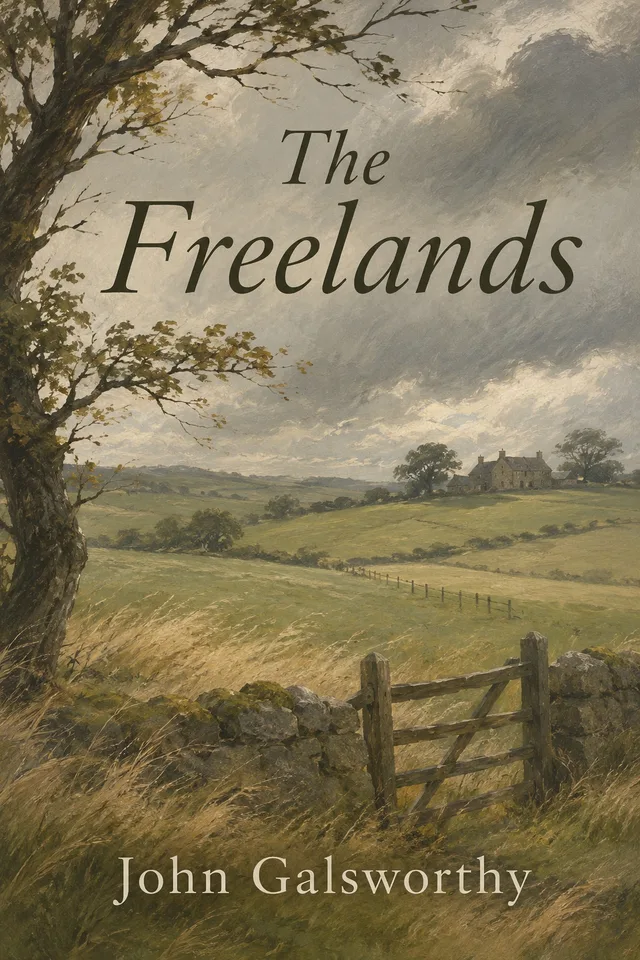
The Freelands
Edizione BooksWhale in inglese di John Galsworthy
The Freeland family encounters rural injustice, political conviction, and generational conflict in an unsettled English countryside.
- Anteprima
- Estratto dal testo preparato
- Formati
- Lettore online, EPUB, PDF
- Accesso
- Claim Libreria
Introduzione al libro
The Freelands
A dispute over a rural laborer’s home draws members of the Freeland family into questions of privilege, freedom, and social responsibility. John Galsworthy contrasts the outlooks of relatives whose lives span urban comfort, country work, and youthful rebellion. Personal loyalties become entangled with the conditions of English agricultural life. The novel combines family observation with an examination of the limits of charitable sympathy.
Edizione BooksWhale
Come è stata preparata
Questa edizione si basa su un testo di pubblico dominio ed è stata preparata da BooksWhale per la lettura digitale.
Base di pubblico dominio
Perché può essere condivisa
John Galsworthy died in 1933, and this work was first published in 1915. This edition uses the public-domain original English text from Project Gutenberg, without later editorial notes or illustrations.
Leggi anteprima
Estratto dal testo preparato
Anteprima selezionata dal testo preparato per la lettura.
Capitolo in anteprimaFull textLeggi anteprima
The Freelands
John Galsworthy
“Liberty's a glorious feast.”—Burns.
Capitolo in anteprimaPROLOGUEAnteprima
One early April afternoon, in a Worcestershire field, the only field in that immediate landscape which was not down in grass, a man moved slowly athwart the furrows, sowing—a big man of heavy build, swinging his hairy brown arm with the grace of strength. He wore no coat or hat; a waistcoat, open over a blue-checked cotton shirt, flapped against belted corduroys that were somewhat the color of his square, pale-brown face and dusty hair. His eyes were sad, with the swimming yet fixed stare of epileptics; his mouth heavy-lipped, so that, but for the yearning eyes, the face would have been almost brutal. He looked as if he suffered from silence. The elm-trees bordering the field, though only just in leaf, showed dark against a white sky. A light wind blew, carrying already a scent from the earth and growth pushing up, for the year was early. The green Malvern hills rose in the west; and not far away, shrouded by trees, a long country house of weathered brick faced to the south. Save for the man sowing, and some rooks crossing from elm to elm, no life was visible in all the green land. And it was quiet—with a strange, a brooding tranquillity. The fields and hills seemed to mock the scars of road and ditch and furrow scraped on them, to mock at barriers of hedge and wall—between the green land and white sky was a conspiracy to disregard those small activities. So lonely was it, so plunged in a ground-bass of silence; so much too big and permanent for any figure of man.
Across and across the brown loam the laborer doggedly finished out his task; scattered the few last seeds into a corner, and stood still. Thrushes and blackbirds were just beginning that even-song whose blitheness, as nothing else on earth, seems to promise youth forever to the land. He picked up his coat, slung it on, and, heaving a straw bag over his shoulder, walked out on to the grass-bordered road between the elms.
“Tryst! Bob Tryst!”
At the gate of a creepered cottage amongst fruit-trees, high above the road, a youth with black hair and pale-brown face stood beside a girl with frizzy brown hair and cheeks like poppies.
“Have you had that notice?”
The laborer answered slowly:
“Yes, Mr. Derek. If she don't go, I've got to.”
“What a d—d shame!”
The laborer moved his head, as though he would have spoken, but no words came.
“Don't do anything, Bob. We'll see about that.”
“Evenin', Mr. Derek. Evenin', Miss Sheila,” and the laborer moved on.
The two at the wicket gate also turned away. A black-haired woman dressed in blue came to the wicket gate in their place. There seemed no purpose in her standing there; it was perhaps an evening custom, some ceremony such as Moslems observe at the muezzin-call. And any one who saw her would have wondered what on earth she might be seeing, gazing out with her dark glowing eyes above the white, grass-bordered roads stretching empty this way and that between the elm-trees and green fields; while the blackbirds and thrushes shouted out their hearts, calling all to witness how hopeful and young was life in this English countryside....
Capitolo in anteprimaCHAPTER IAnteprima
Mayday afternoon in Oxford Street, and Felix Freeland, a little late, on his way from Hampstead to his brother John's house in Porchester Gardens. Felix Freeland, author, wearing the very first gray top hat of the season. A compromise, that—like many other things in his life and works—between individuality and the accepted view of things, aestheticism and fashion, the critical sense and authority. After the meeting at John's, to discuss the doings of the family of his brother Morton Freeland—better known as Tod—he would perhaps look in on the caricatures at the English Gallery, and visit one duchess in Mayfair, concerning the George Richard Memorial. And so, not the soft felt hat which really suited authorship, nor the black top hat which obliterated personality to the point of pain, but this gray thing with narrowish black band, very suitable, in truth, to a face of a pale buff color, to a moustache of a deep buff color streaked with a few gray hairs, to a black braided coat cut away from a buff-colored waistcoat, to his neat boots—not patent leather—faintly buffed with May-day dust. Even his eyes, Freeland gray, were a little buffed over by sedentary habit, and the number of things that he was conscious of. For instance, that the people passing him were distressingly plain, both men and women; plain with the particular plainness of those quite unaware of it. It struck him forcibly, while he went along, how very queer it was that with so many plain people in the country, the population managed to keep up even as well as it did. To his wonderfully keen sense of defect, it seemed little short of marvellous. A shambling, shoddy crew, this crowd of shoppers and labor demonstrators! A conglomeration of hopelessly mediocre visages! What was to be done about it? Ah! what indeed!—since they were evidently not aware of their own dismal mediocrity. Hardly a beautiful or a vivid face, hardly a wicked one, never anything transfigured, passionate, terrible, or grand. Nothing Greek, early Italian, Elizabethan, not even beefy, beery, broad old Georgian. Something clutched-in, and squashed-out about it all—on that collective face something of the look of a man almost comfortably and warmly wrapped round by a snake at the very beginning of its squeeze. It gave Felix Freeland a sort of faint excitement and pleasure to notice this. For it was his business to notice things, and embalm them afterward in ink. And he believed that not many people noticed it, so that it contributed in his mind to his own distinction, which was precious to him. Precious, and encouraged to be so by the press, which—as he well knew—must print his name several thousand times a year. And yet, as a man of culture and of principle, how he despised that kind of fame, and theoretically believed that a man's real distinction lay in his oblivion of the world's opinion, particularly as expressed by that flighty creature, the Fourth Estate. But here again, as in the matter of the gray top hat, he had instinctively compromised, taking in press cuttings which described himself and his works, while he never failed to describe those descriptions—good, bad, and indifferent—as 'that stuff,' and their writers as 'those fellows.'
Not that it was new to him to feel that the country was in a bad way. On the contrary, it was his established belief, and one for which he was prepared to furnish due and proper reasons. In the first place he traced it to the horrible hold Industrialism had in the last hundred years laid on the nation, draining the peasantry from 'the Land'; and in the second place to the influence of a narrow and insidious Officialism, sapping the independence of the People.
This was why, in going to a conclave with his brother John, high in Government employ, and his brother Stanley, a captain of industry, possessor of the Morton Plough Works, he was conscious of a certain superiority in that he, at all events, had no hand in this paralysis which was creeping on the country.
Indice
In questa edizione
- 01Full text
- 02PROLOGUE
- 03CHAPTER I
- 04CHAPTER II
- 05CHAPTER III
- 06CHAPTER IV
- 07CHAPTER V
- 08CHAPTER VI
- 09CHAPTER VII
- 10CHAPTER VIII
- 11CHAPTER IX
- 12CHAPTER X
- 13CHAPTER XI
- 14CHAPTER XII
- 15CHAPTER XIII
- 16CHAPTER XIV
- 17CHAPTER XV
- 18CHAPTER XVI
- 19CHAPTER XVII
- 20CHAPTER XVIII
- 21CHAPTER XIX
- 22CHAPTER XX
- 23CHAPTER XXI
- 24CHAPTER XXII
- 25CHAPTER XXIII
- 26CHAPTER XXIV
- 27CHAPTER XXV
- 28CHAPTER XXVI
- 29CHAPTER XXVII
- 30CHAPTER XXVIII
- 31CHAPTER XXIX
- 32CHAPTER XXX
- 33CHAPTER XXXI
- 34CHAPTER XXXII
- 35CHAPTER XXXIII
- 36CHAPTER XXXIV
- 37CHAPTER XXXV
- 38CHAPTER XXXVI
- 39CHAPTER XXXVII
- 40CHAPTER XXXVIII
Disponibilità lingue
Altre lingue
Altre edizioni linguistiche non sono ancora pubblicate. Qui appariranno quando disponibili.
Richiedi un'altra lingua