inglese Edizione
Letteratura
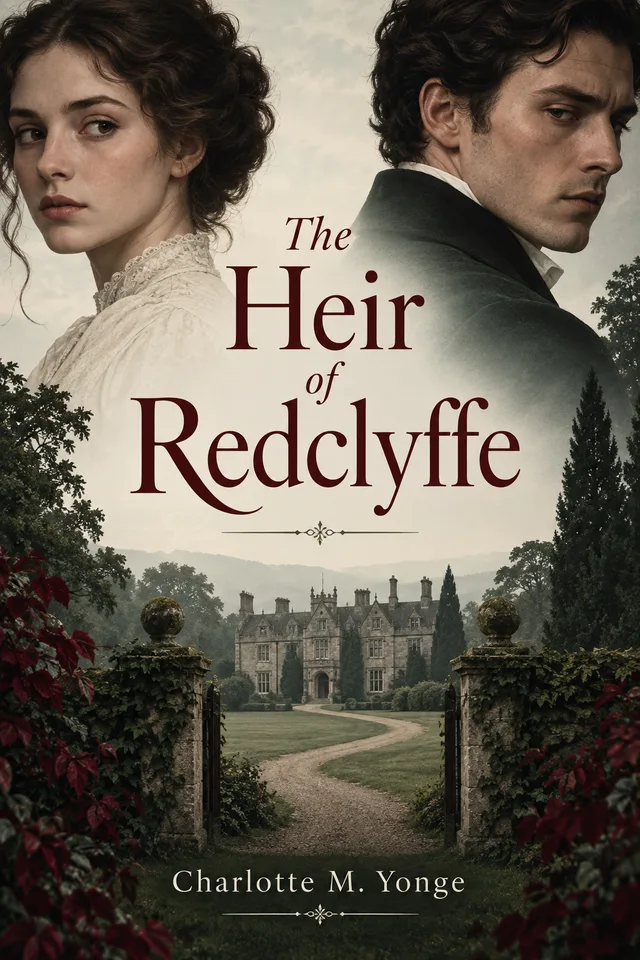
The Heir of Redclyffe
Edizione BooksWhale in inglese di Charlotte M. Yonge
A family inheritance brings two opposing temperaments together: generous idealism on one side, suspicion and self-righteousness on the other.
- Anteprima
- Estratto dal testo preparato
- Formati
- Lettore online, EPUB, PDF
- Accesso
- Claim Libreria
Introduzione al libro
The Heir of Redclyffe
Charlotte M. Yonge’s The Heir of Redclyffe follows Guy Morville, the warm-hearted heir to an old family estate, and his cousin Philip, whose rational principles conceal a deep mistrust of Guy’s character. Their conflict reaches into courtship, religion, inheritance, and family duty, while a later reversal tests what repentance and forgiveness can mean. Yonge’s most famous novel combines domestic feeling with a serious Victorian meditation on moral judgment.
Edizione BooksWhale
Come è stata preparata
Questa edizione si basa su un testo di pubblico dominio ed è stata preparata da BooksWhale per la lettura digitale.
Base di pubblico dominio
Perché può essere condivisa
Charlotte M. Yonge died in 1901 and the original English work was published in 1853; these dates support its public-domain status.
Leggi anteprima
Estratto dal testo preparato
Anteprima selezionata dal testo preparato per la lettura.
Capitolo in anteprimaFull textLeggi anteprima
The Heir of Redclyffe
Charlotte M. Yonge
By Charlotte Yonge
Capitolo in anteprimaCHAPTER 1Anteprima
In such pursuits if wisdom lies, Who, Laura, can thy taste despise? --GAY
The drawing-room of Hollywell House was one of the favoured apartments, where a peculiar air of home seems to reside, whether seen in the middle of summer, all its large windows open to the garden, or, as when our story commences, its bright fire and stands of fragrant green-house plants contrasted with the wintry fog and leafless trees of November. There were two persons in the room--a young lady, who sat drawing at the round table, and a youth, lying on a couch near the fire, surrounded with books and newspapers, and a pair of crutches near him. Both looked up with a smile of welcome at the entrance of a tall, fine-looking young man, whom each greeted with ‘Good morning, Philip.’
‘Good morning, Laura. Good morning, Charles; I am glad you are downstairs again! How are you to-day?’
‘No way remarkable, thank you,’ was the answer, somewhat wearily given by Charles.
‘You walked?’ said Laura.
‘Yes. Where’s my uncle? I called at the post-office, and brought a letter for him. It has the Moorworth post-mark,’ he added, producing it.
‘Where’s that?’ said Charles.
‘The post-town to Redclyffe; Sir Guy Morville’s place.’
‘That old Sir Guy! What can he have to do with my father?’
‘Did you not know,’ said Philip, ‘that my uncle is to be guardian to the boy--his grandson?’
‘Eh? No, I did not.’
‘Yes,’ said Philip; ‘when old Sir Guy made it an especial point that my father should take the guardianship, he only consented on condition that my uncle should be joined with him; so now my uncle is alone in the trust, and I cannot help thinking something must have happened at Redclyffe. It is certainly not Sir Guy’s writing.’
‘It must wait, unless your curiosity will carry you out in search of papa,’ said Charles; ‘he is somewhere about, zealously supplying the place of Jenkins.’
‘Really, Philip,’ said Laura, ‘there is no telling how much good you have done him by convincing him of Jenkins’ dishonesty. To say nothing of the benefit of being no longer cheated, the pleasure of having to overlook the farming is untold.’
Philip smiled, and came to the table where she was drawing. ‘Do you know this place?’ said she, looking up in his face.
‘Stylehurst itself! What is it taken from?’
‘From this pencil sketch of your sister’s, which I found in mamma’s scrap book.’
‘You are making it very like, only the spire is too slender, and that tree--can’t you alter the foliage?--it is an ash.’
‘Is it? I took it for an elm.’
‘And surely those trees in the foreground should be greener, to throw back the middle distance. That is the peak of South Moor exactly, if it looked further off.’
She began the alterations, while Philip stood watching her progress, a shade of melancholy gathering on his face. Suddenly, a voice called ‘Laura! Are you there? Open the door, and you will see.’
On Philip’s opening it, in came a tall camellia; the laughing face, and light, shining curls of the bearer peeping through the dark green leaves.
‘Thank you! Oh, is it you, Philip? Oh, don’t take it. I must bring my own camellia to show Charlie.’
‘You make the most of that one flower,’ said Charles.
‘Only see how many buds!’ and she placed it by his sofa. Is it not a perfect blossom, so pure a white, and so regular! And I am so proud of having beaten mamma and all the gardeners, for not another will be out this fortnight; and this is to go to the horticultural show. Sam would hardly trust me to bring it in, though it was my nursing, not his.’
‘Now, Amy,’ said Philip, when the flower had been duly admired, ‘you must let me put it into the window, for you. It is too heavy for you.’
Capitolo in anteprima‘“DEAR MR. EDMONSTONE,--Anteprima
My dear grandfather died at six this morning. He had an attack of apoplexy yesterday evening, and never spoke again, though for a short time he knew me. We hope he suffered little. Markham will make all arrangements. We propose that the funeral should take place on Tuesday; I hope you will be able to come. I would write to my cousin, Philip Morville, if I knew his address; but I depend on you for saying all that ought to be said. Excuse this illegible letter,--I hardly know what I write.
‘“Yours, very sincerely, ‘“Guy Morville.”’
‘Poor fellow!’ said Philip, ‘he writes with a great deal of proper feeling.’
‘How very sad for him to be left alone there!’ said Mrs. Edmonstone.
‘Very sad--very,’ said her husband. ‘I must start off to him at once--yes, at once. Should you not say so--eh, Philip?’
‘Certainly. I think I had better go with you. It would be the correct thing, and I should not like to fail in any token of respect for poor old Sir Guy.’
‘Of course--of course,’ said Mr. Edmonstone; ‘it would be the correct thing. I am sure he was always very civil to us, and you are next heir after this boy.’
Little Charlotte made a sort of jump, lifted her eyebrows, and stared at Amabel.
Philip answered. ‘That is not worth a thought; but since he and I are now the only representatives of the two branches of the house of Morville, it shall not be my fault if the enmity is not forgotten.’
‘Buried in oblivion would sound more magnanimous,’ said Charles; at which Amabel laughed so uncontrollably, that she was forced to hide her head on her little sister’s shoulder. Charlotte laughed too, an imprudent proceeding, as it attracted attention. Her father smiled, saying, half-reprovingly--‘So you are there, inquisitive pussy-cat?’ And at her mother’s question,--‘Charlotte, what business have you here?’ She stole back to her lessons, looking very small, without the satisfaction of hearing her mother’s compassionate words--‘Poor child!’
‘How old is he?’ asked Mr. Edmonstone, returning to the former subject.
‘He is of the same age as Laura--seventeen and a half,’ answered Mrs. Edmonstone. ‘Don’t you remember my brother saying what a satisfaction it was to see such a noble baby as she was, after such a poor little miserable thing as the one at Redclyffe?’
‘He is grown into a fine spirited fellow,’ said Philip.
‘I suppose we must have him here,’ said Mr. Edmonstone. Should you not say so--eh, Philip?’
‘Certainly; I should think it very good for him. Indeed, his grandfather’s death has happened at a most favourable time for him. The poor old man had such a dread of his going wrong that he kept him--’
‘I know--as tight as a drum.’
‘With strictness that I should think very bad for a boy of his impatient temper. It would have been a very dangerous experiment to send him at once among the temptations of Oxford, after such discipline and solitude as he has been used to.’
‘Don’t talk of it,’ interrupted Mr. Edmonstone, spreading out his hands in a deprecating manner. ‘We must do the best we can with him, for I have got him on my hands till he is five-and-twenty--his grandfather has tied him up till then. If we can keep him out of mischief, well and good; if not, it can’t be helped.’
‘You have him all to yourself,’ said Charles.
‘Ay, to my sorrow. If your poor father was alive, Philip, I should be free of all care. I’ve a pretty deal on my hands,’ he proceeded, looking more important than troubled. ‘All that great Redclyffe estate is no sinecure, to say nothing of the youth himself. If all the world will come to me, I can’t help it. I must go and speak to the men, if I am to be off to Redclyffe tomorrow. Will you come, Philip?’
Indice
In questa edizione
- 01Full text
- 02CHAPTER 1
- 03‘“DEAR MR. EDMONSTONE,--
- 04CHAPTER 2
- 05CHAPTER 3
- 06CHAPTER 4
- 07CHAPTER 5
- 08CHAPTER 6
- 09CHAPTER 7
- 10CHAPTER 8
- 11BE STEADFAST.
- 12CHAPTER 9
- 13CHAPTER 10
- 14CHAPTER 11
- 15CHAPTER 12
- 16CHAPTER 13
- 17CHAPTER 14
- 18CHAPTER 15
- 19CHAPTER 16
- 20CHAPTER 17
- 21CHAPTER 18
- 22CHAPTER 19
- 23CHAPTER 20
- 24CHAPTER 21
- 25CHAPTER 22
- 26CHAPTER 23
- 27CHAPTER 24
- 28CHAPTER 25
- 29CHAPTER 26
- 30CHAPTER 27
- 31CHAPTER 28
- 32CHAPTER 29
- 33CHAPTER 30
- 34CHAPTER 31
- 35CHAPTER 32
- 36CHAPTER 33
- 37CHAPTER 34
- 38‘PH. M.’
- 39CHAPTER 35
- 40CHAPTER 36
- 41CHAPTER 37
- 42CHAPTER 38
- 43CHAPTER 39
- 44‘I--’
- 45‘C. M, EDMONSTONE.
- 46‘A. F. MORVILLE.’
- 47CHAPTER 40
- 48CHAPTER 41
- 49CHAPTER 42
- 50CHAPTER 43
- 51‘L. EDMONSTONE.’
- 52CHAPTER 44
- 53THE END.
Disponibilità lingue
Altre lingue
Altre edizioni linguistiche non sono ancora pubblicate. Qui appariranno quando disponibili.
Richiedi un'altra lingua