inglese Edizione
Politica
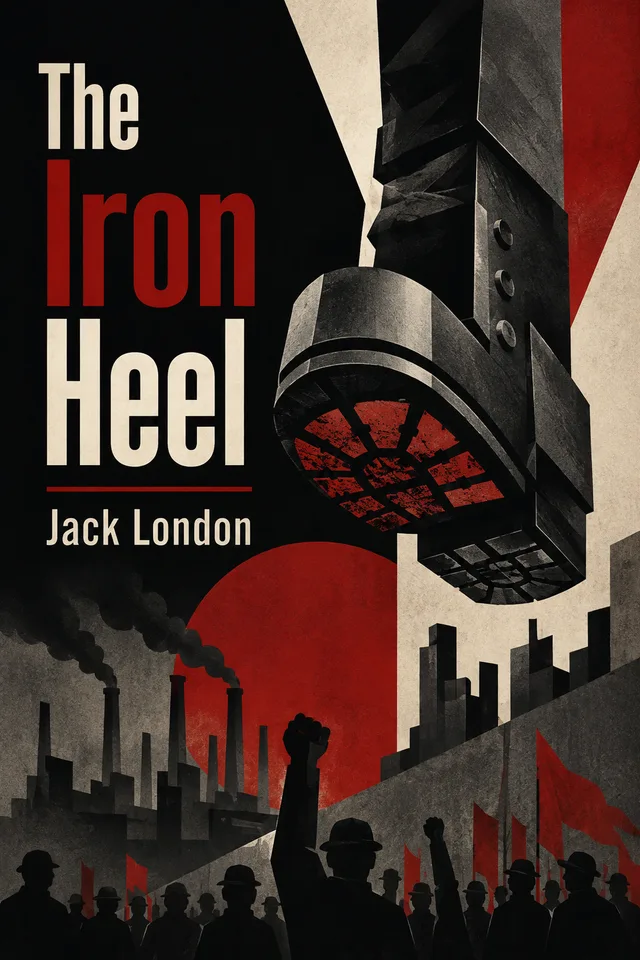
The Iron Heel
Edizione BooksWhale in inglese di Jack London
Jack London’s dystopian political novel imagines oligarchy, class war, labor movements, repression, and revolutionary memory.
- Anteprima
- Estratto dal testo preparato
- Formati
- Lettore online, EPUB, PDF
- Accesso
- Claim Libreria
Introduzione al libro
The Iron Heel
The Iron Heel is one of the earliest major dystopian political novels in English, framed as a future historian’s edition of a revolutionary memoir. Jack London combines socialist argument, class conflict, corporate power, state violence, and speculative history in a book that influenced later political fiction.
Edizione BooksWhale
Come è stata preparata
Questa edizione si basa su un testo di pubblico dominio ed è stata preparata da BooksWhale per la lettura digitale.
Base di pubblico dominio
Perché può essere condivisa
Author died in 1916; original text first published in 1908. These dates support the public-domain basis for this original-language edition.
Leggi anteprima
Estratto dal testo preparato
Anteprima selezionata dal testo preparato per la lettura.
Capitolo in anteprimaFull textLeggi anteprima
The Iron Heel
by Jack London
“At first, this Earth, a stage so gloomed with woe You almost sicken at the shifting of the scenes. And yet be patient. Our Playwright may show In some fifth act what this Wild Drama means.”
It cannot be said that the Everhard Manuscript is an important historical document. To the historian it bristles with errors—not errors of fact, but errors of interpretation. Looking back across the seven centuries that have lapsed since Avis Everhard completed her manuscript, events, and the bearings of events, that were confused and veiled to her, are clear to us. She lacked perspective. She was too close to the events she writes about. Nay, she was merged in the events she has described.
Nevertheless, as a personal document, the Everhard Manuscript is of inestimable value. But here again enter error of perspective, and vitiation due to the bias of love. Yet we smile, indeed, and forgive Avis Everhard for the heroic lines upon which she modelled her husband. We know to-day that he was not so colossal, and that he loomed among the events of his times less largely than the Manuscript would lead us to believe.
We know that Ernest Everhard was an exceptionally strong man, but not so exceptional as his wife thought him to be. He was, after all, but one of a large number of heroes who, throughout the world, devoted their lives to the Revolution; though it must be conceded that he did unusual work, especially in his elaboration and interpretation of working-class philosophy. “Proletarian science” and “proletarian philosophy” were his phrases for it, and therein he shows the provincialism of his mind—a defect, however, that was due to the times and that none in that day could escape.
But to return to the Manuscript. Especially valuable is it in communicating to us the _feel_ of those terrible times. Nowhere do we find more vividly portrayed the psychology of the persons that lived in that turbulent period embraced between the years 1912 and 1932—their mistakes and ignorance, their doubts and fears and misapprehensions, their ethical delusions, their violent passions, their inconceivable sordidness and selfishness. These are the things that are so hard for us of this enlightened age to understand. History tells us that these things were, and biology and psychology tell us why they were; but history and biology and psychology do not make these things alive. We accept them as facts, but we are left without sympathetic comprehension of them.
This sympathy comes to us, however, as we peruse the Everhard Manuscript. We enter into the minds of the actors in that long-ago world-drama, and for the time being their mental processes are our mental processes. Not alone do we understand Avis Everhard’s love for her hero-husband, but we feel, as he felt, in those first days, the vague and terrible loom of the Oligarchy. The Iron Heel (well named) we feel descending upon and crushing mankind.
And in passing we note that that historic phrase, the Iron Heel, originated in Ernest Everhard’s mind. This, we may say, is the one moot question that this new-found document clears up. Previous to this, the earliest-known use of the phrase occurred in the pamphlet, “Ye Slaves,” written by George Milford and published in December, 1912. This George Milford was an obscure agitator about whom nothing is known, save the one additional bit of information gained from the Manuscript, which mentions that he was shot in the Chicago Commune. Evidently he had heard Ernest Everhard make use of the phrase in some public speech, most probably when he was running for Congress in the fall of 1912. From the Manuscript we learn that Everhard used the phrase at a private dinner in the spring of 1912. This is, without discussion, the earliest-known occasion on which the Oligarchy was so designated.
Capitolo in anteprimaJACKSON’S ARMAnteprima
Little did I dream the fateful part Jackson’s arm was to play in my life. Jackson himself did not impress me when I hunted him out. I found him in a crazy, ramshackle[1] house down near the bay on the edge of the marsh. Pools of stagnant water stood around the house, their surfaces covered with a green and putrid-looking scum, while the stench that arose from them was intolerable.
[1] An adjective descriptive of ruined and dilapidated houses in which great numbers of the working people found shelter in those days. They invariably paid rent, and, considering the value of such houses, enormous rent, to the landlords.
I found Jackson the meek and lowly man he had been described. He was making some sort of rattan-work, and he toiled on stolidly while I talked with him. But in spite of his meekness and lowliness, I fancied I caught the first note of a nascent bitterness in him when he said:
“They might a-given me a job as watchman,[2] anyway.”
[2] In those days thievery was incredibly prevalent. Everybody stole property from everybody else. The lords of society stole legally or else legalized their stealing, while the poorer classes stole illegally. Nothing was safe unless guarded. Enormous numbers of men were employed as watchmen to protect property. The houses of the well-to-do were a combination of safe deposit vault and fortress. The appropriation of the personal belongings of others by our own children of to-day is looked upon as a rudimentary survival of the theft-characteristic that in those early times was universal.
I got little out of him. He struck me as stupid, and yet the deftness with which he worked with his one hand seemed to belie his stupidity. This suggested an idea to me.
“How did you happen to get your arm caught in the machine?” I asked.
He looked at me in a slow and pondering way, and shook his head. “I don’t know. It just happened.”
“Carelessness?” I prompted.
“No,” he answered, “I ain’t for callin’ it that. I was workin’ overtime, an’ I guess I was tired out some. I worked seventeen years in them mills, an’ I’ve took notice that most of the accidents happens just before whistle-blow.[3] I’m willin’ to bet that more accidents happens in the hour before whistle-blow than in all the rest of the day. A man ain’t so quick after workin’ steady for hours. I’ve seen too many of ’em cut up an’ gouged an’ chawed not to know.”
[3] The laborers were called to work and dismissed by savage, screaming, nerve-racking steam-whistles.
“Many of them?” I queried.
“Hundreds an’ hundreds, an’ children, too.”
With the exception of the terrible details, Jackson’s story of his accident was the same as that I had already heard. When I asked him if he had broken some rule of working the machinery, he shook his head.
“I chucked off the belt with my right hand,” he said, “an’ made a reach for the flint with my left. I didn’t stop to see if the belt was off. I thought my right hand had done it—only it didn’t. I reached quick, and the belt wasn’t all the way off. And then my arm was chewed off.”
“It must have been painful,” I said sympathetically.
“The crunchin’ of the bones wasn’t nice,” was his answer.
His mind was rather hazy concerning the damage suit. Only one thing was clear to him, and that was that he had not got any damages. He had a feeling that the testimony of the foremen and the superintendent had brought about the adverse decision of the court. Their testimony, as he put it, “wasn’t what it ought to have ben.” And to them I resolved to go.
One thing was plain, Jackson’s situation was wretched. His wife was in ill health, and he was unable to earn, by his rattan-work and peddling, sufficient food for the family. He was back in his rent, and the oldest boy, a lad of eleven, had started to work in the mills.
Capitolo in anteprimapart was a curious blend similar to the one in his carriage ofAnteprima
awkwardness and ease. That slight awkwardness! He never got over it, and it was delicious. His behavior in our drawing-room reminded me of a careful bull in a china shop.[1]
[1] In those days it was still the custom to fill the living rooms with bric-a-brac. They had not discovered simplicity of living. Such rooms were museums, entailing endless labor to keep clean. The dust-demon was the lord of the household. There were a myriad devices for catching dust, and only a few devices for getting rid of it.
It was at this time that vanished my last doubt of the completeness of my love for him (a subconscious doubt, at most). It was at the Philomath Club—a wonderful night of battle, wherein Ernest bearded the masters in their lair. Now the Philomath Club was the most select on the Pacific Coast. It was the creation of Miss Brentwood, an enormously wealthy old maid; and it was her husband, and family, and toy. Its members were the wealthiest in the community, and the strongest-minded of the wealthy, with, of course, a sprinkling of scholars to give it intellectual tone.
The Philomath had no club house. It was not that kind of a club. Once a month its members gathered at some one of their private houses to listen to a lecture. The lecturers were usually, though not always, hired. If a chemist in New York made a new discovery in say radium, all his expenses across the continent were paid, and as well he received a princely fee for his time. The same with a returning explorer from the polar regions, or the latest literary or artistic success. No visitors were allowed, while it was the Philomath’s policy to permit none of its discussions to get into the papers. Thus great statesmen—and there had been such occasions—were able fully to speak their minds.
I spread before me a wrinkled letter, written to me by Ernest twenty years ago, and from it I copy the following:
“Your father is a member of the Philomath, so you are able to come. Therefore come next Tuesday night. I promise you that you will have the time of your life. In your recent encounters, you failed to shake the masters. If you come, I’ll shake them for you. I’ll make them snarl like wolves. You merely questioned their morality. When their morality is questioned, they grow only the more complacent and superior. But I shall menace their money-bags. That will shake them to the roots of their primitive natures. If you can come, you will see the cave-man, in evening dress, snarling and snapping over a bone. I promise you a great caterwauling and an illuminating insight into the nature of the beast.
“They’ve invited me in order to tear me to pieces. This is the idea of Miss Brentwood. She clumsily hinted as much when she invited me. She’s given them that kind of fun before. They delight in getting trustful-souled gentle reformers before them. Miss Brentwood thinks I am as mild as a kitten and as good-natured and stolid as the family cow. I’ll not deny that I helped to give her that impression. She was very tentative at first, until she divined my harmlessness. I am to receive a handsome fee—two hundred and fifty dollars—as befits the man who, though a radical, once ran for governor. Also, I am to wear evening dress. This is compulsory. I never was so apparelled in my life. I suppose I’ll have to hire one somewhere. But I’d do more than that to get a chance at the Philomaths.”
Of all places, the Club gathered that night at the Pertonwaithe house. Extra chairs had been brought into the great drawing-room, and in all there must have been two hundred Philomaths that sat down to hear Ernest. They were truly lords of society. I amused myself with running over in my mind the sum of the fortunes represented, and it ran well into the hundreds of millions. And the possessors were not of the idle rich. They were men of affairs who took most active parts in industrial and political life.
Indice
In questa edizione
- 01Full text
- 02JACKSON’S ARM
- 03part was a curious blend similar to the one in his carriage of
- 04THE BISHOP’S VISION
- 05book, entitled “The Battles of Labor,” is quoted the declaration that
- 06part was virtually suicide for the whole Revolution. The Iron Heel, at
- 07part of the curriculum, as it were, of the school of Revolution.[1]
- 08Part way up Sonoma Mountain, John Carlson let the girls go on, leading
Disponibilità lingue
Altre lingue
Altre edizioni linguistiche non sono ancora pubblicate. Qui appariranno quando disponibili.
Richiedi un'altra lingua