inglese Edizione
Letteratura
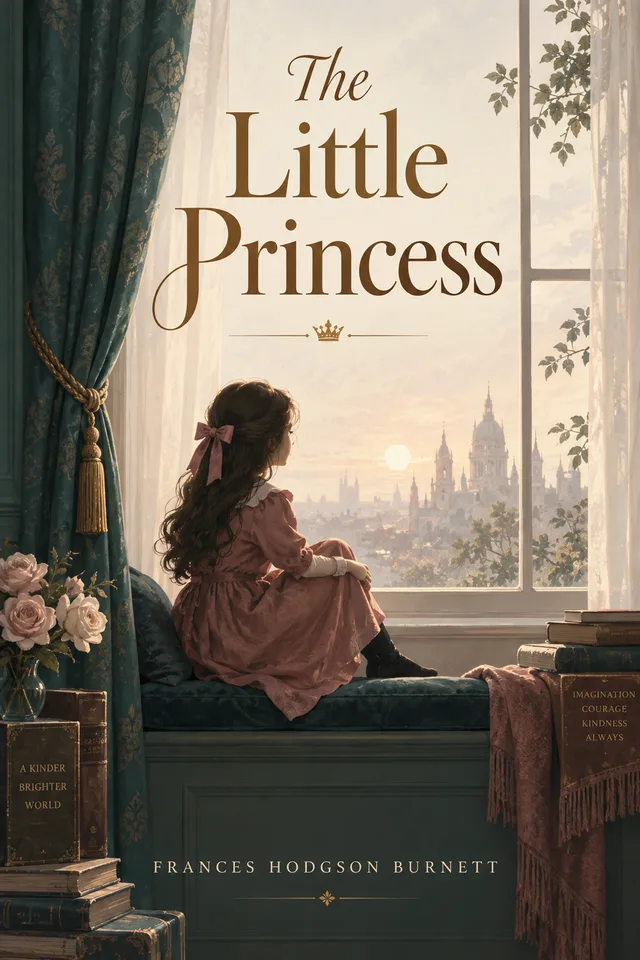
The Little Princess
Edizione BooksWhale in inglese di Frances Hodgson Burnett
Sara Crewe’s imagination becomes her refuge when a privileged schoolgirl is suddenly treated as an orphaned servant.
- Anteprima
- Estratto dal testo preparato
- Formati
- Lettore online, EPUB, PDF
- Accesso
- Claim Libreria
Introduzione al libro
The Little Princess
Frances Hodgson Burnett’s The Little Princess follows Sara Crewe from luxury to hardship at Miss Minchin’s boarding school. Her quiet generosity, storytelling, and refusal to surrender her dignity turn a Victorian children’s tale into a warm study of friendship, resilience, class, and the moral power of imagination. The novel’s contrast between outward poverty and inward wealth has made Sara one of children’s literature’s most enduring heroines.
Edizione BooksWhale
Come è stata preparata
Questa edizione si basa su un testo di pubblico dominio ed è stata preparata da BooksWhale per la lettura digitale.
Base di pubblico dominio
Perché può essere condivisa
Frances Hodgson Burnett died in 1924 and the original English work was published in 1905; these dates support its public-domain status.
Leggi anteprima
Estratto dal testo preparato
Anteprima selezionata dal testo preparato per la lettura.
Capitolo in anteprimaFull textLeggi anteprima
The Little Princess
Frances Hodgson Burnett
Sara
Once on a dark winter's day, when the yellow fog hung so thick and heavy in the streets of London that the lamps were lighted and the shop windows blazed with gas as they do at night, an odd-looking little girl sat in a cab with her father and was driven rather slowly through the big thoroughfares.
She sat with her feet tucked under her, and leaned against her father, who held her in his arm, as she stared out of the window at the passing people with a queer old-fashioned thoughtfulness in her big eyes.
She was such a little girl that one did not expect to see such a look on her small face. It would have been an old look for a child of twelve, and Sara Crewe was only seven. The fact was, however, that she was always dreaming and thinking odd things and could not herself remember any time when she had not been thinking things about grown-up people and the world they belonged to. She felt as if she had lived a long, long time.
At this moment she was remembering the voyage she had just made from Bombay with her father, Captain Crewe. She was thinking of the big ship, of the Lascars passing silently to and fro on it, of the children playing about on the hot deck, and of some young officers' wives who used to try to make her talk to them and laugh at the things she said.
Principally, she was thinking of what a queer thing it was that at one time one was in India in the blazing sun, and then in the middle of the ocean, and then driving in a strange vehicle through strange streets where the day was as dark as the night. She found this so puzzling that she moved closer to her father.
"Papa," she said in a low, mysterious little voice which was almost a whisper, "papa."
"What is it, darling?" Captain Crewe answered, holding her closer and looking down into her face. "What is Sara thinking of?"
"Is this the place?" Sara whispered, cuddling still closer to him. "Is it, papa?"
"Yes, little Sara, it is. We have reached it at last." And though she was only seven years old, she knew that he felt sad when he said it.
It seemed to her many years since he had begun to prepare her mind for "the place," as she always called it. Her mother had died when she was born, so she had never known or missed her. Her young, handsome, rich, petting father seemed to be the only relation she had in the world. They had always played together and been fond of each other. She only knew he was rich because she had heard people say so when they thought she was not listening, and she had also heard them say that when she grew up she would be rich, too. She did not know all that being rich meant. She had always lived in a beautiful bungalow, and had been used to seeing many servants who made salaams to her and called her "Missee Sahib," and gave her her own way in everything. She had had toys and pets and an ayah who worshipped her, and she had gradually learned that people who were rich had these things. That, however, was all she knew about it.
During her short life only one thing had troubled her, and that thing was "the place" she was to be taken to some day. The climate of India was very bad for children, and as soon as possible they were sent away from it--generally to England and to school. She had seen other children go away, and had heard their fathers and mothers talk about the letters they received from them. She had known that she would be obliged to go also, and though sometimes her father's stories of the voyage and the new country had attracted her, she had been troubled by the thought that he could not stay with her.
Capitolo in anteprimaMISS MINCHIN,Anteprima
Select Seminary for Young Ladies.
"Here we are, Sara," said Captain Crewe, making his voice sound as cheerful as possible. Then he lifted her out of the cab and they mounted the steps and rang the bell. Sara often thought afterward that the house was somehow exactly like Miss Minchin. It was respectable and well furnished, but everything in it was ugly; and the very armchairs seemed to have hard bones in them. In the hall everything was hard and polished--even the red cheeks of the moon face on the tall clock in the corner had a severe varnished look. The drawing room into which they were ushered was covered by a carpet with a square pattern upon it, the chairs were square, and a heavy marble timepiece stood upon the heavy marble mantel.
As she sat down in one of the stiff mahogany chairs, Sara cast one of her quick looks about her.
"I don't like it, papa," she said. "But then I dare say soldiers--even brave ones--don't really LIKE going into battle."
Captain Crewe laughed outright at this. He was young and full of fun, and he never tired of hearing Sara's queer speeches.
"Oh, little Sara," he said. "What shall I do when I have no one to say solemn things to me? No one else is as solemn as you are."
"But why do solemn things make you laugh so?" inquired Sara.
"Because you are such fun when you say them," he answered, laughing still more. And then suddenly he swept her into his arms and kissed her very hard, stopping laughing all at once and looking almost as if tears had come into his eyes.
It was just then that Miss Minchin entered the room. She was very like her house, Sara felt: tall and dull, and respectable and ugly. She had large, cold, fishy eyes, and a large, cold, fishy smile. It spread itself into a very large smile when she saw Sara and Captain Crewe. She had heard a great many desirable things of the young soldier from the lady who had recommended her school to him. Among other things, she had heard that he was a rich father who was willing to spend a great deal of money on his little daughter.
"It will be a great privilege to have charge of such a beautiful and promising child, Captain Crewe," she said, taking Sara's hand and stroking it. "Lady Meredith has told me of her unusual cleverness. A clever child is a great treasure in an establishment like mine."
Sara stood quietly, with her eyes fixed upon Miss Minchin's face. She was thinking something odd, as usual.
"Why does she say I am a beautiful child?" she was thinking. "I am not beautiful at all. Colonel Grange's little girl, Isobel, is beautiful. She has dimples and rose-colored cheeks, and long hair the color of gold. I have short black hair and green eyes; besides which, I am a thin child and not fair in the least. I am one of the ugliest children I ever saw. She is beginning by telling a story."
She was mistaken, however, in thinking she was an ugly child. She was not in the least like Isobel Grange, who had been the beauty of the regiment, but she had an odd charm of her own. She was a slim, supple creature, rather tall for her age, and had an intense, attractive little face. Her hair was heavy and quite black and only curled at the tips; her eyes were greenish gray, it is true, but they were big, wonderful eyes with long, black lashes, and though she herself did not like the color of them, many other people did. Still she was very firm in her belief that she was an ugly little girl, and she was not at all elated by Miss Minchin's flattery.
Capitolo in anteprimaTHE LITTLE GIRL IN THE ATTIC.Anteprima
The next morning she left this on the little table, and in the evening it had been taken away with the other things; so she knew the Magician had received it, and she was happier for the thought. She was reading one of her new books to Becky just before they went to their respective beds, when her attention was attracted by a sound at the skylight. When she looked up from her page she saw that Becky had heard the sound also, as she had turned her head to look and was listening rather nervously.
"Something's there, miss," she whispered.
"Yes," said Sara, slowly. "It sounds--rather like a cat--trying to get in."
She left her chair and went to the skylight. It was a queer little sound she heard--like a soft scratching. She suddenly remembered something and laughed. She remembered a quaint little intruder who had made his way into the attic once before. She had seen him that very afternoon, sitting disconsolately on a table before a window in the Indian gentleman's house.
"Suppose," she whispered in pleased excitement--"just suppose it was the monkey who got away again. Oh, I wish it was!"
She climbed on a chair, very cautiously raised the skylight, and peeped out. It had been snowing all day, and on the snow, quite near her, crouched a tiny, shivering figure, whose small black face wrinkled itself piteously at sight of her.
"It is the monkey," she cried out. "He has crept out of the Lascar's attic, and he saw the light."
Becky ran to her side.
"Are you going to let him in, miss?" she said.
"Yes," Sara answered joyfully. "It's too cold for monkeys to be out. They're delicate. I'll coax him in."
She put a hand out delicately, speaking in a coaxing voice--as she spoke to the sparrows and to Melchisedec--as if she were some friendly little animal herself.
"Come along, monkey darling," she said. "I won't hurt you."
He knew she would not hurt him. He knew it before she laid her soft, caressing little paw on him and drew him towards her. He had felt human love in the slim brown hands of Ram Dass, and he felt it in hers. He let her lift him through the skylight, and when he found himself in her arms he cuddled up to her breast and looked up into her face.
"Nice monkey! Nice monkey!" she crooned, kissing his funny head. "Oh, I do love little animal things."
He was evidently glad to get to the fire, and when she sat down and held him on her knee he looked from her to Becky with mingled interest and appreciation.
"He IS plain-looking, miss, ain't he?" said Becky.
"He looks like a very ugly baby," laughed Sara. "I beg your pardon, monkey; but I'm glad you are not a baby. Your mother COULDN'T be proud of you, and no one would dare to say you looked like any of your relations. Oh, I do like you!"
She leaned back in her chair and reflected.
"Perhaps he's sorry he's so ugly," she said, "and it's always on his mind. I wonder if he HAS a mind. Monkey, my love, have you a mind?"
But the monkey only put up a tiny paw and scratched his head.
"What shall you do with him?" Becky asked.
"I shall let him sleep with me tonight, and then take him back to the Indian gentleman tomorrow. I am sorry to take you back, monkey; but you must go. You ought to be fondest of your own family; and I'm not a REAL relation."
And when she went to bed she made him a nest at her feet, and he curled up and slept there as if he were a baby and much pleased with his quarters.
"It Is the Child!"
The next afternoon three members of the Large Family sat in the Indian gentleman's library, doing their best to cheer him up. They had been allowed to come in to perform this office because he had specially invited them. He had been living in a state of suspense for some time, and today he was waiting for a certain event very anxiously. This event was the return of Mr. Carmichael from Moscow. His stay there had been prolonged from week to week. On his first arrival there, he had not been able satisfactorily to trace the family he had gone in search of. When he felt at last sure that he had found them and had gone to their house, he had been told that they were absent on a journey. His efforts to reach them had been unavailing, so he had decided to remain in Moscow until their return. Mr. Carrisford sat in his reclining chair, and Janet sat on the floor beside him. He was very fond of Janet. Nora had found a footstool, and Donald was astride the tiger's head which ornamented the rug made of the animal's skin. It must be owned that he was riding it rather violently.
Indice
In questa edizione
- 01Full text
- 02MISS MINCHIN,
- 03THE LITTLE GIRL IN THE ATTIC.
Disponibilità lingue
Altre lingue
Altre edizioni linguistiche non sono ancora pubblicate. Qui appariranno quando disponibili.
Richiedi un'altra lingua