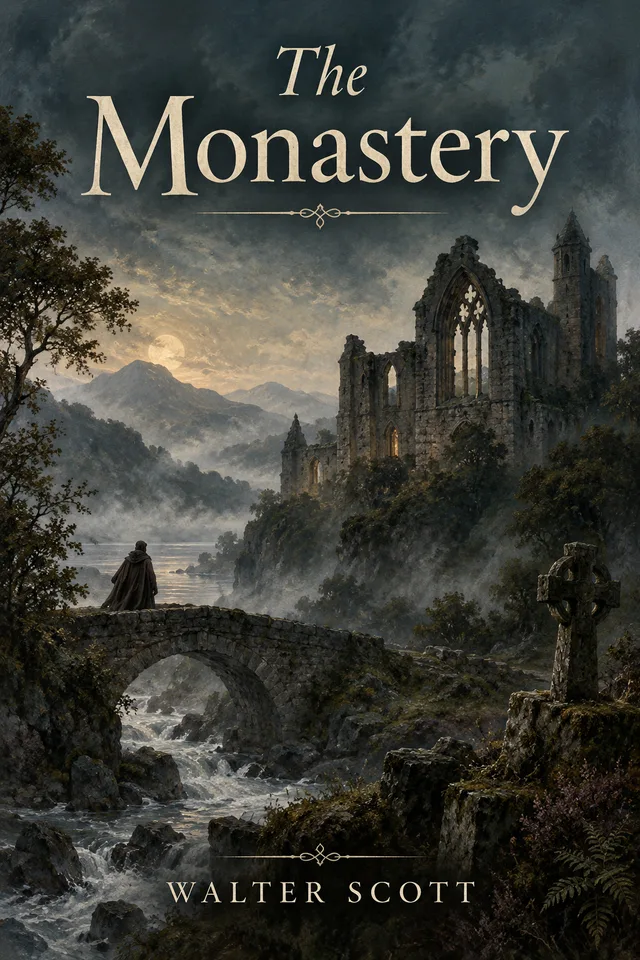
inglese Edizione
Letteratura
The Monastery
Edizione BooksWhale in inglese di Walter Scott
At a troubled Scottish abbey, reform, superstition, political change, and romantic adventure collide as an old order begins to disappear.
- Anteprima
- Estratto dal testo preparato
- Formati
- Lettore online, EPUB, PDF
- Accesso
- Claim Libreria
Introduzione al libro
The Monastery
Walter Scott’s The Monastery is set in the Scottish Borders during the Reformation and follows the people connected with the fictional abbey of Kennaquhair. The wandering Christie of the Clinthill, the mysterious White Lady, rival families, and the young Edward Glendinning move through a world where religious upheaval and local legend overlap. Scott turns national history into an atmospheric romance of loyalty, conflict, and cultural transformation.
Edizione BooksWhale
Come è stata preparata
Questa edizione si basa su un testo di pubblico dominio ed è stata preparata da BooksWhale per la lettura digitale.
Base di pubblico dominio
Perché può essere condivisa
Walter Scott died in 1832 and the original English work was published in 1820; these dates support its public-domain status.
Leggi anteprima
Estratto dal testo preparato
Anteprima selezionata dal testo preparato per la lettura.
Capitolo in anteprimaFull textLeggi anteprima
The Monastery
Walter Scott
Capitolo in anteprimaTHE MONASTERY.Anteprima
THE MONASTERY.
Capitolo in anteprimaINTRODUCTION--(1830.)Anteprima
It would be difficult to assign any good reason why the author of Ivanhoe, after using, in that work, all the art he possessed to remove the personages, action, and manners of the tale, to a distance from his own country, should choose for the scene of his next attempt the celebrated ruins of Melrose, in the immediate neighbourhood of his own residence. But the reason, or caprice, which dictated his change of system, has entirely escaped his recollection, nor is it worth while to attempt recalling what must be a matter of very little consequence.
The general plan of the story was, to conjoin two characters in that bustling and contentious age, who, thrown into situations which gave them different views on the subject of the Reformation, should, with the same sincerity and purity of intention, dedicate themselves, the one to the support of the sinking fabric of the Catholic Church, the other to the establishment of the Reformed doctrines. It was supposed that some interesting subjects for narrative might be derived from opposing two such enthusiasts to each other in the path of life, and contrasting the real worth of both with their passions and prejudices. The localities of Melrose suited well the scenery of the proposed story; the ruins themselves form a splendid theatre for any tragic incident which might be brought forward; joined to the vicinity of the fine river, with all its tributary streams, flowing through a country which has been the scene of so much fierce fighting, and is rich with so many recollections of former times, and lying almost under the immediate eye of the author, by whom they were to be used in composition.
The situation possessed farther recommendations. On the opposite bank of the Tweed might be seen the remains of ancient enclosures, surrounded by sycamores and ash-trees of considerable size. These had once formed the crofts or arable ground of a village, now reduced to a single hut, the abode of a fisherman, who also manages a ferry. The cottages, even the church which once existed there, have sunk into vestiges hardly to be traced without visiting the spot, the inhabitants having gradually withdrawn to the more prosperous town of Galashiels, which has risen into consideration, within two miles of their neighbourhood. Superstitious eld, however, has tenanted the deserted groves with aerial beings, to supply the want of the mortal tenants who have deserted it. The ruined and abandoned churchyard of Boldside has been long believed to be haunted by the Fairies, and the deep broad current of the Tweed, wheeling in moonlight round the foot of the steep bank, with the number of trees originally planted for shelter round the fields of the cottagers, but now presenting the effect of scattered and detached groves, fill up the idea which one would form in imagination for a scene that Oberon and Queen Mab might love to revel in. There are evenings when the spectator might believe, with Father Chaucer, that the
--Queen of Faery, With harp, and pipe, and symphony, Were dwelling in the place.
Another, and even a more familiar refuge of the elfin race, (if tradition is to be trusted,) is the glen of the river, or rather brook, named the Allen, which falls into the Tweed from the northward, about a quarter of a mile above the present bridge. As the streamlet finds its way behind Lord Sommerville's hunting-seat, called the Pavilion, its valley has been popularly termed the Fairy Dean, or rather the Nameless Dean, because of the supposed ill luck attached by the popular faith of ancient times, to any one who might name or allude to the race, whom our fathers distinguished as the Good Neighbours, and the Highlanders called Daoine Shie, or Men of Peace; rather by way of compliment, than on account of any particular idea of friendship or pacific relation which either Highlander or Borderer entertained towards the irritable beings whom they thus distinguished, or supposed them to bear to humanity. [Footnote: See Rob Roy, Note, p. 202.]
Indice
In questa edizione
- 01Full text
- 02THE MONASTERY.
- 03INTRODUCTION--(1830.)
- 04INTRODUCTORY EPISTLE
- 05ANSWER BY “THE AUTHOR OF WAVERLEY,”
- 06TO THE FOREGOING LETTER FROM CAPTAIN CLUTTERBUCK.
- 07DEAR CAPTAIN,
- 08THE AUTHOR OF WAVERLEY.
- 09THE MONASTERY.
- 10Chapter the First.
- 11Chapter the Second.
- 12Chapter the Third.
- 13Chapter the Fourth.
- 14Chapter the Fifth.
- 15I.
- 16II.
- 17III.
- 18IV.
- 19Chapter the Sixth.
- 20THE REFORMATION.
- 21Chapter the Seventh.
- 22Chapter the Eighth.
- 23Chapter the Ninth.
- 24Chapter the Tenth.
- 25Chapter the Eleventh.
- 26Chapter the Twelfth.
- 27Chapter the Thirteenth.
- 28Chapter the Fourteenth.
- 29Chapter the Fifteenth.
- 30Chapter the Sixteenth.
- 31Chapter the Seventeenth.
- 32Chapter the Eighteenth.
- 33Chapter the Nineteenth.
- 34Chapter the Twentieth.
- 35LOVE'S PILGRIMAGE.
- 36Chapter the Twenty-First.
- 37Chapter the Twenty-Second.
- 38Chapter the Twenty-Third.
- 39Chapter the Twenty-Fourth.
- 40Chapter the Twenty-Fifth.
- 41I.
- 42II.
- 43Chapter the Twenty-Sixth.
- 44Chapter the Twenty-Seventh.
- 45Chapter the Twenty-Eighth.
- 46Chapter the Twenty-Ninth.
- 47Chapter the Thirtieth.
- 48Chapter the Thirty-First.
- 49Chapter the Thirty-Second.
- 50Chapter the Thirty-Third.
- 51Chapter the Thirty-Fourth.
- 52CARTA REGIS ROBERTI I. ABBATI ET CONVENTUI DE MELROSS.
- 53Chapter the Thirty-Fifth.
- 54Chapter the Thirty-Sixth.
- 55Chapter the Thirty-Seventh.
- 56KING JOHN
Disponibilità lingue
Altre lingue
Altre edizioni linguistiche non sono ancora pubblicate. Qui appariranno quando disponibili.
Richiedi un'altra lingua