inglese Edizione
Letteratura
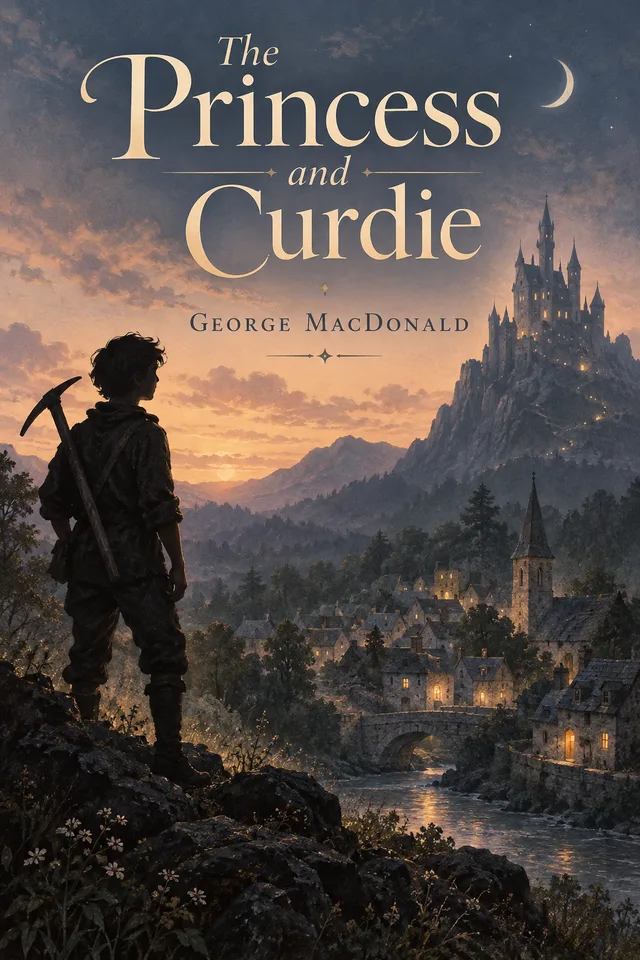
The Princess and Curdie
Edizione BooksWhale in inglese di George MacDonald
Public-domain classic by George MacDonald: The Princess and Curdie, a children's fantasy first published in 1883.
- Anteprima
- Estratto dal testo preparato
- Formati
- Lettore online, EPUB, PDF
- Accesso
- Claim Libreria
Introduzione al libro
The Princess and Curdie
Read The Princess and Curdie by George MacDonald, a classic children's fantasy with enduring literary and historical interest.
Edizione BooksWhale
Come è stata preparata
Questa edizione si basa su un testo di pubblico dominio ed è stata preparata da BooksWhale per la lettura digitale.
Base di pubblico dominio
Perché può essere condivisa
George MacDonald died before 1926 and The Princess and Curdie was first published before 1931; these dates support a conservative public-domain screening for the original-language edition.
Leggi anteprima
Estratto dal testo preparato
Anteprima selezionata dal testo preparato per la lettura.
Capitolo in anteprimaFull textLeggi anteprima
The Princess and Curdie
George MacDonald
Capitolo in anteprimaCHAPTER 1Anteprima
The Mountain
Curdie was the son of Peter the miner. He lived with his father and mother in a cottage built on a mountain, and he worked with his father inside the mountain.
A mountain is a strange and awful thing. In old times, without knowing so much of their strangeness and awfulness as we do, people were yet more afraid of mountains. But then somehow they had not come to see how beautiful they are as well as awful, and they hated them--and what people hate they must fear. Now that we have learned to look at them with admiration, perhaps we do not feel quite awe enough of them. To me they are beautiful terrors.
I will try to tell you what they are. They are portions of the heart of the earth that have escaped from the dungeon down below, and rushed up and out. For the heart of the earth is a great wallowing mass, not of blood, as in the hearts of men and animals, but of glowing hot, melted metals and stones. And as our hearts keep us alive, so that great lump of heat keeps the earth alive: it is a huge power of buried sunlight--that is what it is.
Now think: out of that cauldron, where all the bubbles would be as big as the Alps if it could get room for its boiling, certain bubbles have bubbled out and escaped--up and away, and there they stand in the cool, cold sky--mountains. Think of the change, and you will no more wonder that there should be something awful about the very look of a mountain: from the darkness--for where the light has nothing to shine upon, much the same as darkness--from the heat, from the endless tumult of boiling unrest--up, with a sudden heavenward shoot, into the wind, and the cold, and the starshine, and a cloak of snow that lies like ermine above the blue-green mail of the glaciers; and the great sun, their grandfather, up there in the sky; and their little old cold aunt, the moon, that comes wandering about the house at night; and everlasting stillness, except for the wind that turns the rocks and caverns into a roaring organ for the young archangels that are studying how to let out the pent-up praises of their hearts, and the molten music of the streams, rushing ever from the bosoms of the glaciers fresh born.
Think, too, of the change in their own substance--no longer molten and soft, heaving and glowing, but hard and shining and cold. Think of the creatures scampering over and burrowing in it, and the birds building their nests upon it, and the trees growing out of its sides, like hair to clothe it, and the lovely grass in the valleys, and the gracious flowers even at the very edge of its armour of ice, like the rich embroidery of the garment below, and the rivers galloping down the valleys in a tumult of white and green! And along with all these, think of the terrible precipices down which the traveller may fall and be lost, and the frightful gulfs of blue air cracked in the glaciers, and the dark profound lakes, covered like little arctic oceans with floating lumps of ice.
All this outside the mountain! But the inside, who shall tell what lies there? Caverns of awfullest solitude, their walls miles thick, sparkling with ores of gold or silver, copper or iron, tin or mercury, studded perhaps with precious stones--perhaps a brook, with eyeless fish in it, running, running ceaselessly, cold and babbling, through banks crusted with carbuncles and golden topazes, or over a gravel of which some of the stones arc rubies and emeralds, perhaps diamonds and sapphires--who can tell?--and whoever can't tell is free to think--all waiting to flash, waiting for millions of ages--ever since the earth flew off from the sun, a great blot of fire, and began to cool.
Capitolo in anteprimaCHAPTER 2Anteprima
The White Pigeon
When in the winter they had had their supper and sat about the fire, or when in the summer they lay on the border of the rock-margined stream that ran through their little meadow close by the door of their cottage, issuing from the far-up whiteness often folded in clouds, Curdie's mother would not seldom lead the conversation to one peculiar personage said and believed to have been much concerned in the late issue of events.
That personage was the great-great-grandmother of the princess, of whom the princess had often talked, but whom neither Curdie nor his mother had ever seen. Curdie could indeed remember, although already it looked more like a dream than he could account for if it had really taken place, how the princess had once led him up many stairs to what she called a beautiful room in the top of the tower, where she went through all the--what should he call it?--the behaviour of presenting him to her grandmother, talking now to her and now to him, while all the time he saw nothing but a bare garret, a heap of musty straw, a sunbeam, and a withered apple. Lady, he would have declared before the king himself, young or old, there was none, except the princess herself, who was certainly vexed that he could not see what she at least believed she saw.
As for his mother, she had once seen, long before Curdie was born, a certain mysterious light of the same description as one Irene spoke of, calling it her grandmother's moon; and Curdie himself had seen this same light, shining from above the castle, just as the king and princess were taking their leave. Since that time neither had seen or heard anything that could be supposed connected with her. Strangely enough, however, nobody had seen her go away. If she was such an old lady, she could hardly be supposed to have set out alone and on foot when all the house was asleep. Still, away she must have gone, for, of course, if she was so powerful, she would always be about the princess to take care of her.
But as Curdie grew older, he doubted more and more whether Irene had not been talking of some dream she had taken for reality: he had heard it said that children could not always distinguish betwixt dreams and actual events. At the same time there was his mother's testimony: what was he to do with that? His mother, through whom he had learned everything, could hardly be imagined by her own dutiful son to have mistaken a dream for a fact of the waking world.
So he rather shrank from thinking about it, and the less he thought about it, the less he was inclined to believe it when he did think about it, and therefore, of course, the less inclined to talk about it to his father and mother; for although his father was one of those men who for one word they say think twenty thoughts, Curdie was well assured that he would rather doubt his own eyes than his wife's testimony.
There were no others to whom he could have talked about it. The miners were a mingled company--some good, some not so good, some rather bad--none of them so bad or so good as they might have been; Curdie liked most of them, and was a favourite with all; but they knew very little about the upper world, and what might or might not take place there. They knew silver from copper ore; they understood the underground ways of things, and they could look very wise with their lanterns in their hands searching after this or that sign of ore, or for some mark to guide their way in the hollows of the earth; but as to great-great-grandmothers, they would have mocked Curdie all the rest of his life for the absurdity of not being absolutely certain that the solemn belief of his father and mother was nothing but ridiculous nonsense. Why, to them the very word 'great-great-grandmother' would have been a week's laughter! I am not sure that they were able quite to believe there were such persons as great-great-grandmothers; they had never seen one. They were not companions to give the best of help toward progress, and as Curdie grew, he grew at this time faster in body than in mind--with the usual consequence, that he was getting rather stupid--one of the chief signs of which was that he believed less and less in things he had never seen. At the same time I do not think he was ever so stupid as to imagine that this was a sign of superior faculty and strength of mind. Still, he was becoming more and more a miner, and less and less a man of the upper world where the wind blew. On his way to and from the mine he took less and less notice of bees and butterflies, moths and dragonflies, the flowers and the brooks and the clouds. He was gradually changing into a commonplace man.
Indice
In questa edizione
- 01Full text
- 02CHAPTER 1
- 03CHAPTER 2
- 04CHAPTER 3
- 05CHAPTER 4
- 06CHAPTER 5
- 07CHAPTER 6
- 08CHAPTER 7
- 09CHAPTER 8
- 10CHAPTER 9
- 11CHAPTER 10
- 12CHAPTER 11
- 13CHAPTER 12
- 14CHAPTER 13
- 15CHAPTER 14
- 16CHAPTER 15
- 17CHAPTER 16
- 18CHAPTER 17
- 19CHAPTER 18
- 20CHAPTER 19
- 21CHAPTER 20
- 22CHAPTER 21
- 23CHAPTER 22
- 24CHAPTER 23
- 25CHAPTER 24
- 26CHAPTER 25
- 27CHAPTER 26
- 28CHAPTER 27
- 29CHAPTER 28
- 30CHAPTER 29
- 31CHAPTER 30
- 32CHAPTER 31
- 33CHAPTER 32
- 34CHAPTER 33
- 35CHAPTER 34
- 36CHAPTER 35
Disponibilità lingue
Altre lingue
Altre edizioni linguistiche non sono ancora pubblicate. Qui appariranno quando disponibili.
Richiedi un'altra lingua