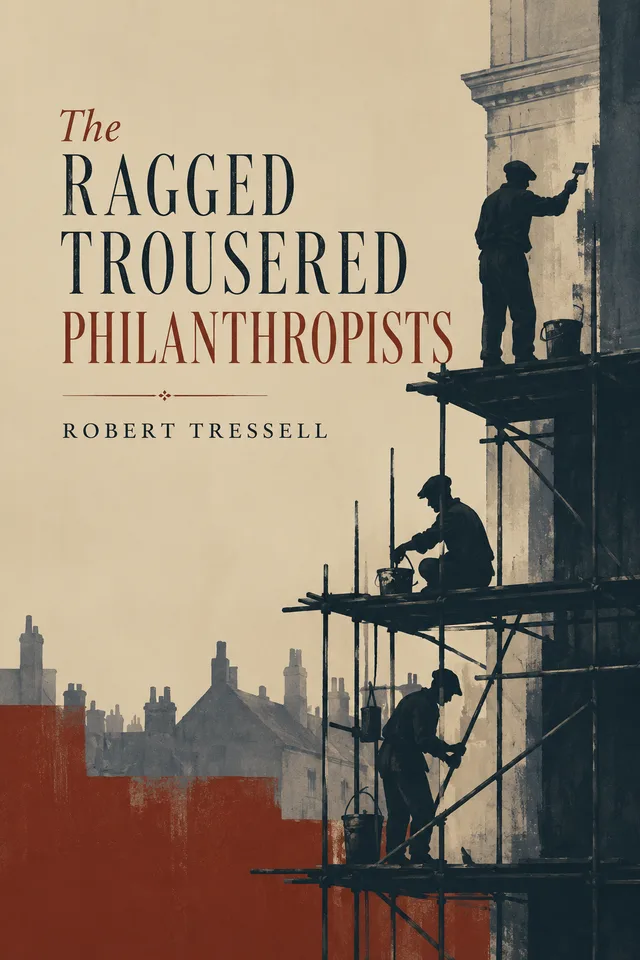
inglese Edizione
Letteratura
The Ragged Trousered Philanthropists
Edizione BooksWhale in inglese di Robert Tressell
A landmark English social novel about labor, poverty, class power, and the moral cost of everyday exploitation.
- Anteprima
- Estratto dal testo preparato
- Formati
- Lettore online, EPUB, PDF
- Accesso
- Claim Libreria
Introduzione al libro
The Ragged Trousered Philanthropists
The Ragged Trousered Philanthropists follows a group of house painters whose work, wages, debts, and arguments expose the machinery of poverty in Edwardian Britain. Robert Tressell’s original English novel remains a classic of working-class fiction, socialist realism, and public-domain social literature for readers interested in labor history, inequality, and political fiction.
Edizione BooksWhale
Come è stata preparata
Questa edizione si basa su un testo di pubblico dominio ed è stata preparata da BooksWhale per la lettura digitale.
Base di pubblico dominio
Perché può essere condivisa
Robert Tressell died in 1911, and The Ragged Trousered Philanthropists was first published in 1914; these dates support the public-domain basis for this original English edition.
Leggi anteprima
Estratto dal testo preparato
Anteprima selezionata dal testo preparato per la lettura.
Capitolo in anteprimaFull textLeggi anteprima
The Ragged Trousered Philanthropists
Robert Tressell
The Ragged Trousered Philanthropists
by Robert Tressell
Preface
In writing this book my intention was to present, in the form of an
interesting story, a faithful picture of working-class life—more
especially of those engaged in the Building trades—in a small town in
the south of England.
I wished to describe the relations existing between the workmen and
their employers, the attitude and feelings of these two classes towards
each other; their circumstances when at work and when out of
employment; their pleasures, their intellectual outlook, their
religious and political opinions and ideals.
The action of the story covers a period of only a little over twelve
months, but in order that the picture might be complete it was
necessary to describe how the workers are circumstanced at all periods
of their lives, from the cradle to the grave. Therefore the characters
include women and children, a young boy—the apprentice—some improvers,
journeymen in the prime of life, and worn-out old men.
I designed to show the conditions relating from poverty and
unemployment: to expose the futility of the measures taken to deal with
them and to indicate what I believe to be the only real remedy,
namely—Socialism. I intended to explain what Socialists understand by
the word “poverty”: to define the Socialist theory of the causes of
poverty, and to explain how Socialists propose to abolish poverty.
It may be objected that, considering the number of books dealing with
these subjects already existing, such a work as this was uncalled for.
The answer is that not only are the majority of people opposed to
Socialism, but a very brief conversation with an average anti-socialist
is sufficient to show that he does not know what Socialism means. The
same is true of all the anti-socialist writers and the “great
statesmen” who make anti-socialist speeches: unless we believe that
they are deliberate liars and imposters, who to serve their own
interests labour to mislead other people, we must conclude that they do
not understand Socialism. There is no other possible explanation of the
extraordinary things they write and say. The thing they cry out against
is not Socialism but a phantom of their own imagining.
Another answer is that “The Philanthropists” is not a treatise or
essay, but a novel. My main object was to write a readable story full
of human interest and based on the happenings of everyday life, the
subject of Socialism being treated incidentally.
This was the task I set myself. To what extent I have succeeded is for
others to say; but whatever their verdict, the work possesses at least
one merit—that of being true. I have invented nothing. There are no
scenes or incidents in the story that I have not either witnessed
myself or had conclusive evidence of. As far as I dared I let the
characters express themselves in their own sort of language and
consequently some passages may be considered objectionable. At the same
time I believe that—because it is true—the book is not without its
humorous side.
The scenes and characters are typical of every town in the South of
England and they will be readily recognized by those concerned. If the
Capitolo in anteprimabook is published I think it will appeal to a very large number ofAnteprima
readers. Because it is true it will probably be denounced as a libel on
the working classes and their employers, and upon the
religious-professing section of the community. But I believe it will be
acknowledged as true by most of those who are compelled to spend their
lives amid the surroundings it describes, and it will be evident that
no attack is made upon sincere religion.
Capitolo in anteprimaChapter 1Anteprima
An Imperial Banquet. A Philosophical Discussion. The Mysterious
Stranger. Britons Never shall be Slaves
The house was named “The Cave”. It was a large old-fashioned
three-storied building standing in about an acre of ground, and
situated about a mile outside the town of Mugsborough. It stood back
nearly two hundred yards from the main road and was reached by means of
a by-road or lane, on each side of which was a hedge formed of hawthorn
trees and blackberry bushes. This house had been unoccupied for many
years and it was now being altered and renovated for its new owner by
the firm of Rushton & Co., Builders and Decorators.
There were, altogether, about twenty-five men working there,
carpenters, plumbers, plasterers, bricklayers and painters, besides
several unskilled labourers. New floors were being put in where the old
ones were decayed, and upstairs two of the rooms were being made into
one by demolishing the parting wall and substituting an iron girder.
Some of the window frames and sashes were so rotten that they were
being replaced. Some of the ceilings and walls were so cracked and
broken that they had to be replastered. Openings were cut through walls
and doors were being put where no doors had been before. Old broken
chimney pots were being taken down and new ones were being taken up and
fixed in their places. All the old whitewash had to be washed off the
ceilings and all the old paper had to be scraped off the walls
preparatory to the house being repainted and decorated. The air was
full of the sounds of hammering and sawing, the ringing of trowels, the
rattle of pails, the splashing of water brushes, and the scraping of
the stripping knives used by those who were removing the old wallpaper.
Besides being full of these the air was heavily laden with dust and
disease germs, powdered mortar, lime, plaster, and the dirt that had
been accumulating within the old house for years. In brief, those
employed there might be said to be living in a Tariff Reform
Paradise—they had Plenty of Work.
At twelve o’clock Bob Crass—the painters’ foreman—blew a blast upon a
whistle and all hands assembled in the kitchen, where Bert the
apprentice had already prepared the tea, which was ready in the large
galvanized iron pail that he had placed in the middle of the floor. By
the side of the pail were a number of old jam-jars, mugs, dilapidated
tea-cups and one or two empty condensed milk tins. Each man on the
“job” paid Bert threepence a week for the tea and sugar—they did not
have milk—and although they had tea at breakfast-time as well as at
dinner, the lad was generally considered to be making a fortune.
Two pairs of steps, laid parallel on their sides at a distance of about
eight feet from each other, with a plank laid across, in front of the
fire, several upturned pails, and the drawers belonging to the dresser,
formed the seating accommodation. The floor of the room was covered
with all manner of debris, dust, dirt, fragments of old mortar and
plaster. A sack containing cement was leaning against one of the walls,
and a bucket containing some stale whitewash stood in one corner.
As each man came in he filled his cup, jam-jar or condensed milk tin
with tea from the steaming pail, before sitting down. Most of them
brought their food in little wicker baskets which they held on their
laps or placed on the floor beside them.
At first there was no attempt at conversation and nothing was heard but
the sounds of eating and drinking and the drizzling of the bloater
which Easton, one of the painters, was toasting on the end of a pointed
stick at the fire.
“I don’t think much of this bloody tea,” suddenly remarked Sawkins, one
Indice
In questa edizione
- 01Full text
- 02book is published I think it will appeal to a very large number of
- 03Chapter 1
- 04“GREAT DISTRESS IN MUGSBOROUGH.
- 05HUNDREDS OUT OF EMPLOYMENT.
- 06WORK OF THE CHARITY SOCIETY.
- 07789 CASES ON THE BOOKS.
- 08“THE SUFFERING POOR
- 09“BRAMWELL BOOTH.”
- 10Chapter 2
- 11RUSHTON & CO.
- 12MUGSBOROUGH
- 13FUNERALS FURNISHED
- 14chapter took place, was executing a kind of strategic movement in the
- 15Chapter 3
- 16part of the gums; presently it began to whimper, drawing up its knees
- 17CORPORATION OF MUGSBOROUGH
- 18FINAL NOTICE
- 19MR W. EASTON,
- 20JAMES LEAH.
- 21J. DIDLUM & CO LTD.
- 22QUALITY STREET, MUGSBOROUGH
- 23MR W. EASTON,
- 24J. DIDLUM & CO. LTD.
- 25Chapter 4
- 26TERRIBLE DOMESTIC TRAGEDY
- 27DOUBLE MURDER AND SUICIDE
- 28Chapter 5
- 29Chapter 6
- 30TERRIBLE DOMESTIC TRAGEDY
- 31Chapter 7
- 32Chapter 8
- 33part of Philpot’s reply. “I’ve got some of the beastly stuff on my coat
- 34part of the rag. “The smell of the turps will go away in about a hour’s
- 35Chapter 9
- 36Chapter 10
- 37Chapter 11
- 38Chapter 12
- 39Chapter 13
- 40Chapter 14
- 41Chapter 15
- 42part of the contents slopped over and trickled through his fingers. By
- 43Chapter 16
- 44Chapter 17
- 45Chapter 18
- 46Chapter 19
- 47NOTICE
- 48Chapter 20
- 49Chapter 21
- 50part, although I have all these raw materials, they are of no use to
- 51Chapter 22
- 52Chapter 23
- 53Chapter 24
- 54part of their journey they met Mr and Mrs Crass, who were also out
- 55Chapter 25
- 56part. I don’t want to go messin’ about with no corpses,” replied
- 57PROVE YOUR PRINCIPLES: OR, LOOK AT BOTH SIDES
- 58PART. So you see that these little discs of metal—this Money—is a
- 59part—but the Whole.”...
- 60Chapter 26
- 61Chapter 27
- 62Chapter 28
- 63Chapter 29
- 64Chapter 30
- 65part, I think the best thing to do is to chuck up the sponge at once;
- 66Chapter 31
- 67Chapter 32
- 68Chapter 33
- 69Chapter 34
- 70Chapter 35
- 71part in the processions. They said it was that sort of thing that drove
- 72JUMBLE SALE
- 73Chapter 36
- 74HELPING THE NEEDY
- 75part of the report: “Thanks are expressed to Sir Graball D’Encloseland
- 76Chapter 37
- 77book gave rules for the feeding of delicate children, and there were
- 78GREAT SPEECH BY SIR GRABALL D’ENCLOSELAND
- 79Chapter 38
- 80Chapter 39
- 81Chapter 40
- 82Chapter 41
- 83CHURCH OF THE WHITED SEPULCHRE,
- 84MUGSBOROUGH
- 85Chapter 42
- 86Chapter 43
- 87TIME SHEET
- 88OF WORK DONE BY IN THE EMPLOY OF
- 89RUSHTON & CO
- 90BUILDERS & DECORATORS: MUGSBOROUGH
- 91NO SMOKING OR INTOXICANTS ALLOWED DURING WORKING HOURS
- 92EACH PIECE OF WORK MUST BE FULLY DESCRIBED, WHAT IT WAS, AND HOW LONG
- 93IT TOOK TO DO.
- 94CONFIDENCE.
- 95book was eighteen shillings a roll. Slyme was paid sixpence a roll for
- 96“MACARONI’S ROYAL ITALIAN CAFE”
- 97part, HE was not going to tear his guts out for nobody!
- 98J.H.
- 99WHAT IS SOCIALISM?
- 100LOOK OUT FOR THE SOCIALIST VAN
- 101Chapter 44
- 102Chapter 45
- 103WILL DELIVER A
- 104ORATION
- 105ENTITLED
- 106THE GREAT SECRET, OR
- 107HOW TO LIVE WITHOUT WORK
- 108A MEETING WILL BE
- 109ARRANGED
- 110part of the result of their labour. The object of Socialism is to stop
- 111part of their lives striving to accumulate money, and when they have
- 112Chapter 46
- 113Chapter 47
- 114JOSEPH PHILPOT
- 115book in each pew—none of them would have been able to gather the sense
- 116J.L.
- 117Chapter 48
- 118part of it consisted of warnings against the dangers of Socialism.
- 119part—intellectually—on a level with Hottentots? The only things they
- 120Chapter 49
- 121part of her time to Ruth, who, in her delirium, lived and told over and
- 122Chapter 50
- 123Chapter 51
- 124Chapter 52
- 125Chapter 53
- 126Chapter 54
Disponibilità lingue
Altre lingue
Altre edizioni linguistiche non sono ancora pubblicate. Qui appariranno quando disponibili.
Richiedi un'altra lingua