inglese Edizione
Letteratura
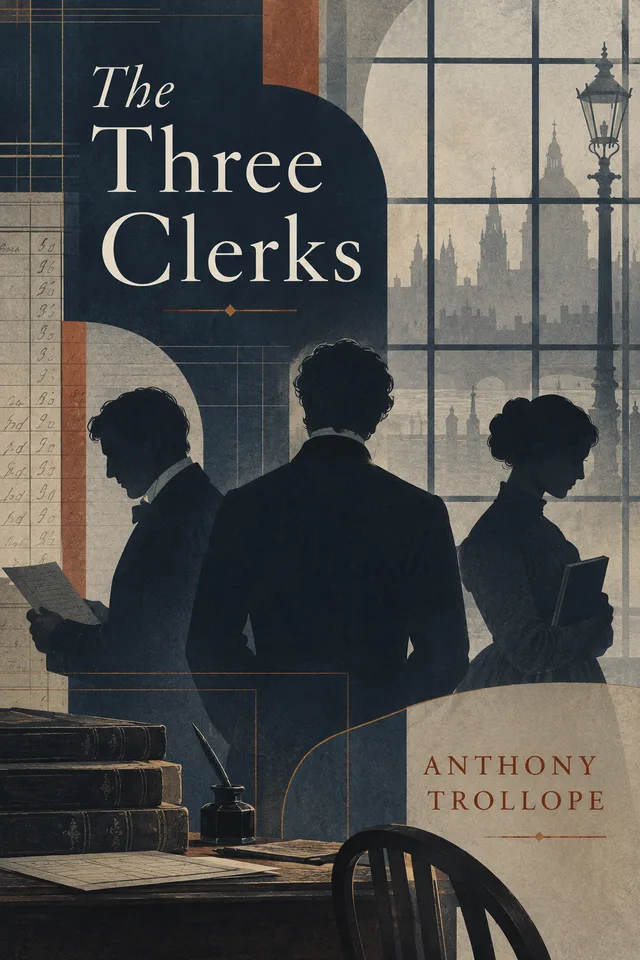
The Three Clerks
Edizione BooksWhale in inglese di Anthony Trollope
Three young men enter office life, where friendship, romance, ambition, and money collide.
- Anteprima
- Estratto dal testo preparato
- Formati
- Lettore online, EPUB, PDF
- Accesso
- Claim Libreria
Introduzione al libro
The Three Clerks
Trollope follows three clerks through government employment, social expectations, love, and the pressure to appear successful in Victorian London.
Edizione BooksWhale
Come è stata preparata
Questa edizione si basa su un testo di pubblico dominio ed è stata preparata da BooksWhale per la lettura digitale.
Base di pubblico dominio
Perché può essere condivisa
The source text is public domain; Anthony Trollope died in 1882 and the work dates from 1858.
Leggi anteprima
Estratto dal testo preparato
Anteprima selezionata dal testo preparato per la lettura.
Capitolo in anteprimaFull textLeggi anteprima
The Three Clerks
Anthony Trollope
Capitolo in anteprimaINTRODUCTIONAnteprima
There is the proper mood and the just environment for the reading as well as for the writing of works of fiction, and there can be no better place for the enjoying of a novel by Anthony Trollope than under a tree in Kensington Gardens of a summer day. Under a tree in the avenue that reaches down from the Round Pond to the Long Water. There, perhaps more than anywhere else, lingers the early Victorian atmosphere. As we sit beneath our tree, we see in the distance the dun, red-brick walls of Kensington Palace, where one night Princess Victoria was awakened to hear that she was Queen; there in quaint, hideously ugly Victorian rooms are to be seen Victorian dolls and other playthings; the whole environment is early Victorian. Here to the mind's eye how easy it is to conjure up ghosts of men in baggy trousers and long flowing whiskers, of prim women in crinolines, in hats with long trailing feathers and with ridiculous little parasols, or with Grecian-bends and chignons—church-parading to and fro beneath the trees or by the water's edge—perchance, even the fascinating Lady Crinoline and the elegant Mr. Macassar Jones, whose history has been written by Clerk Charley in the pages we are introducing to the 'gentle reader'. As a poetaster of an earlier date has written:—
Indeed, the historian of social manners, when dealing with the Victorian period, will perforce have recourse to the early volumes of Punch and to the novels of Thackeray, Dickens, and Trollope.
There are certain authors of whom personally we know little, but of whose works we cannot ever know enough, such a one for example as Shakespeare; others of whose lives we know much, but for whose works we can have but scant affection: such is Doctor Johnson; others who are intimate friends in all their aspects, as Goldsmith and Charles Lamb; yet others, who do not quite come home to our bosoms, whose writings we cannot entirely approve, but for whom and for whose works we find a soft place somewhere in our hearts, and such a one is Anthony Trollope. His novels are not for every-day reading, any more than are those of Marryat and Borrow—to take two curious examples. There are times and moods and places in which it would be quite impossible to read The Three Clerks; others in which this story is almost wholly delightful. With those who are fond of bed-reading Trollope should ever be a favourite, and it is no small compliment to say this, for small is the noble army of authors who have given us books which can enchant in the witching hour between waking and slumber. It is probable that all lovers of letters have their favourite bed-books. Thackeray has charmingly told us of his. Of the few novels that can really be enjoyed when the reader is settling down for slumber almost all have been set forth by writers who—consciously or unconsciously—have placed character before plot; Thackeray himself, Miss Austen, Borrow, Marryat, Sterne, Dickens, Goldsmith and—Trollope.
Books are very human in their way, as what else should they be, children of men and women as they are? Just as with human friends so with book friends, first impressions are often misleading; good literary coin sometimes seems to ring untrue, but the untruth is in the ear of the reader, not of the writer. For instance, Trollope has many odd and irritating tricks which are apt to scare off those who lack perseverance and who fail to understand that there must be something admirable in that which was once much admired by the judicious. He shares with Thackeray the sinful habit of pulling up his readers with a wrench by reminding them that what is set before them is after all mere fiction and that the characters in whose fates they are becoming interested are only marionettes. With Dickens and others he shares the custom, so irritating to us of to-day, of ticketing his personages with clumsy, descriptive labels, such as, in The Three Clerks, Mr. Chaffanbrass, Sir Gregory Hardlines, Sir Warwick West End, Mr. Neverbend, Mr. Whip Vigil, Mr. Nogo and Mr. Gitemthruet. He must plead guilty, also, to some bad ways peculiarly his own, or which he made so by the thoroughness with which he indulged in them. He moralizes in his own person in deplorable manner: is not this terrible:—'Poor Katie!—dear, darling, bonnie Katie!—sweet, sweetest, dearest child! why, oh, why, has that mother of thine, that tender-hearted loving mother, put thee unguarded in the way of such perils as this? Has she not sworn to herself that over thee at least she would watch as a hen over her young, so that no unfortunate love should quench thy young spirit, or blanch thy cheek's bloom?' Is this not sufficient to make the gentlest reader swear to himself?
Capitolo in anteprimaCHAPTER I. — THE WEIGHTS AND MEASURESAnteprima
All the English world knows, or knows of, that branch of the Civil Service which is popularly called the Weights and Measures. Every inhabitant of London, and every casual visitor there, has admired the handsome edifice which generally goes by that name, and which stands so conspicuously confronting the Treasury Chambers. It must be owned that we have but a slip-slop way of christening our public buildings. When a man tells us that he called on a friend at the Horse Guards, or looked in at the Navy Pay, or dropped a ticket at the Woods and Forests, we put up with the accustomed sounds, though they are in themselves, perhaps, indefensible. The 'Board of Commissioners for Regulating Weights and Measures', and the 'Office of the Board of Commissioners for Regulating Weights and Measures', are very long phrases; and as, in the course of this tale, frequent mention will be made of the public establishment in question, the reader's comfort will be best consulted by maintaining its popular though improper denomination.
It is generally admitted that the Weights and Measures is a well-conducted public office; indeed, to such a degree of efficiency has it been brought by its present very excellent secretary, the two very worthy assistant-secretaries, and especially by its late most respectable chief clerk, that it may be said to stand quite alone as a high model for all other public offices whatever. It is exactly antipodistic of the Circumlocution Office, and as such is always referred to in the House of Commons by the gentleman representing the Government when any attack on the Civil Service, generally, is being made.
And when it is remembered how great are the interests entrusted to the care of this board, and of these secretaries and of that chief clerk, it must be admitted that nothing short of superlative excellence ought to suffice the nation. All material intercourse between man and man must be regulated, either justly or unjustly, by weights and measures; and as we of all people depend most on such material intercourse, our weights and measures should to us be a source of never-ending concern. And then that question of the decimal coinage! is it not in these days of paramount importance? Are we not disgraced by the twelve pennies in our shilling, by the four farthings in our penny? One of the worthy assistant-secretaries, the worthier probably of the two, has already grown pale beneath the weight of this question. But he has sworn within himself, with all the heroism of a Nelson, that he will either do or die. He will destroy the shilling or the shilling shall destroy him. In his more ardent moods he thinks that he hears the noise of battle booming round him, and talks to his wife of Westminster Abbey or a peerage. Then what statistical work of the present age has shown half the erudition contained in that essay lately published by the secretary on The Market Price of Coined Metals? What other living man could have compiled that chronological table which is appended to it, showing the comparative value of the metallic currency for the last three hundred years? Compile it indeed! What other secretary or assistant-secretary belonging to any public office of the present day, could even read it and live? It completely silenced Mr. Muntz for a session, and even The Times was afraid to review it.
Such a state of official excellence has not, however, been obtained without its drawbacks, at any rate in the eyes of the unambitious tyros and unfledged novitiates of the establishment. It is a very fine thing to be pointed out by envying fathers as a promising clerk in the Weights and Measures, and to receive civil speeches from mammas with marriageable daughters. But a clerk in the Weights and Measures is soon made to understand that it is not for him to—
Indice
In questa edizione
- 01Full text
- 02INTRODUCTION
- 03CHAPTER I. — THE WEIGHTS AND MEASURES
- 04CHAPTER II. — THE INTERNAL NAVIGATION
- 05CHAPTER III. — THE WOODWARDS
- 06CHAPTER IV. — CAPTAIN CUTTWATER
- 07CHAPTER V. — BUSHEY PARK
- 08CHAPTER VI. — SIR GREGORY HARDLINES
- 09CHAPTER VII. — MR. FIDUS NEVERBEND
- 10CHAPTER VIII. — THE HON. UNDECIMUS SCOTT
- 11CHAPTER IX. — MR. MANYLODES
- 12CHAPTER X. — WHEAL MARY JANE
- 13CHAPTER XI. — THE THREE KINGS
- 14CHAPTER XII. — CONSOLATION
- 15'H. N.
- 16CHAPTER XIII. — A COMMUNICATION OF IMPORTANCE
- 17CHAPTER XIV. — VERY SAD
- 18CHAPTER XV. — NORMAN RETURNS TO TOWN
- 19CHAPTER XVI. — THE FIRST WEDDING
- 20CHAPTER XVII. — THE HONOURABLE MRS. VAL AND MISS GOLIGHTLY
- 21CHAPTER XVIII. — A DAY WITH ONE OF THE NAVVIES.—MORNING
- 22'MY DEAR SIR,
- 23'VERAX CORKSCREW.
- 24CHAPTER XIX. — A DAY WITH ONE OF THE NAVVIES.—AFTERNOON
- 25CHAPTER XX. — A DAY WITH ONE OF THE NAVVIES.—EVENING
- 26CHAPTER XXI. — HAMPTON COURT BRIDGE
- 27CHAPTER XXII. — CRINOLINE AND MACASSAR; OR, MY AUNT'S WILL
- 28"CRINOLINE AND MACASSAR."
- 29"CRINOLINE AND MACASSAR."
- 30CHAPTER XXIII. — SURBITON COLLOQUIES
- 31CHAPTER XXIV. — MR. M'BUFFER ACCEPTS THE CHILTERN HUNDREDS
- 32'I?'
- 33CHAPTER XXV. — CHISWICK GARDENS
- 34CHAPTER XXVI. — KATIE'S FIRST BALL
- 35CHAPTER XXVII. — EXCELSIOR
- 36CHAPTER XXVIII. — OUTERMAN v TUDOR
- 37CHAPTER XXIX. — EASY IS THE SLOPE OF HELL
- 38'U.S.
- 39CHAPTER XXX. — MRS. WOODWARD'S REQUEST
- 40CHAPTER XXXI. — HOW APOLLO SAVED THE NAVVY
- 41CHAPTER XXXII. — THE PARLIAMENTARY COMMITTEE
- 42CHAPTER XXXIII. — TO STAND, OR NOT TO STAND
- 43CHAPTER XXXIV. — WESTMINSTER HALL
- 44CHAPTER XXXV. — MRS. VAL'S NEW CARRIAGE
- 45CHAPTER XXXVI. — TICKLISH STOCK
- 46'MY DEAR TUDOR,
- 47'U. S.'
- 48CHAPTER XXXVII. — TRIBULATION
- 49CHAPTER XXXVIII. — ALARIC TUDOR TAKES A WALK
- 50CHAPTER XXXIX. — THE LAST BREAKFAST
- 51CHAPTER XL
- 52MR. CHAFFANBRASS
- 53CHAPTER XLI. — THE OLD BAILEY
- 54CHAPTER XLII. — A PARTING INTERVIEW
- 55CHAPTER XLIII. — MILLBANK
- 56CHAPTER XLIV. — THE CRIMINAL POPULATION IS DISPOSED OF
- 57CHAPTER XLV. — THE FATE OF THE NAVVIES
- 58CHAPTER XLVI. — MR. NOGO'S LAST QUESTION
- 59CHAPTER XLVII. — CONCLUSION
Disponibilità lingue
Altre lingue
Altre edizioni linguistiche non sono ancora pubblicate. Qui appariranno quando disponibili.
Richiedi un'altra lingua