inglese Edizione
Letteratura
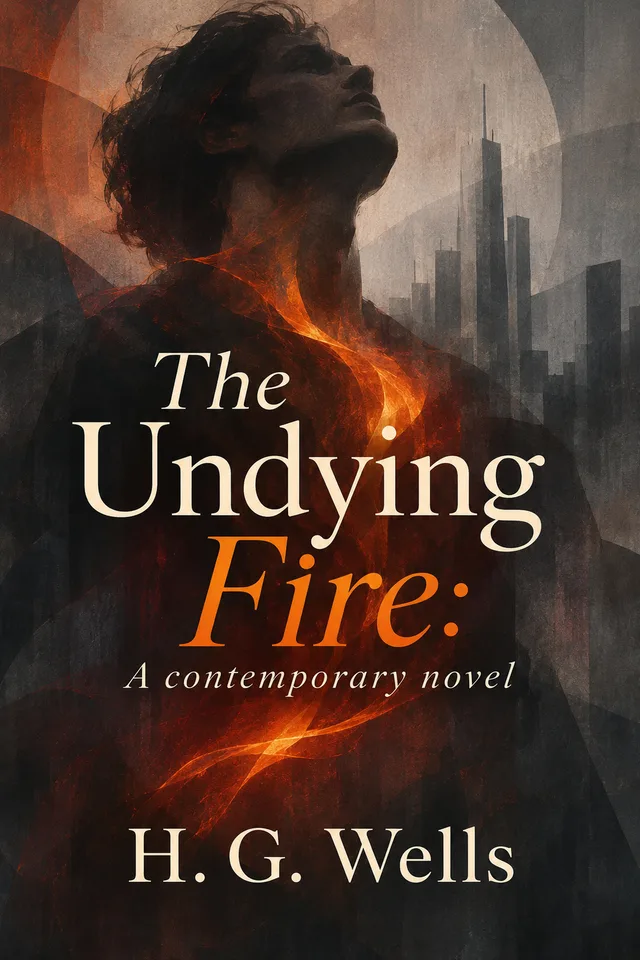
The Undying Fire: A contemporary novel
Edizione BooksWhale in inglese di H. G. Wells
A modern reworking of the Book of Job in which a schoolmaster’s losses prompt a debate about suffering, faith, and education.
- Anteprima
- Estratto dal testo preparato
- Formati
- Lettore online, EPUB, PDF
- Accesso
- Claim Libreria
Introduzione al libro
The Undying Fire: A contemporary novel
A modern reworking of the Book of Job in which a schoolmaster’s losses prompt a debate about suffering, faith, and education. Seven chapters follow the conversations surrounding Job Huss, a headmaster under pressure from events both personal and professional. A seaside setting frames competing explanations of human responsibility and the possibility of progress.
Edizione BooksWhale
Come è stata preparata
Questa edizione si basa su un testo di pubblico dominio ed è stata preparata da BooksWhale per la lettura digitale.
Base di pubblico dominio
Perché può essere condivisa
The original work by H. G. Wells is in the public domain in the United States. This edition uses the historical English text from Project Gutenberg and excludes modern editorial material.
Leggi anteprima
Estratto dal testo preparato
Anteprima selezionata dal testo preparato per la lettura.
Capitolo in anteprimaCHAPTER THE FIRST THE PROLOGUE IN HEAVENLeggi anteprima
CHAPTER THE FIRST THE PROLOGUE IN HEAVEN
Capitolo in anteprima§ 1Anteprima
Two eternal beings, magnificently enhaloed, the one in a blinding excess of white radiance and the other in a bewildering extravagance of colours, converse amidst stupendous surroundings. These surroundings are by tradition palatial, but there is now also a marked cosmic tendency about them. They have no definite locality; they are above and comprehensive of the material universe.
There is a quality in the scene as if a futurist with a considerable knowledge of modern chemical and physical speculation and some obscure theological animus had repainted the designs of a pre-Raphaelite. The vast pillars vanish into unfathomable darknesses, and the complicated curves and whorls of the decorations seem to have been traced by the flight of elemental particles. Suns and planets spin and glitter through the avanturine depths of a floor of crystalline ether. Great winged shapes are in attendance, wrought of iridescences and bearing globes, stars, rolls of the law, flaming swords, and similar symbols. The voices of the Cherubim and Seraphim can be heard crying continually, “Holy, Holy, Holy.”
Now, as in the ancient story, it is a reception of the sons of God.
The Master of the gathering, to whom one might reasonably attribute a sublime boredom, seeing that everything that can possibly happen is necessarily known to him, displays on the contrary as lively an interest in his interlocutor as ever. This interlocutor is of course Satan, the Unexpected.
The contrast of these two eternal beings is very marked; while the Deity, veiled and almost hidden in light, with his hair like wool and his eyes like the blue of infinite space, conveys an effect of stable, remote, and mountainous grandeur, Satan has the compact alertness of habitual travel; he is as definite as a grip-sack, and he brings a flavour of initiative and even bustle upon a scene that would otherwise be one of serene perfection. His halo even has a slightly travelled look. He has been going to and fro in the earth and walking up and down in it; his labels are still upon him. His status in heaven remains as undefined as it was in the time of Job; it is uncertain to this day whether he is to be regarded as one of the sons of God or as an inexplicable intruder among them. (But see upon this question the Encyclopædia Biblica under his name.) Whatever his origin there can be little doubt of his increasing assurance of independence and importance in the Divine presence. His freedom may be sanctioned or innate, but he himself has no doubt remaining of the security of his personal autonomy. He believes that he is a necessary accessory to God, and that his incalculable quality is an indispensable relief to the acquiescences of the Archangels. He never misses these reunions. If God is omnipresent by a calm necessity, Satan is everywhere by an infinite activity. They engage in unending metaphysical differences into which Satan has imported a tone of friendly badinage. They play chess together.
But the chess they play is not the little ingenious game that originated in India; it is on an altogether different scale. The Ruler of the Universe creates the board, the pieces, and the rules; he makes all the moves; he may make as many moves as he likes whenever he likes; his antagonist, however, is permitted to introduce a slight inexplicable inaccuracy into each move, which necessitates further moves in correction. The Creator determines and conceals the aim of the game, and it is never clear whether the purpose of the adversary is to defeat or assist him in his unfathomable project. Apparently the adversary cannot win, but also he cannot lose so long as he can keep the game going. But he is concerned, it would seem, in preventing the development of any reasoned scheme in the game.
Capitolo in anteprima§ 2Anteprima
Celestial badinage is at once too high and broad to come readily within the compass of earthly print and understanding. The Satanic element of unexpectedness can fill the whole sphere of Being with laughter; thrills begotten of those vast reverberations startle our poor wits at the strangest moments. It is the humour of Satan to thrust upon the Master his own title of the Unique and to seek to wrest from him the authorship of life. (But such jesting distresses the angels.)
“I alone create.”
“But I—I ferment.”
“Matter I made and all things.”
“Stagnant as a sleeping top but for the wabble I give it.”
“You are just the little difference of the individual. You are the little Uniqueness in everyone and everything, the Unique that breaks the law, a marginal idiosyncracy.”
“Sire, you are the Unique, the Uniqueness of the whole.”
Heaven smiled, and there were halcyon days in the planets. “I shall average you out in the end and you will disappear.”
“And everything will end.”
“Will be complete.”
“Without me!”
“You spoil the symmetry of my universe.”
“I give it life.”
“Life comes from me.”
“No, Sire, life comes from me.”
One of the great shapes in attendance became distinct as Michael bearing his sword. “He blasphemes, O Lord. Shall I cast him forth?”
“But you did that some time ago,” answered Satan, speaking carelessly over his shoulder and not even looking at the speaker. “You keep on doing it. And—I am here.”
“He returns,” said the Lord soothingly. “Perhaps I will him to return. What should we be without him?”
“Without me, time and space would freeze into crystalline perfection,” said Satan, and at his smile the criminal statistics of a myriad planets displayed an upward wave. “It is I who trouble the waters. I trouble all things. I am the spirit of life.”
“But the soul,” said God.
Satan, sitting with one arm thrown over the back of his throne towards Michael, raised his eyebrows by way of answer. This talk about the soul he regarded as a divine weakness. He knew nothing of the soul.
“I made man in my own image,” said God.
“And I made him a man of the world. If it had not been for me he would still be a needless gardener—pretending to cultivate a weedless garden that grew right because it couldn’t grow wrong—in ‘those endless summers the blessed ones see.’ Think of it, ye Powers and Dominions! Perfect flowers! Perfect fruits! Never an autumn chill! Never a yellow leaf! Golden leopards, noble lions, carnivores unfulfilled, purring for his caresses amidst the aimless friskings of lambs that would never grow old! Good Lord! How bored he would have been! How bored! Instead of which, did I not launch him on the most marvellous adventures? It was I who gave him history. Up to the very limit of his possibilities. Up to the very limit.... And did not you, O Lord, by sending your angels with their flaming swords, approve of what I had done?”
God gave no answer.
“But that reminds me,” said Satan unabashed.
Indice
In questa edizione
- 01CHAPTER THE FIRST THE PROLOGUE IN HEAVEN
- 02§ 1
- 03§ 2
- 04§ 3
- 05§ 4
- 06§ 5
- 07CHAPTER THE SECOND AT SEA VIEW, SUNDERING-ON-SEA
- 08§ 1
- 09§ 2
- 10§ 3
- 11CHAPTER THE THIRD THE THREE VISITORS
- 12§ 1
- 13§ 2
- 14§ 3
- 15§ 4
- 16§ 5
- 17§ 6
- 18§ 7
- 19§ 8
- 20§ 9
- 21§ 10
- 22CHAPTER THE FOURTH DO WE TRULY DIE?
- 23§ 1
- 24§ 2
- 25§ 3
- 26§ 4
- 27CHAPTER THE FIFTH ELIHU REPROVES JOB
- 28§ 1
- 29§ 2
- 30§ 3
- 31§ 4
- 32§ 5
- 33§ 6
- 34§ 7
- 35CHAPTER THE SIXTH THE OPERATION
- 36§ 1
- 37CHAPTER THE SEVENTH LETTERS AND A TELEGRAM
- 38§ 1
- 39§ 2
- 40§ 3
- 41§ 4
Disponibilità lingue
Altre lingue
Altre edizioni linguistiche non sono ancora pubblicate. Qui appariranno quando disponibili.
Richiedi un'altra lingua